From on-chain perpetuals to asset-backed stock tokens, this article explains issuance, custody, investor rights, and El Salvador’s Issuer and DASP framework.
Continue readingPoland CASP Update
NOTICE
Due to the ongoing regulatory uncertainty within the EU resulting from the MiCA implementation, we are no longer providing EU licensing services until further notice. If you require licensing solutions, we recommend considering alternative jurisdictions such as Switzerland SRO, Dubai VARA, or the El Salvador Crypto License.
This notice, dated 7 March 2025, is provided solely for general guidance and does not constitute legal, financial, or regulatory advice.
Poland CASP Update
Poland MiCA Latest News: Extended Transition Period
With the arrival of 2025, cryptocurrency asset service providers (VASPs) in Poland and Europe face a brand-new legal environment. Starting from December 30, 2024, the EU MiCA regulation officially comes into effect, but Poland has not yet fully incorporated this set of regulations into its national law. This situation has left many Polish crypto industry professionals confused about how MiCA applies to them, how the transition period is arranged, and how their legal status will change.
Progress on New Crypto Market Law in Poland
Poland is brewing a new Crypto Asset Market Act but progress has been relatively slow. As early as February 2024, the first draft was released and underwent several rounds of public discussion. Although MiCA has already come into effect across the EU, Poland still needs local legislation to implement it specifically, such as determining which government department will manage and regulate crypto enterprises. Without such local legislation, even with MiCA in place, the government cannot handle applications and supervision of crypto service providers.
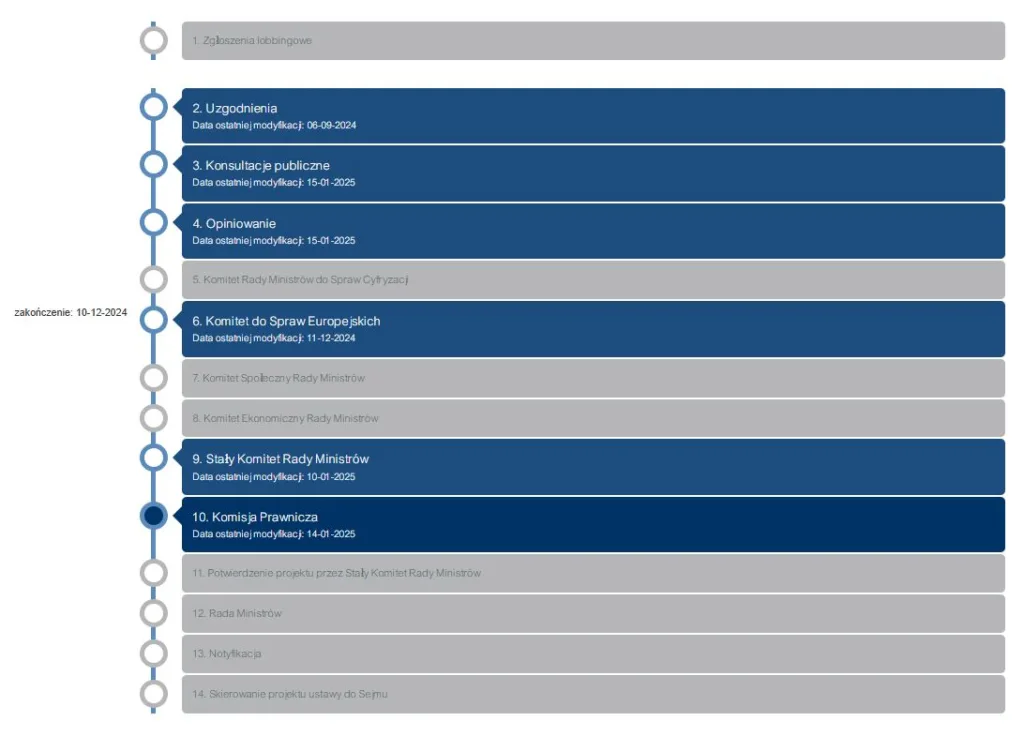
Currently, the specifics of the new bill are still evolving. Since it has not yet been submitted to the Polish Parliament (Figure 1), there may be changes in the future.
Impact of Legal Delays: Is It Good News for Polish VASPs?
According to Article 152m, Paragraph 1 of the Polish Crypto Asset Market Act:
“From the effective date of this Act until the date of granting or refusing the license as described in Article 59, Paragraph 1(a) of Regulation (EU) 2023/1114, but no later than June 30, 2025, any entity registered in the virtual currency activities register on the effective date of this Act shall conduct its virtual currency activities in accordance with the current anti-money laundering and counter-terrorist financing regulations.”
Based on the above, the Polish legal draft once proposed shortening the transition period to six months (until June 30, 2025). This means that companies that became Polish VASPs before December 30, 2024, could only carry out virtual currency-related businesses until June 30, 2025. After this date, Polish VASPs would need to obtain a CASP license to continue operating.
Because Poland failed to pass its domestic crypto legislation before December 30, 2024 (see Figure 1), MiCA cannot be fully implemented here. During this period, according to MiCA provisions, Polish crypto enterprises can enjoy an 18-month transition period — that is, from December 30, 2024, they do not need to immediately apply for a new CASP license and can operate until July 2026 (although the draft is still changing and may be altered in the future).
Key Information Points:
- Grandfathering Clause: MiCA stipulates that crypto enterprises legally operating before December 30, 2024, can continue to provide services without license restrictions until July 1, 2026.
- Transition Period Regulations Cannot Be Shortened: As an EU regulation, MiCA’s provisions are the same in all member states. Unless a country acts early to shorten the transition period, but since Poland has not implemented domestic crypto legislation, Polish enterprises should enjoy the full 18 months.
- Benefits for Enterprises: This 18-month transition period provides Polish crypto companies ample time to adjust their businesses to comply with the new regulations, develop long-term compliance plans, and seek new development opportunities in a relatively stable environment.
Different Opinions from the Financial Supervision Authority
On 2 January 2025, the Polish Financial Supervision Authority (KNF) issued a statement offering a different view on the application of MiCA during the transition period. The KNF believes that even if the new bill passes after the end of the year, it is still possible to shorten the transition period. This means that if the law indeed shortens the transition period, previous enterprises may face disputes, especially if they are forced to exit the business registry as a result.
Industry insiders, however, believe that as long as enterprises are registered before 30 December 2024, they should enjoy the full 18 months. If the government improperly removes these companies, they could even claim compensation from the state.
Negative Impacts of the Legal VacuumSteps
The lack of sound Polish legislation has also brought some issues. Currently, due to the lack of specific legal support, crypto enterprises cannot apply for a new CASP license, and submitted applications will temporarily not be processed. However, this situation is temporary, and it is expected that applications can begin to be accepted by February 2025.
In addition, from December 30, 2024, Poland will no longer accept new crypto enterprise registrations. In other words, new companies cannot enter the market in the short term, but existing enterprises can seize this opportunity to consolidate themselves and prepare for a more defined regulatory and supervisory environment in the future.
Steps to Obtain a CASP License in Poland
Below is a detailed step-by-step guide for applying for a CASP license, along with our services:
1.Establish a Company in Poland:
If your enterprise is not yet registered in Poland, this is the first step. Setting up a local entity in Poland is a necessary condition to proceed with the license application process.
2.Business Assessment:
This phase includes in-depth consultation aimed at understanding your business model, scope of activities, and compliance needs. The main tasks include:
- Determining the range of services offered, such as custody, exchange, asset conversion, order execution, portfolio management, or advisory services.
- Assessing the minimum capital requirements based on the scope of services.
- Defining specific regulatory obligations related to your business model.
- Evaluating potential compliance risks and operational adjustment needs.
3.Document Preparation:
The next phase focuses on preparing and submitting a full set of documents to demonstrate compliance with MiCA requirements. This requires your internal team to work with us to prepare the following:
- Detailed description of operational processes.
- Anti-Money Laundering (AML) and risk management framework.
- Corporate governance policies, including the appointment of a compliance officer and key personnel.
- Financial documents meeting capital requirements.
4.Application Submission and Regulatory Communication:
This phase includes submitting the CASP license application to the Polish Financial Supervision Authority (KNF), maintaining communication with the regulatory body, and handling any follow-up issues. The main steps include:
- Final review and submission of application materials.
- We maintain continuous communication with KNF to address feedback and additional requirements.
- We will provide subsequent support to ensure a smooth review process.
Why Choose Us?
At Crypto License, we focus on helping enterprises navigate the complexities of MiCA and the Polish regulatory environment. With years of experience in crypto compliance and license applications, our team ensures that your application is completed efficiently and professionally. From initial consultation to post-approval support, we will accompany you throughout the process.
Follow us for the latest updates on MiCA and its implementation in Poland. Contact us now to start your journey to obtaining a Polish CASP license.
Other Recommended Licenses
Switzerland
Renowned for its strong reputation and offering the most comprehensive functionality for crypto services.
Canada
A cost-effective license to conduct both payment and crypto activities, making it attractive for new market entrants.
El Salvador
A pioneering country in the adoption of Bitcoin as legal tender, fostering crypto-friendly opportunities.
What Clients Say About Our Services
Have Questions?
Netherlands PI License
The Netherlands Remains the Top Destination for FinTech Seeking a Payment Institution (PI) License
The Netherlands, with its long history in global trade and the world’s first stock market, has solidified its position as a leading European financial hub, particularly after the UK’s Brexit. This has made the country a top choice for fintech companies seeking a Payment Institution (PI) license.
Its clear regulatory framework, combined with an innovation-friendly environment, attracts fintech firms from around the globe. Securing a PI license in the Netherlands not only enhances credibility but also grants access to the country’s thriving fintech ecosystem, opening doors to expansion across the entire European market.
Table of Contents
Here's how we help you succeed:
- Your External Compliance Team: We’ll handle the complex DNB requirements so you can focus on building your business. We’ll build a strong application to boost your approval chances.
- Comprehensive Support: We offer a one-stop service for Netherlands PI application, including legal consultation, document review, AML/KYC policy development, external audit arrangements, and more. We streamline the process to save you time and effort.
Ready to launch your Netherlands PI license? Let’s partner up! Contact us today.
Who’s the Regulator?
The Dutch Central Bank (DNB) regulates the issuance of Payment Institution license, ensuring compliance with Dutch laws and maintaining financial stability. With a strong mandate for overseeing safe institutions, DNB is one of Europe’s most respected regulators.
Why Obtain a Netherlands PI License?
Securing a PI license in the Netherlands provides fintech companies with a gateway to the European financial market, enabling them to expand services across the EU and European Economic Area (EEA). The Dutch financial sector is renowned for its skilled talent pool, advanced infrastructure, and fintech-friendly policies, making it an ideal jurisdiction for fintech expansion.
Some key advantages include:
- Access to the European Single Market
Once licensed in the Netherlands, your business can operate freely across all EU/EEA countries, offering seamless access to a broad market.
- Reputation & Credibility
Dutch regulations are highly respected, enhancing investor confidence and strengthening customer trust in your company.
- Highly Skilled Workforce
The Netherlands boasts a diverse, multilingual talent pool with strong expertise in technology and finance. This makes it a prime destination for fintech companies in search of top-tier professionals.
What Can a Netherlands PI License Offer?
With a PI license, fintech companies can provide a variety of services, including:
- Account information services.
- Enabling the placement of cash on a payment account and managing payment account transactions.
- Enabling cash withdrawals and managing related account transactions.
- Executing payment transactions, including money transfers, on a payment account.
- Executing payment transactions where funds are covered by a credit line.
- Issuing payment instruments and accepting payment transactions.
- Money transfer services.
- Payment initiation services.
Who Needs a Netherlands PI License?
Fintech firms offering payment-related services must apply for a PI license if they intend to operate within the EU or provide cross-border payment services. This includes:
- Account Information Service Providers (AISPs)
- Currency Exchange Services
- E-commerce Platforms
- Money Remittance Companies
- Payment Service Providers (PSPs)
What Are the Requirements?
To successfully obtain a PI license in the Netherlands, there are several key requirements to meet:
1. Documentation
Proper documentation is a critical component of any licensing application. Below is a list of essential documents the firm must prepare for its application:
- AML/CTF Policy
- Anti Bribery and Corruption Policy
- Business Continuity & Disaster Recovery Plan
- Business Plan
- Data Protection/GDPR Compliance Policy
- Financial Forecast (36 months)
- Fraud Policy
- IT Security Policy
- Organisational Structure Chart
- Remuneration Policy
- Sensitive Data Handling & Privacy Policy
- Wind-down Plan
2. Ideal Company Structure
We propose the establishment of two boards: an Executive Board and a Supervisory Board, each consisting of four directors, with a minimum of two directors based in the Netherlands.
For the Management Team, a minimum of three to four members is recommended, with at least one member possessing extensive experience in financial expertise. Key positions should include the CEO, CFO, CTO, and Compliance Officer.
Please note that establishing a physical presence of key personnel in the Netherlands will provide significant advantages for the company during the evaluation process.
3. Initial Capital
The minimum initial capital required is €125,000.
However, we advise applicants to include forecasted losses based on projections, along with an additional 10% in cash, to demonstrate the applicant’s perseverance and commitment to investing in the Netherlands.
4. Physical Presence
A physical office in the Netherlands is mandatory for meeting regulatory requirements; virtual offices and co-working spaces are not allowed.
The PI License Application Journey
A realistic estimated timeline for obtaining a PI license is 8-12 months, as shown below:

Step 1: Company Incorporation, Structure, and Tax Analysis
Estimated 2 months

Step 2: Document Preparation for DNO & PI License Application
Estimated 3 months

Step 3: Post-Submission Interviews, Feedback, and Document Amendments
Estimated 6 months
FAQs: Netherlands PI License
A Netherlands Payment Institution licence allows holders to build a reputable brand, provide services across the Eurozone, access a skilled pool of finance talent, and benefit from tax advantages. Currently, the country hosts 430 active companies in the Dutch fintech market; the notable ones include Adyen, Bitfury, Bunq, Flow Traders, and Mollie.
A Payment Institution licence allows you to provide a range of services, including payment processing, electronic money issuance, fund transfers, and payment account services.
Yes, having a local office is mandatory.
Having a team with relevant fintech experience is essential from a regulatory perspective and will significantly enhance your likelihood of success. We recommend including at least two individuals with fintech expertise on your board and management team.
No, the Dutch Central Bank (DNB) only conducts a paper review during the application stage. However, it is advisable to develop a demo system along with a handbook to showcase your proposed services. The authorised IT system should be implemented within six months after the licence is granted.
The application process typically takes approximately 8 to 10 months, provided there is strong support from your team. We will take care of the timelines for you!
One-time fees comprise initial company setup expenses, such as registration charges, licence application costs, technology infrastructure investments, recruitment agency fees, and any other regulatory obligations.
Recurring costs encompass ongoing expenses, including annual audits, quarterly reporting, software subscriptions, employee salaries, office rent, and utilities.
We will perform a detailed analysis of your company's shareholding structure and provide tailored made recommendations. Our all-in-one incorporation service simplifies the entire process, making company setup straightforward and hassle-free.
Hiring experienced local talent, especially for high-ranking positions like Director, can be challenging due to trust concerns and their risk exposure, considering their established reputations. However, these individuals are crucial for leading teams and securing licences in fintech companies. We understand the concerns of both sides and can act as an intermediary to bridge the gap. We can help you build a strong local team through our extensive network.
We understand that preparing policies can be both challenging and time-consuming. Therefore, we are more than happy to take on the responsibility of drafting all the required documents. What we need from you is your input and timely responses to get things done.
We have connections with banking channels that can help you open corporate accounts and safeguard accounts seamlessly.
Dutch is the official language of the Kingdom of the Netherlands. Interestingly, The Netherlands is an English-friendly country, with 93% of the Dutch population speaking English. The Dutch Central Bank (DNB) accepts documents submitted in both Dutch and English. Additionally, our team communicates fluently in both English and Mandarin.
Getting the right individuals involved can be challenging, especially when they come from diverse cultural backgrounds, departments, and entities. Furthermore, understanding the regulator's expectations can also be difficult. We act as intermediaries, helping to manage relationships among all parties to ensure the project progresses smoothly.
Yes, our firm has seven years of experience providing post-authorization support to over 20 companies. Think of us as your internal compliance team; we will be there whenever you need assistance!
Yes, we can offer valuable insights for your international expansion plans and help you navigate the regulatory landscape in various jurisdictions. We have successfully supported over 10 clients from different regions in expanding their businesses across Europe, the UK, Hong Kong, and Southeast Asia.
Once licensed, you will need to fulfil ongoing reporting and compliance obligations, such as submitting regular operational reports, conducting customer due diligence, and ensuring adherence to anti-money laundering (AML) regulations. Being aware of these requirements is essential for keeping your licence active.
Failure to comply with regulatory requirements can result in penalties, including fines or, in severe cases, revocation of your licence. It is essential to establish robust compliance systems to mitigate these risks.
Yes, it’s important to be aware of regulations such as the Payment Services Directive II (PSD2), the Anti-Money Laundering Directive, and the Digital Operational Resilience Act (DORA). Staying informed about these regulations is vital for successful operations.
We recommend subscribing to regulatory updates from the Dutch Central Bank. Additionally, we can provide ongoing insights and updates regarding regulatory changes that may affect your operations.
A business plan should include an executive summary, market analysis, product and service details, marketing strategy, operational plan, competitor analysis (SWOT), and comprehensive financial projections.
A financial forecast encompasses detailed revenue projections, cost structures, and cash flow management over a three-year period. For a licence application, a solid financial forecast includes realistic metrics, typically illustrating significant losses in the first year, reduced losses in the second year, and achieving breakeven in the third year. Additionally, a good forecast should incorporate different scenarios, including normal, best-case, and worst-case outcomes, to provide a comprehensive view of potential financial performance.
An IT security policy establishes comprehensive guidelines to safeguard digital assets and sensitive data from unauthorised access and cyber threats. It encompasses critical areas such as access control protocols, data protection measures, incident response strategies, employee training programs, and regular security audits to ensure resilience against emerging threats.
A wind-down plan outlines how a firm will address major issues like software and hardware shutdowns, specifying responsibilities, shutdown procedures, risk management strategies, employee communication, and compliance with regulations to ensure a smooth transition and mitigate potential problems.
A remuneration policy outlines how employees are compensated, including salaries, bonuses, and benefits, ensuring competitiveness, fairness, and compliance with labour laws. The Board of Remuneration is responsible for deciding compensation packages based on factors such as company financial performance, economic conditions like inflation, and other relevant metrics.
Yes, establishing a local team is essential in the eyes of the regulator. They expect applicants to demonstrate a strong local presence in the Netherlands. The local team should comprise at least two local directors, along with key positions such as a CEO, CFO, Compliance Officer, and Head of IT.
The Netherlands' key rates are 25.8% for corporate tax, 21% for VAT, and 15% for dividend tax.
What Clients Say About Our Services
Have Questions?
Ireland PI Licence
Ireland PI License
A Leading Destination for FinTech Seeking a Payment Institution (PI) License
Ireland has become a favoured destination for fintech companies, offering a vibrant financial ecosystem and strong ties to both the EU and international markets. Since Brexit, Ireland has emerged as a prominent European financial hub, attracting fintech firms seeking to be licensed there.
With a strong regulatory framework under the Central Bank of Ireland, the country offers a business-friendly environment that fosters innovation and growth. Its strategic location, English-speaking workforce, and favourable tax regime add to its appeal. Securing a PI license in Ireland boosts credibility and grants access to the EU’s Single Market, making it a prime gateway for fintech expansion across Europe.
Table of Contents
Here's how we help you succeed:
- Your External Compliance Team: We’ll handle the complex CBI requirements so you can focus on building your business. We’ll build a strong application to boost your approval chances.
- Comprehensive Support: We offer a one-stop service for Ireland PI application, including legal consultation, document review, AML/KYC policy development, external audit arrangements, and more. We streamline the process to save you time and effort.
Ready to launch your Ireland PI license? Let’s partner up! Contact us today.
Who’s the Regulator?
The Central Bank of Ireland (CBI) regulates the issuance of Payment Institution license, ensuring compliance with Irish laws and safeguarding financial stability. CBI is one of the most respected regulators across the Eurozone.
Why is Ireland a good pick?
Securing a Payment Institution (PI) license in Ireland provides fintech companies with direct access to the European financial market, facilitating expansion throughout the EU and European Economic Area (EEA). Ireland’s reputation for its strong financial regulatory environment, business friendly environment makes it a prime location for fintech companies to scale and grow.
Some key advantages include:
- Access to the European Market
Once licensed in Ireland, your business can operate freely across all EU/EEA countries, providing access to a wide market of over 450 million people. - Reputation & Credibility
Ireland’s regulatory framework is well-regarded and recognised across Europe, allowing fintech companies to enhance their credibility and image. This helps boost investor confidence and foster stronger customer trust. - Favourable Business Environment
Ireland is an English-speaking country in Europe, alongside the UK, which makes communication easier for international businesses. In the 2023 IMD World Competitiveness Ranking, Ireland was ranked 2nd out of 64 economies. Furthermore, according to the World Bank’s Ease of Doing Business report, Ireland consistently ranks within the top 20 countries globally. - Tax Benefits
Ireland offers an appealing corporate tax rate of 12.5%, one of the lowest in the EU, making it financially attractive for multinational companies to set up entities and pay less tax.
What type of business can you conduct with an Ireland PI License?
With a PI license, fintech companies can provide a variety of services, including:
- Account information services.
- Enabling the placement of cash on a payment account and managing payment account transactions.
- Enabling cash withdrawals and managing related account transactions.
- Executing payment transactions, including money transfers, on a payment account.
- Executing payment transactions where funds are covered by a credit line.
- Issuing payment instruments and accepting payment transactions.
- Money transfer services.
- Payment initiation services.
Who Needs an Ireland PI License?
Fintech firms offering payment-related services must apply for a PI license if they intend to operate within the EU or provide cross-border payment services. This includes:
- Account Information Service Providers (AISPs)
- Currency Exchange Services
- E-commerce Platforms
- Money Remittance Companies
- Payment Service Providers (PSPs)
What Are the Requirements?
To successfully obtain a PI license in the Ireland, there are several key requirements to meet:
1. Documentation
Proper documentation is a critical component of any licensing application. Below is a list of essential documents the firm must prepare for its application:
- AML/CTF Policy
- Anti Bribery and Corruption Policy
- Business Continuity & Disaster Recovery Plan
- Business Plan
- Data Protection/GDPR Compliance Policy
- Financial Forecast (36 months)
- Fraud Policy
- IT Security Policy
- Organisational Structure Chart
- Remuneration Policy
- Sensitive Data Handling & Privacy Policy
- Wind-down Plan
2. Ideal Company Structure
We propose the establishment of a board of directors with wide expertise coverage, including finance, legal compliance, information technology, risk management, marketing, and operations. This diverse skill set will ensure comprehensive oversight and strategic direction, enabling the firm to achieve sustainable growth.
For the Management Team, a minimum of three to four members is recommended, with at least one member possessing extensive experience in financial expertise. Key positions should include the CEO, CFO, CTO, and Money Laundering Reporting Officer (MLRO).
Please note that the CEO must be an Irish national. Having a localised team of key personnel will provide significant advantages for the company during the evaluation process.
3. Initial Capital
The minimum initial capital required is €125,000.
However, we advise applicants to include projected losses in their forecasts to demonstrate their ability to manage the project and their financial viability to sustain the venture.
4. Physical Presence
A physical office in Ireland is mandatory; virtual offices and co-working spaces are not accepted.
The PI License Application Journey
A realistic estimated timeline for obtaining a PI license is 8-12 months, as shown below:
FAQs: Ireland PI License
Ireland’s Payment Institution licence allows holders to establish a reputable brand, offer services across the Eurozone, and enjoy various tax benefits. The country is home to thousands of multinational corporations and is consistently ranked as a top destination due to its ease of doing business.
A Payment Institution licence allows you to provide a range of services, including payment processing, electronic money issuance, fund transfers, and payment account services.
Yes, having a local office is mandatory.
Having a team with relevant fintech experience is essential from a regulatory perspective and will significantly enhance your likelihood of success. We recommend including at least two individuals with fintech expertise on your board and management team.
No, the Central Bank of Ireland only conducts a paper review during the application stage. However, it is advisable to develop a demo system along with a handbook to showcase your proposed services. The authorised IT system should be implemented within six months after the licence is granted.
The application process typically takes approximately 8 to 10 months, provided there is strong support from your team. We will take care of the timelines for you!
One-time fees comprise initial company setup expenses, such as registration charges, licence application costs, technology infrastructure investments, recruitment agency fees, and any other regulatory obligations.
Recurring costs encompass ongoing expenses, including annual audits, quarterly reporting, software subscriptions, employee salaries, office rent, and utilities.
We will perform a detailed analysis of your company's shareholding structure and provide tailored made recommendations. Our all-in-one incorporation service simplifies the entire process, making company setup straightforward and hassle-free.
Hiring experienced local talent, especially for high-ranking positions like Director, can be challenging due to trust concerns and their risk exposure, considering their established reputations. However, these individuals are crucial for leading teams and securing licences in fintech companies. We understand the concerns of both sides and can act as an intermediary to bridge the gap. We can help you build a strong local team through our extensive network.
We understand that preparing policies can be both challenging and time-consuming. Therefore, we are more than happy to take on the responsibility of drafting all the required documents. What we need from you is your input and timely responses to get things done.
We have connections with banking channels that can help you open corporate accounts and safeguard accounts seamlessly.
English is the official language of the Republic of Ireland. Our team communicate in both English and Mandarin.
Getting the right individuals involved can be challenging, especially when they come from diverse cultural backgrounds, departments, and entities. Furthermore, understanding the regulator's expectations can also be difficult. We act as intermediaries, helping to manage relationships among all parties to ensure the project progresses smoothly.
Yes, our firm has seven years of experience providing post-authorization support to over 20 companies. Think of us as your internal compliance team; we will be there whenever you need assistance!
Yes, we can offer valuable insights for your international expansion plans and help you navigate the regulatory landscape in various jurisdictions. We have successfully supported over 10 clients from different regions in expanding their businesses across Europe, the UK, Hong Kong, and Southeast Asia.
Once licensed, you will need to fulfil ongoing reporting and compliance obligations, such as submitting regular operational reports, conducting customer due diligence, and ensuring adherence to anti-money laundering (AML) regulations. Being aware of these requirements is essential for keeping your licence active.
Failure to comply with regulatory requirements can result in penalties, including fines or, in severe cases, revocation of your licence. It is essential to establish robust compliance systems to mitigate these risks.
Yes, it’s important to be aware of regulations such as the Payment Services Directive II (PSD2), the Anti-Money Laundering Directive, and the Digital Operational Resilience Act (DORA). Staying informed about these regulations is vital for successful operations.
We recommend subscribing to regulatory updates from the Central Bank of Ireland. Additionally, we can provide ongoing insights and updates regarding regulatory changes that may affect your operations.
A business plan should include an executive summary, market analysis, product and service details, marketing strategy, operational plan, competitor analysis (SWOT), and comprehensive financial projections.
A financial forecast encompasses detailed revenue projections, cost structures, and cash flow management over a three-year period. For a licence application, a solid financial forecast includes realistic metrics, typically illustrating significant losses in the first year, reduced losses in the second year, and achieving breakeven in the third year. Additionally, a good forecast should incorporate different scenarios, including normal, best-case, and worst-case outcomes, to provide a comprehensive view of potential financial performance.
An IT security policy establishes comprehensive guidelines to safeguard digital assets and sensitive data from unauthorised access and cyber threats. It encompasses critical areas such as access control protocols, data protection measures, incident response strategies, employee training programs, and regular security audits to ensure resilience against emerging threats.
A wind-down plan outlines how a firm will address major issues like software and hardware shutdowns, specifying responsibilities, shutdown procedures, risk management strategies, employee communication, and compliance with regulations to ensure a smooth transition and mitigate potential problems.
A remuneration policy outlines how employees are compensated, including salaries, bonuses, and benefits, ensuring competitiveness, fairness, and compliance with labour laws. The Board of Remuneration is responsible for deciding compensation packages based on factors such as company financial performance, economic conditions like inflation, and other relevant metrics.
Yes, establishing a local team is essential in the eyes of the regulator. They expect applicants to demonstrate a strong local presence in the Ireland. The local team should comprise at least two local directors, along with key positions such as a CEO, CFO, Compliance Officer, and Head of IT.
What Clients Say About Our Services
Have Questions?
UK EMI Licensing
UK EMI Licensing Made Easy
Looking to expand your FinTech services in the UK market quickly and efficiently? A UK EMI license is essential for offering a range of regulated services, from e-wallet, e-money issuance and payment processing to IBAN accounts, payment cards, and SWIFT payments. With a UK EMI license, you can build trust as a regulated entity, attract customers and investors, and position your business for growth and valuable partnerships.
Table of Contents
Get Your UK EMI License with Our Expert Support
- Your External Compliance Team: We’ll handle the complex FCA requirements, letting you focus on your business. We’ll build a strong application to boost your approval chances.
- Comprehensive Support: We offer a one-stop service for UK EMI application, including legal consultation, document review, AML/KYC policy development, external audit arrangements, and more. We streamline the process to save you time and effort.
- Flexible Options: Need speed? We can help you explore EMI acquisitions for a faster route, if your budget allows.
Ready to launch your UK EMI? Let’s partner up! Contact us today.
Why Secure a UK EMI License?
- Expand Your Reach: Offer a diverse range of services like e-money issuance, payment processing, IBAN accounts, payment cards, and SWIFT payments.
- Build Trust: Gain credibility, attract customers and investors by operating as a regulated entity.
- Valuable Asset: Your EMI license can increase your business value and open doors to new partnerships or funding opportunities.
Key EMI License Requirements
To secure a UK EMI license from the FCA, you must meet these requirements:
- Initial Capital: GBP 350,000.
- Registration Fee: GBP 5,000.
- Safeguarding: Have a plan to protect client funds (segregated accounts or insurance).
- Leadership: Appoint UK-based leadership with proven financial services experience.
- Plan: Submit a detailed business plan outlining operations, risk management, forecast budget for the next three years, and security.
What FinTech Services Can You Offer with a UK EMI License?
With a UK EMI license, electronic money institutions can legally provide a wide range of regulated financial services, expanding their reach in the UK market. Key services include:
- Issuing Electronic Money: Create and manage digital payment solutions such as prepaid cards and e-wallets.
- Cash Deposits and Withdrawals: Facilitate cash deposits into and withdrawals from payment accounts.
- Payment Transactions: Execute payment transactions, including fund transfers, direct debits, card transactions, and credit transfers.
- Issuing Payment Instruments: Issue payment instruments and acquire payment transactions for greater service versatility.
- Money Remittance: Enable secure, compliant money transfers domestically and internationally.
- Payment Initiation Services (PIS): Initiate payments on behalf of customers, adding convenience and flexibility.
- Account Information Services (AIS): Offer comprehensive account information services, allowing users to access and manage their financial data.
The UK EMI Application Journey
Step 1: Evaluation
2 - 4 weeks We'll assess your business plan, advise on structure, and outline requirements, costs, and timelines.
Step 2: Fit & Proper
Estimated 1 - 2 weeks We ensure your team is qualified and ready for FCA compliance.
Step 3: Company Formation
Approximately 1 week We'll set up your UK LLC.
Step 4: Documentation & Preparation
Estimated 4-6 weeks, complex cases may take longer We'll help craft your plan, forecasts, policies, and coordinate with your departments to build a strong application package that meets FCA’s standard.
Step 5: Local Presence
Estimated 2 - 4 weeks, can be done in parallel with Documentation Prep We'll assist with recruiting local staff (director, CoSec, MLRO) and securing office space.
Step 6: Safeguarding Accounts
Estimated 2 - 4 weeks We'll leverage our connections to help open safeguarding accounts and access payment infrastructure
Step 7: FCA Submission
Estimated 1 - 2 weeks We'll submit your application electronically via the FCA's Connect system.
Step 8: FCA Follow-up
Estimated variable, can range from a few weeks to several months We'll support you throughout any follow-ups, questions, or interviews with the FCA.Costs and Timeline
- Costs: Expect setup costs (local staff, accounting), licensing fees, and ongoing compliance like auditing and reporting. Contact us for a clear breakdown.
- Timeline: Based on our experience, the process can take several months. We’ll streamline it, aiming for the fastest possible outcome. Our FCA experience helps minimise delays.
Important Note on Passporting
UK EMI licenses no longer offer automatic EEA access. Let’s discuss your European expansion strategy – we’ll help you navigate the options.
FAQs: UK EMI Licensing
VAT exemption on most financial services, potential for remote onboarding, no transaction caps, and a globally respected jurisdiction with a well-developed fintech ecosystem.
Small EMIs have limits on transaction volume and e-money balances while Full EMIs offer unrestricted operations. We'll analyse your business model and revenue projections to help you choose the right license.
Based on our experience, expect several months. We'll streamline the process for the fastest possible outcome.
Yes, your leadership must be UK-based. We can help find suitable staff and space.
Experience helps, but we can guide you in building a strong team or connect you with experienced compliance professionals, ensuring a strong application.
No, Brexit changed that. We'll help you craft a European expansion strategy.
The best fit depends on your target markets, preferred languages, local talent pool, and specific regulatory considerations. Popular choices include Lithuania (fast licensing), Ireland (established fintech hub), and Luxembourg (strong financial reputation). Let's develop a tailored expansion strategy together – we'll help you choose the jurisdiction that best suits your business goals.
Beyond FCA fees, expect legal, tech, and office setup costs. We’ll also assess potential costs for recruitment and external audit requirements to give you a realistic picture.
Expect FCA fees (based on income), compliance monitoring, audits, and potential insurance. We can help with estimates.
Secure customer onboarding platforms, transaction processing systems, AML/KYC monitoring software, and risk management tools. We can advise on suitable solutions or connect you with trusted technology providers.
Yes! We offer ongoing compliance services to keep you on track.
We have a proven track record and a client-focused, streamlined project management approach for licensing applications. We're experts in navigating UK and global regulations, aiming to be your long-term partner for both UK compliance and global expansion.
Absolutely! From company formation to application submission and FCA communication, we'll guide you every step of the way.
What Clients Say About Our Services
About CryptoLicense
CryptoLicense specializes in simplifying the registration and licensing process for financial service providers seeking a UK EMI License. We support startups, payment service providers, and FinTech businesses in navigating the UK’s regulatory environment, ensuring full FCA compliance and smooth entry into the UK market.
With in-depth knowledge of key markets, we provide tailored compliance solutions for businesses in regions such as Hong Kong, Singapore, Malaysia, Europe and North America. Our expertise spans popular licenses, including the Czech Republic VASP license, Swiss SRO, Polish VASP, and Salvadoran cryptocurrency licenses. Our global network and understanding of local practices give your business a competitive edge.
We recognize the unique challenges international businesses face, from complex regulations and cross-border compliance to cultural differences. CryptoLicense offers comprehensive support, from navigating FCA requirements to providing customized compliance solutions. Our goal is to streamline the licensing process, empowering you to successfully launch and expand your FinTech or e-money services in the UK and beyond.
Your UK EMI License Specialists
Streamlining Compliance for E-Money Institutions in the UK
Sheldon | Director
Sheldon is a seasoned FinTech professional with 7 years of experience specializing in cross-border payments and cryptocurrency licensing, spanning from the web2 to web3 era. He has successfully managed over 30 projects, delivering expertise in payment and cryptocurrency license applications. With a strong network of strategic partnerships, Sheldon brings valuable connections and resources to every endeavor.
Jing C | Consultant
Jing is a skilled professional specializing in project management for regulatory compliance and financial institution business development. Currently handling licensing requests in Czech and Switzerland, he also brings a strong legal background in dispute resolution to his work.
Have Questions?
UK API Licensing
UK API License Application
Your Payment Solutions Gateway
Launch innovative payment solutions in the UK by obtaining the coveted Authorized Payment Institution (API) license. With the UK API License, you can establish your business as a regulated provider of secure payment services. At CryptoLicense, we simplify the application process, guiding you through FCA requirements to help you confidently secure your API license and succeed in the competitive UK market.
Table of Contents
Get Your UK API License with Our Expert Support
- Your External Compliance Team: We’ll handle the complex FCA requirements so you can focus on building your business. We’ll build a strong application to boost your approval chances.
- Comprehensive Support: We offer a one-stop service for UK API application, including legal consultation, document review, AML/KYC policy development, external audit arrangements, and more. We streamline the process to save you time and effort.
- Flexible Options: Need speed? We can help you explore API acquisitions for a faster route, if your budget allows.
Ready to launch your UK API? Let’s partner up! Contact us today.
Why Invest in a UK API License?
- Expand Your Capabilities: Offer a wide range of regulated payment services, including remittance, payment accounts and processing, card issuing, and more.
- Build Trust: Gain credibility, attract customers and investors by operating as a regulated entity.
- Valuable Asset: An API license can increase your business value and open doors to new partnerships and funding.
Key UK API License Requirements
The FCA sets the requirements for API applicants. Here’s a basic overview:
- Initial Capital: GBP 20,000.
- Registration Fee: GBP 5,000.
- Safeguarding: Have a plan to protect client funds (segregated accounts or insurance).
- Leadership: Appoint experienced UK-based leadership with financial services expertise.
- Plan: Submit a comprehensive business plan outlining operations, risk management, revenue forecast, and security measures.
Services Under UK Payment Institution License
A UK Payment Institution License allows businesses to offer a broad range of regulated payment services, including:
- Deposit and manage cash within payment accounts.
- Enable cash withdrawals and account operations.
- Execute payment transactions, including direct debits and credit transfers. – Process card-based payments and credit transfers.
- Conduct transactions backed by a credit line.
- Issue payment instruments and acquire payment transactions.
- Facilitate money remittance services.
- Provide payment initiation and account information services.
The UK API Application Journey
Step 1: Evaluation
2 - 4 weeks We'll assess your business plan, advise on structure, and outline requirements, costs, and timelines.
Step 2: Fit & Proper
Estimated 1 - 2 weeks We ensure your team is qualified and ready for FCA compliance.
Step 3: Company Formation
Approximately 1 week We'll set up your UK LLC.
Step 4: Documentation & Preparation
Estimated 4 - 8 weeks, depending on complexity We'll help you develop a strong application that includes detailed plans, forecasts, policies, and coordinate with your departments to produce materials that meet FCA’s standard.
Step 5: Local Presence
Estimated 2 - 4 weeks, can be done in parallel with Documentation Prep We'll assist with recruiting local staff (director, CoSec, MLRO) and securing office space.
Step 6: Safeguarding Accounts
Estimated 2 - 4 weeks We'll leverage our connections to help you establish safeguarding accounts and access necessary payment infrastructure.
Step 7: FCA Submission
Estimated 1 - 2 weeks We'll electronically submit your application via the FCA's Connect system.
Step 8: FCA Follow-up
Estimated variable, can range from a few weeks to several months We'll support you throughout any follow-up communications, questions, or interviews with the FCA.Costs and Timeline
- Costs: Expect setup costs (local staff, accounting), licensing fees, and ongoing compliance. Contact us for a clear breakdown.
- Timeline: Based on our experience, the process can take several months. We’ll streamline it, aiming for the fastest possible outcome. Our FCA experience helps minimise delays.
Important Note on Passporting
UK API licenses no longer offer automatic EEA access. Let’s discuss your European expansion strategy – we’ll help you navigate the options.
FAQs: UK EMI Licensing
Operating within the UK's innovative FinTech market provides numerous benefits: expand your service offerings, build stronger credibility, and tap into new growth opportunities alongside established financial institutions.
APIs primarily focus on enabling seamless data sharing and payment initiation between financial institutions and third parties. EMIs offer a wider range of services, including e-money issuance, payment processing, and account management. We can advise the right choice based on your specific business model.
An API primarily focuses on secure data sharing and payment initiation between financial systems, while an SPI is a licensed entity that can directly offer payment services like account management, processing, and potentially card issuance. We'll help you choose the right licence for your business.
Based on our experience, the process can take several months and if potential FCA requests for further information arise. We'll streamline the process for the fastest possible outcome.
Yes, your leadership must be UK-based. We can help find suitable staff and space.
No, Brexit changed that. We'll help you craft a European expansion strategy.
Relevant experience is beneficial, but not always required. We can help you build a qualified team or connect you with experienced professionals.
Expect to implement systems for secure data transmission, API management, fraud prevention, and compliance monitoring. We can advise on suitable solutions or connect you with trusted technology providers.
Costs include FCA application fees, setup costs (office space, staffing), technological infrastructure, ongoing compliance, and potential audits. We'll provide a transparent breakdown.
Yes! We offer ongoing compliance services to keep you on track.
We have a proven track record and a client-focused, streamlined project management approach for cross-border licensing applications. We're experts in navigating UK and global regulations, aiming to be your long-term partner for both UK compliance and global expansion.
Absolutely! From company formation to application submission and FCA communication, we'll guide you every step of the way.
What Clients Say About Our Services
About CryptoLicense
CryptoLicense specializes in simplifying the registration and licensing process for payment and crypto businesses seeking a UK API License. We help startups, crypto businesses, and financial service providers navigate the UK’s regulatory landscape with ease, ensuring full compliance and a smooth market entry.
With in-depth knowledge of key markets, we provide tailored compliance solutions for businesses in regions such as Hong Kong, Singapore, Malaysia, Europe and North America. Our expertise spans popular licenses, including the Czech Republic VASP license, Swiss SRO, Polish VASP, and Salvadoran cryptocurrency licenses. Our global network and understanding of local practices give your business a competitive edge.
We understand the unique challenges international businesses face, from complex regulations to cross-border compliance and cultural differences. CryptoLicense provides end-to-end support, from navigating FCA requirements to delivering tailored compliance solutions. Our goal is to streamline the licensing process, empowering you to launch and scale your payment or FinTech venture in the UK and beyond.
Your UK API License Specialists
Simplifying Compliance for Payment Institutions in the UK
Sheldon | Director
Sheldon is a seasoned FinTech professional with 7 years of experience specializing in cross-border payments and cryptocurrency licensing, spanning from the web2 to web3 era. He has successfully managed over 30 projects, delivering expertise in payment and cryptocurrency license applications. With a strong network of strategic partnerships, Sheldon brings valuable connections and resources to every endeavor.
Jing C | Consultant
Jing is a skilled professional specializing in project management for regulatory compliance and financial institution business development. Currently handling licensing requests in Czech and Switzerland, he also brings a strong legal background in dispute resolution to his work.
Have Questions?
Australia Crypto License
Australia’s crypto licensing framework consists of two key layers. At the operational level, crypto asset service providers are required to register with the Australian Transaction Reports and Analysis Centre (AUSTRAC) as a DCE or RSP under the Anti-Money Laundering and Counter-Terrorism Financing Act 2006. Where business activities fall within Australia’s definition of regulated financial services, an Australian Financial Services Licence (AFSL), issued by ASIC under the Corporations Act 2001, is also required.
Table of Contents
AUSTRAC DCE & RSP Registration
Table of Contents
AUSTRAC DCE & RSP Registration
Operating crypto services in Australia requires registration with Australian Transaction Reports and Analysis Centre (AUSTRAC) under the Anti-Money Laundering and Counter-Terrorism Financing Act 2006.
Businesses providing crypto exchange, fiat on- or off-ramp, or crypto-related payment services must register as a Digital Currency Exchange (DCE) and a Remittance Service Provider (RSP). These requirements apply to both Australian and foreign-owned businesses targeting the Australian market.
CryptoLicense supports clients through the AUSTRAC registration process, with a focus on correct scoping, clean structure, and long-term regulatory viability.
Key Requirements
To register and operate as a DCE and RSP in Australia, businesses are expected to meet the following core requirements:
- A clearly defined business model and scope of activities
- A compliant AML/CTF program aligned with AUSTRAC requirements
- Customer due diligence and transaction monitoring procedures
- Clear governance and accountability for AML/CTF matters
- Ongoing reporting and record-keeping capabilities
These are operational requirements, not one-off submission items. AUSTRAC expects them to be implemented and maintained on an ongoing basis.
Digital Currency Exchange (DCE)
DCE registration is required if a business:
- Exchanges fiat to crypto or crypto to crypto
- Operates a crypto exchange, brokerage, or OTC desk
- Facilitates the buying or selling of digital assets
DCE registration places the business under AUSTRAC’s AML/CTF supervision and requires an implemented AML program.
Remittance Service Provider (RSP)
RSP registration is required if a business:
- Moves money for customers, domestically or cross-border
- Provides fiat payment services connected to crypto
- Offers fiat on-ramp or off-ramp services
For most fiat-crypto business models, RSP registration applies together with DCE.
Regulatory Context and Upcoming Changes
Australia is strengthening its crypto regulatory framework, including expanded AML/CTF obligations and a transition toward a broader Virtual Asset Service Provider (VASP) regime.
Current DCE and RSP registrations remain valid. However, businesses are expected to maintain up-to-date AML frameworks and adjust controls as requirements evolve. Structuring the registration correctly at the outset reduces future disruption.
Local Director & Compliance Officer
CryptoLicense can arrange an Australian resident director and AML/CTF compliance officer for foreign-owned businesses.
Project Timeline
A standard AUSTRAC DCE & RSP project typically takes around 4–5 months, depending on business complexity and readiness.
- Scoping and structure review
- AML/CTF framework preparation
- DCE and RSP submission and operational readiness
Timelines are indicative and subject to regulatory review.
Information Required
- Company and ownership details
- Description of business activities
- Operational and fund flow information
- Details of directors, officers, and compliance personnel
CryptoLicense provides structured guidance to keep the process efficient.
How CryptoLicense Supports You
- Business model and regulatory scope review
- Mandatory DCE and RSP registration
- AML/CTF policy drafting and implementation
- Local director and compliance officer arrangement
- Ongoing advisory as regulations change
Next Step
If you are planning to operate crypto exchange, on- or off-ramp, or crypto-enabled payment services in Australia, DCE and RSP registration is the starting point.
CryptoLicense can assist with planning and completing the registration clearly and correctly.
Note: Businesses offering custody, investment-style, or advanced financial services may also require AFSL. This should be assessed and planned separately.
Australian Financial Services Licence (AFSL) for Digital Asset Services
Table of Contents
AFSL Overview
An Australian Financial Services Licence (AFSL) is issued under the Corporations Act 2001 and regulated by the Australian Securities and Investments Commission (ASIC).
For digital asset services, AFSL is required where activities fall within the scope of regulated financial services under Australian law. This typically applies when services go beyond AML-regulated activities and involve custody, investment-style features, or regulated financial products.
AFSL does not replace AUSTRAC registration.
It is a separate licensing regime that applies based on the nature of the services provided.
When AFSL Applies
AFSL may be required where a digital asset service provider:
- Provides custody or holds client digital assets
- Offers investment-style, yield, or managed services
- Deals in digital assets classified as financial products
- Provides financial advice or arranges regulated financial services
In practice, most full-scale, client-facing digital asset platforms should expect AFSL to be required, or should plan for it early as part of their Australia market strategy.
Relationship with AUSTRAC
Australia applies a layered regulatory model:
- AUSTRAC(DCE & RSP)
Covers AML/CTF obligations, transaction monitoring, and reporting. - ASIC(AFSL)
Covers financial services licensing, conduct obligations, and consumer protection.
Where applicable, businesses must comply with both regimes in parallel, depending on how their digital asset services are structured.
Regulatory Developments and Outlook
Australia continues to refine its regulatory approach to digital asset services, with closer alignment between AML/CTF oversight and financial services regulation.
While AFSL is an established regime under the Corporations Act, regulators are applying increasing scrutiny to how digital asset services fit within existing financial services rules, particularly in relation to custody arrangements, product classification, and consumer-facing offerings.
Businesses should plan their AFSL strategy with the expectation that regulatory standards will continue to evolve.
AFSL Requirements
AFSL applications are assessed on substance, not documentation alone.
Core requirements typically include:
- A clearly defined and permissible financial services scope
- Responsible Managers with relevant experience
- Appropriate compliance systems and internal controls
- Adequate financial resources and risk management arrangements
- Ongoing reporting and licence maintenance obligations
AFSL represents an ongoing regulatory commitment, not a one-time approval.
Legal Assessment of the Business Model
Whether AFSL is required, and which AFSL authorisations apply, depends on how the digital asset business model operates in practice.
For digital asset services, this typically requires a formal legal assessment of:
- The nature of the services offered
- How digital assets are classified
- How clients interact with the platform or product
This assessment is usually conducted by an Australian-qualified lawyer and forms the basis for determining the correct AFSL authorisation scope, if any.
Early legal analysis helps avoid misclassification, scope gaps, and restructuring after submission.
Project Timeline (Indicative)
AFSL projects are more complex and time-intensive than AUSTRAC registration.
A typical AFSL project takes around 9–12 months, depending on:
- Scope of regulated activities
- Readiness of governance and personnel
- Legal analysis and ASIC review process
Early planning alongside AUSTRAC registration helps reduce delays and unnecessary rework.
How CryptoLicense Supports You
CryptoLicense supports clients across the AFSL lifecycle, including:
- AFSL applicability and authorisation scoping
- Coordination of legal assessment of the business model
- Licensing strategy and structural planning
- Responsible Manager sourcing and structuring
- AFSL application preparation and submission
- Ongoing advisory support post-licensing
Our role is to help clients approach AFSL deliberately and correctly, based on a clear understanding of regulatory scope.
Next Step
If your digital asset services involve custody, investment-style features, or regulated financial products, a legal assessment of the business model should be the first step before proceeding with an AFSL application.
CryptoLicense can assist with assessing AFSL applicability and planning the appropriate licensing pathway.
Other Recommended Licenses
Switzerland
Renowned for its strong reputation and offering the most comprehensive functionality for crypto services.
Canada
A cost-effective license to conduct both payment and crypto activities, making it attractive for new market entrants.
El Salvador
A pioneering country in the adoption of Bitcoin as legal tender, fostering crypto-friendly opportunities.
What Clients Say About Our Services
Have Questions?
The Web3 Shutdown Wave: Why Licensing and Compliance Are Becoming a Matter of Survival
Last month, BitMEX announced that it would shut down permanently on September 23.
Around the same time, crypto data platform CryptoRank reported that at least 17 major crypto projects had shut down or entered bankruptcy since the start of 2026. Together, those projects had disclosed more than $8.9 billion in funding.
Wise’s US Trust Bank Bid Under the GENIUS Act: What to Know About the Compliance Challenges
On July 24, the Office of the Comptroller of the Currency (OCC) denied Wise’s application for a US national trust bank charter, citing unresolved compliance deficiencies. Wise shares fell sharply on the news.
Continue readingLatvia’s MiCA Licensing Surge: What’s Driving It?
We have recently written extensively about payments and compliance for tokenized US stocks. It has been a while since we returned to our core area of expertise: crypto licensing.
Continue reading