
What Makes a Tokenized Stock a Real RWA? El Salvador's Issuer and DASP Framework
Two major A-share IPOs recently came to market: ChangXin Memory Technologies (CXMT) and Unitree Robotics.
In both cases, trading had already started on chain before the shares were formally listed.
Ahead of CXMT’s IPO, a perpetual contract linked to its share price appeared on chain with an initial reference price of about $5. It later traded above $8. The move was even more pronounced with Unitree. Before its shares were listed, on-chain traders were already taking positions in UNITREE contracts, which briefly traded above $140 on the day of the IPO.
The appeal is easy to understand.
Retail investors have few ways to gain exposure to a popular company before its IPO. On chain, however, a market can begin pricing that company before it rings the opening bell, with trading available around the clock.
Price action and trading opportunities are enough to attract the attention of more platforms.
But there is a substantial difference between trading a synthetic price on chain and putting legally enforceable rights to real shares on chain. The latter requires an issuer, custody arrangements, asset backing and a regulatory structure.
Using CXMT and Unitree as a starting point, this article looks at what genuine stock tokenization requires and why El Salvador has become a jurisdiction worth considering.
Does trading a stock price on chain mean owning the stock?
The CXMT and UNITREE products traded on chain are, in substance, synthetic perpetual contracts.
Buying a UNITREE contract does not make the investor a shareholder in Unitree. It does not carry the shareholder status, dividend rights or voting rights that normally come with the company’s shares.
An asset-backed stock token needs several additional elements:
- Real shares or corresponding economic rights must exist off chain.
- An identifiable entity must hold or control those assets.
- The legal relationship between the token and the underlying asset must be defined.
- The token holder’s rights to returns, redemption and other benefits must be set out clearly.
El Salvador already has a live example of this structure.
MIO3, S.A. de C.V., a local digital asset service provider (DASP), has spent the past two years working on real-world asset tokenization and digital asset issuance. It later launched TOHKN, an investment platform for investors.
In 2026, TOHKN launched US Public Markets, a program that issues digital assets linked to US stocks and exchange-traded funds.
Its current reference assets include Nvidia, Tesla, Apple, Microsoft, SPY and QQQ.
The structure has several notable features:
- Maximum authorized issuance: $100 million
- Issuer: MIO3 Markets 1, S.A.S. de C.V.
- DASP: MIO3, S.A. de C.V.
- Reference assets: US stocks, ETFs and fractional shares
- Asset backing: Each token has 1:1 economic backing from the corresponding reference asset
- Off-chain custody: The reference assets are held through a registered US broker-dealer
- Investor rights: Token holders receive economic exposure to the reference assets but are not registered directly as shareholders of Nvidia, Tesla or the other companies
The compliance structure is the most important part of the model. It uses two separate entities:
Issuer: MIO3 Markets 1, S.A.S. de C.V.
DASP: MIO3, S.A. de C.V.
The distinction between these two roles is central to understanding El Salvador’s RWA framework.

Is a DASP registration enough to launch an RWA?
El Salvador’s DASP registration is often described as an RWA licence. That description is not accurate.
The country’s Digital Assets Issuance Law regulates issuers and DASPs separately.
What does the issuer do?
The issuer is the entity that issues the digital asset. A company tokenizing stocks, real estate or receivables must address several questions:
- What is the underlying asset or reference asset?
- Which economic rights does the token represent?
- How will the proceeds be used?
- How will investors receive returns or redeem their tokens?
- Which entity is responsible for the obligations attached to the token?
- What risks arise from the issuance?
An issuer does not first obtain a general issuance licence that allows it to launch products at will.
Under the rules of the National Commission of Digital Assets (CNAD), an entity is registered as an issuer only after at least one specific issuance has been approved.
A public offering application also requires:
- A CNAD-registered structurer
- A Relevant Information Document (DIR)
- The proposed issuance structure and supporting materials
- A report from a CNAD-registered certifier
- CNAD review of the specific issuance
The issuer review is therefore focused on the substance of the RWA:
What assets support it, what rights investors receive and whether the issuer can meet its obligations.
CNAD states that once a formal application is complete, it reviews an issuance authorization within five business days. That does not mean the entire project can be completed in five days. Structuring the product, preparing the DIR, engaging the certifier and assembling the application all take place before the formal review period begins.

What does the DASP do?
DASP stands for Digital Asset Service Provider.
Depending on its approved scope, a DASP may provide:
- Digital asset trading and trading platform services
- Subscription and placement services for digital asset issuances
- Promotion and structuring of investment products
- Transfers of digital assets
- Custody and administration
- Receipt, transmission and execution of buy and sell orders
The DASP handles the services needed to bring an existing token to market, including placement, distribution, custody and trading.
Its registration process therefore focuses on a different set of questions. CNAD first identifies the specific services the applicant intends to provide and then reviews:
- The company and its governance structure
- Management and key personnel
- The proposed business model
- Risk management
- AML and KYC policies
- Client and asset protection
- Technology and information security
- Business continuity
CNAD is assessing whether the company can operate a digital asset business safely and on an ongoing basis.
Once the application is complete, the statutory assessment period is up to 20 business days. If information is missing, the applicant has 10 business days to provide it. An initial registration fee is payable after approval. These timelines cover only the formal review stage.
How does a US stock become an on-chain RWA?
Leaving the technical layer aside, the structure can be summarized as follows:
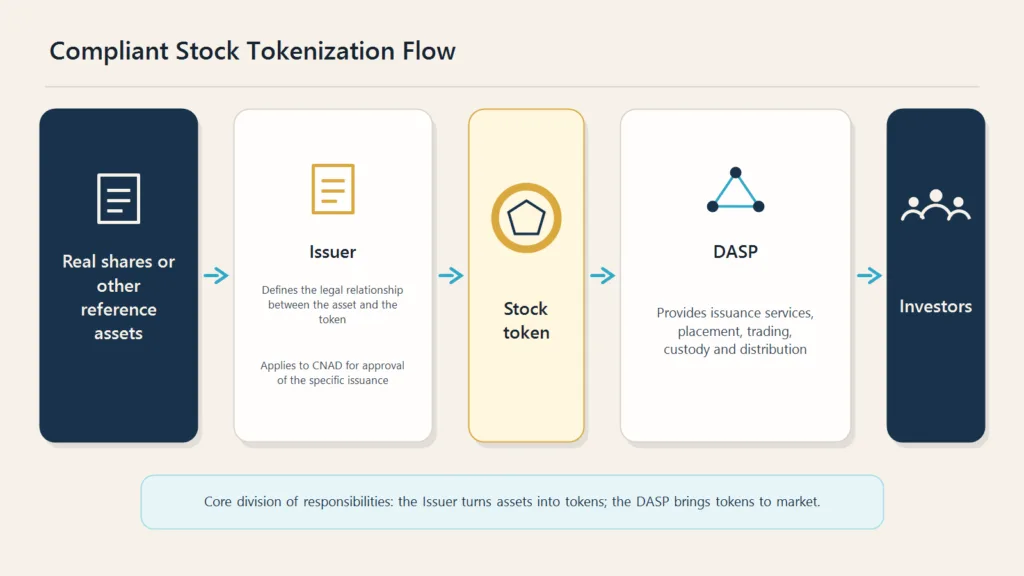
For an exchange that already has a large user base and trading infrastructure, the question is not simply whether a DASP registration permits it to offer tokenized stocks. The platform must decide which role, or combination of roles, it wants to assume.
Three routes are available to an exchange
Route A: DASP only
The platform does not become the RWA issuer. Instead, it works with an external issuer.
- The third-party issuer is responsible for the underlying assets and token issuance.
- The platform handles placement, trading, custody and distribution to users.
- Its role is closer to RWA infrastructure and a distribution channel.
This is the lighter route and reduces the platform’s direct responsibility for issuing the product.
Route B: Issuer with an external DASP
The exchange group establishes its own issuing entity to structure and issue the stock token, while using a registered third-party DASP for digital asset services.
This allows the group to:
- Control the product and underlying asset structure
- Outsource trading, custody or placement
- Avoid building a full DASP operation at the outset
Route C: Integrated issuer and DASP structure
The third route is the model currently used by TOHKN.
The group has both:
- MIO3 Markets 1 as the issuer
- MIO3 as the DASP
One entity issues the product, while the regulated service provider handles the digital asset services.
This creates a more complete structure covering issuance, token operations, trading and distribution. It also places more regulatory responsibility on the group.

Do issuer and DASP approvals solve the whole problem?
- Is every token fully backed at all times?
- Who holds the shares?
- Are the underlying assets segregated from the platform’s own assets?
- How are dividends passed through to token holders?
- How are stock splits, mergers, delistings and other corporate actions handled?
- When an investor exits, how are the token and the underlying shares reconciled?
One is the traditional securities market where the real shares exist. The other is the digital asset market where the token is issued and traded.El Salvador’s framework offers a practical way to allocate the responsibilities between those markets:
Who issues the token, who holds the assets, who distributes the product and how the different functions fit into one compliance structure.
If you are building or preparing to build a tokenized stock or RWA product, or considering an issuer and DASP structure in El Salvador, feel free to reach out to CryptoLicense. We can discuss how the available structures may fit your product and business plan.