

Latvia’s MiCA Licensing Surge: What’s Driving It?
We have recently written extensively about payments and compliance for tokenized US stocks. It has been a while since we returned to our core area of expertise: crypto licensing.
This month marks an important turning point for Europe’s crypto market. On July 1, the EU’s final MiCA transitional period came to an end.

The impact has been immediate, prompting both Binance and Tether to adjust their European operations.
- Before the deadline, Binance withdrew its MiCA application in Greece. From July 1, it also stopped onboarding new users in several EU markets and restricted certain crypto-asset services.
- Because USDT does not meet MiCA’s stablecoin requirements, Binance and other platforms have restricted USDT trading for users in the European Economic Area, while some platforms have delisted the relevant trading pairs altogether.
So, for a crypto business that wants to remain active in the EU, how should it choose a licensing route?
Today, CryptoLicense looks at a less prominent licensing jurisdiction: Latvia.
Latvia has a population of less than two million and did not grant its first crypto-asset service provider (CASP) authorisation until December 2025. By July this year, however, the number of authorised firms had risen to ten. Companies including Paybis and Backpack have also chosen to combine CASP authorisation with a payments licence.
What is Latvia seeking to gain by accelerating authorisations?
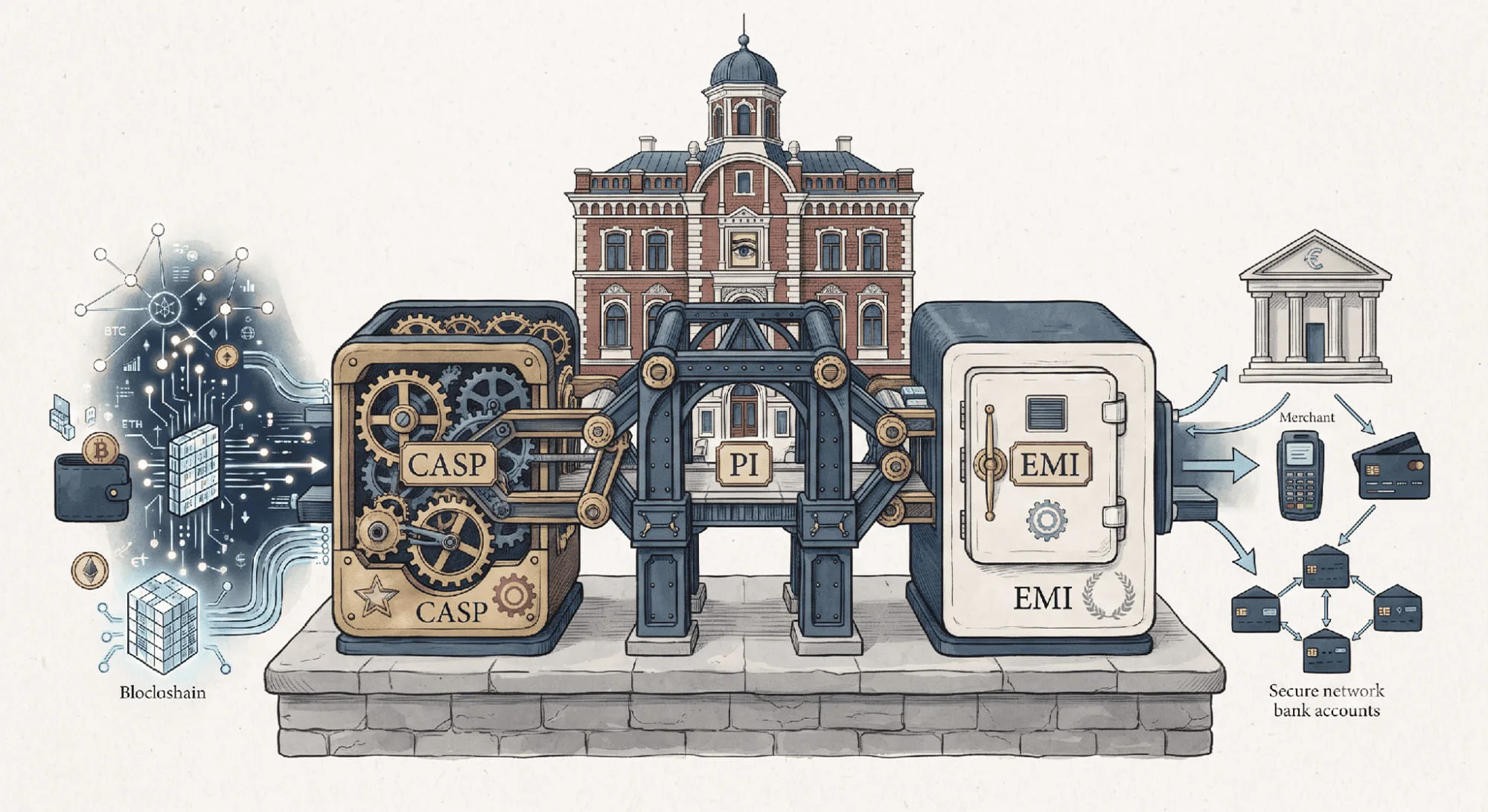
This article explains what a Latvian CASP authorisation covers, why businesses may also need payment institution (PI) or electronic money institution (EMI) authorisation, and how to structure the overall application process.
Ⅰ. Why Smaller Member States Have an Opportunity After the MiCA Transition
The basic logic is straightforward.
Once the transitional period ends, a firm that wants to continue providing crypto-asset services in the EU must first choose a Member State in which to apply for CASP authorisation.
Once authorised, it can use MiCA’s cross-border notification procedure to enter other EU markets.
That makes the jurisdiction of the first authorisation an important strategic choice.
Although every Member State applies MiCA, regulators still differ in how they communicate with applicants, what they focus on during review, how much they charge and how efficiently they process applications. These practical differences can materially affect the timing and cost of an entire licensing project.
This is where a country such as Latvia has an opportunity.
Its domestic market is small. What businesses value is the ability to establish a compliant route from Latvia into the wider EU market.
Latvia offers free pre-licensing consultations, while its application process and review timelines are relatively transparent.
Latvijas Banka, Latvia’s central bank and financial market supervisor, oversees CASPs, PIs and EMIs. A business that handles both crypto-assets and fiat payments can therefore map out its overall licensing structure with a single regulator at an early stage.
This does not mean the authorisations can be obtained together. CASP, PI and EMI applications remain separate and are reviewed independently. Latvia’s size does not lower the standards imposed under MiCA.
In practice, these conditions have already attracted a range of firms:
- In December 2025, blockchain fintech company BlockBen received Latvia’s first MiCA CASP authorisation.
- It was followed by crypto-asset custodian Nexdesk, crypto exchange platform Paybis Europe, crypto exchange Backpack EU and stablecoin payments company Nodu Digital.
Their business models differ, but each intends to serve the broader EU market. Their arrival also shows that Latvia’s licensing framework has moved beyond policy design and into active authorisation.
Ⅱ. Latvia's Current Regulatory Framework
The regulatory framework is easier to understand in light of the firms already authorised.
The core rules for CASPs come from Regulation (EU) 2023/1114, better known as the Markets in Crypto-Assets Regulation (MiCA). Applications, capital requirements and client protections are governed by this framework.
Latvia’s Law on Crypto-asset Services designates Latvijas Banka as the competent authority and supplements MiCA with local rules on fees, reporting and enforcement.
Two further EU regulations are relevant to day-to-day operations:
- Regulation (EU) 2023/1113 extends the Travel Rule to transfers of crypto-assets.
- Regulation (EU) 2022/2554, the Digital Operational Resilience Act (DORA), governs ICT security, business continuity and technology outsourcing.

The point at which on-chain assets move into fiat payments requires particular attention:
CASP authorisation may cover custody, exchange and transfers of crypto-assets. If a product also involves payment accounts, fiat transfers or merchant settlement, the business may need PI or EMI authorisation under Latvia’s Law on Payment Services and Electronic Money.
This is why several of the firms mentioned above have adopted a dual-licence structure.
All of these activities fall under the supervision of Latvijas Banka. Eligible PIs and EMIs may apply for access to EKS, the electronic clearing system operated by Latvijas Banka, to process Single Euro Payments Area (SEPA) credit transfers and instant payments. CASP authorisation alone does not provide access to EKS.
Ⅲ. What Does CASP Authorisation Cover?
MiCA defines ten categories of crypto-asset services. A firm may apply for one or more of them under the same authorisation, depending on its business model.
In practical terms, they cover the following activities:
- Trading and exchange: operating a trading platform for crypto-assets, exchanging crypto-assets for funds, or exchanging one crypto-asset for another.
- Custody and transfers: providing custody and administration of crypto-assets on behalf of clients, or transferring crypto-assets for clients.
- Orders and placements: receiving, transmitting and executing client orders, or placing crypto-assets.
- Advice and portfolio management: providing advice on crypto-assets or managing crypto-asset portfolios under a client mandate.
Crypto exchanges, brokerage platforms, custodial wallets and crypto-asset transfer platforms can generally identify their activities within these service categories.
Three boundaries deserve particular attention:
- Issuing a stablecoin: A platform may apply to provide custody, exchange and transfer services for stablecoins. If the firm issues a stablecoin itself, it must determine whether the token is an asset-referenced token (ART) or an e-money token (EMT) and meet the relevant issuer requirements.
- Handling fiat payments: CASP authorisation may cover transfers of crypto-assets, but payment accounts, fiat remittances and merchant settlement may require PI or EMI authorisation. The dual-licence structures discussed above are designed to cover this part of the business.
- Offering real-world assets: The first question is how the token is classified. If it qualifies as a financial instrument under the second Markets in Financial Instruments Directive (MiFID II), the relevant services fall within the securities regulatory framework. The classification ultimately depends on the rights attached to the token, the flow of funds and the services actually provided.
Ⅳ. How to Apply for CASP Authorisation in Latvia
Latvijas Banka divides the process into preparation, submission, assessment, authorisation and ongoing supervision. The overall process currently takes approximately nine to eighteen months.
An applicant does not need to begin by working through every form. Clarifying the following points will establish the framework for the application.

1. Define the Business with the Regulator
Before submitting a formal application, a firm can request a free pre-licensing consultation.
The company does not necessarily need to be incorporated before its first meeting with the regulator. It should, however, be able to explain what it intends to offer, who its clients will be, how fiat and crypto-assets will move through the product, and who will manage the business.
This stage should answer two questions:
- Which crypto-asset services require authorisation?
- Will fiat payments, e-money issuance or securities activities require additional financial authorisations?
Applications often require repeated revisions later because these business boundaries were not resolved at the outset.
2. Establish the Corporate and Management Structure
The applicant must establish a company in Latvia and conduct the relevant activities there.
Its place of effective management must be in the EU, and at least one director must reside in the EU.
The regulator will also assess whether the firm has genuine management capability. Directors and senior managers must understand the business, and the firm must clearly allocate responsibility for anti-money laundering (AML), risk management, ICT security and internal governance.
Shareholders with holdings of 10% or more, as well as ultimate beneficial owners, must provide information on their background, source of funds and business reputation.
3. Determine the Capital Requirement
MiCA has three minimum capital thresholds for CASPs. The applicable threshold is determined by the service carrying the highest capital requirement within the firm’s application:
- EUR 50,000: receiving and transmitting orders, executing orders, transferring crypto-assets, placing crypto-assets, providing advice, and managing crypto-asset portfolios.
- EUR 125,000: custody and administration, exchanging crypto-assets for funds, and exchanging crypto-assets for other crypto-assets.
- EUR 150,000: operating a trading platform for crypto-assets.

The firm must maintain prudential safeguards equal to the higher of the applicable minimum capital requirement or one quarter of its fixed overheads from the preceding year.
For a newly established company, this is generally calculated using projected fixed overheads for the first twelve months of operation. If the firm is also applying for PI or EMI authorisation, the corresponding capital requirements must be calculated separately.
4. Prepare the Application
The application must answer three core questions: who the company is, what it intends to do, and how it will manage risk. The required materials generally include:
- A business plan, scope of services and three-year financial projections.
- Information on shareholders, ultimate beneficial owners, directors and senior management.
- Corporate governance, internal controls and risk management arrangements.
- AML, sanctions compliance and customer risk management policies.
- Wallet, key management, technology systems and cybersecurity arrangements.
- Client asset segregation, complaints handling and conflicts of interest procedures.
- Outsourcing, business continuity and wind-down arrangements.
- Rules and procedures for the specific custody, exchange, trading platform or transfer services proposed.
The regulator does more than check whether each document is present. The policies must align with system permissions, staff responsibilities and client agreements in actual operations.
5. Enter the Formal Review Process
Latvia currently charges an application review fee of EUR 2,500 for CASP authorisation.
Once Latvijas Banka receives the application, it has 25 working days to assess whether the submission is complete.
After confirming completeness, it proceeds to the substantive assessment and, in principle, decides whether to grant authorisation within 40 working days.
The often-cited “25 plus 40 working days” describes the statutory review framework. It does not guarantee authorisation within 65 working days. Requests for additional information, changes to the business model or further questions from the regulator can all extend the overall timeline.
Latvia’s process may be transparent, but speed ultimately depends on whether the scope of the business is clear, the management team is in place and the application materials reflect the proposed operating model.
V. How Does a Latvian CASP Enter Other EU Markets?
Obtaining Latvian CASP authorisation is the first step in an EU expansion strategy.
To enter other Member States, such as France or Germany, the firm must complete a cross-border notification procedure commonly known as passporting.

The process is relatively straightforward:
- The firm notifies Latvijas Banka of the Member States it intends to enter, the services it will provide and the intended start date.
- Within ten working days, Latvijas Banka transmits the relevant information to the competent authorities in the host Member States and to the EU authorities.
- The firm may begin providing services once it receives confirmation and, in any event, no later than the fifteenth calendar day after submitting the information.
Passporting only extends the services already covered by the Latvian CASP authorisation. Once the firm enters a host market, it must also address applicable local requirements relating to advertising, consumer protection, data and language.
If the firm also holds PI or EMI authorisation, it must complete a separate cross-border process for its payment services.
CASP and payments authorisations can be planned together, but each has its own passporting procedure.
VI. What Does Ongoing Supervision Require?
Once authorised, a firm enters the ongoing supervisory phase.
A Latvian CASP must pay an annual supervisory fee to Latvijas Banka. The fee is capped at 0.6% of its annual revenue from crypto-asset services, subject to a minimum of EUR 3,000.

Ongoing compliance focuses on several areas:
- Changes to directors, senior management or qualifying shareholders must be notified to the regulator as required. Certain changes are subject to a new assessment.
- AML controls, sanctions screening, on-chain monitoring and suspicious transaction reporting must operate continuously. Transfers of crypto-assets must also comply with the Travel Rule.
- Custodians must maintain effective client asset segregation, key management and security incident response arrangements.
- Firms must manage ICT risk, business continuity and technology outsourcing in accordance with DORA. Using third-party systems does not transfer the firm’s regulatory responsibility.
- Fees, risks, conflicts of interest and complaints channels must be clearly disclosed to clients. Material business changes and operational incidents must also be reported promptly.
Staffing, systems, audits and day-to-day compliance are the areas that require sustained investment after authorisation.
Ⅶ. Which Businesses Are a Good Fit for Latvia?
Latvia has a small domestic market, so it offers limited appeal to a firm focused solely on local customers. It is more likely to suit the following types of business:
- Businesses connecting crypto-assets and fiat: Stablecoin payments, on-ramps and off-ramps, merchant settlement and crypto payment gateways may need to consider CASP authorisation alongside PI or EMI authorisation.
- Businesses combining custody, wallets, exchange and transfers: Latvia has already reviewed a range of service combinations, giving the regulator some practical experience with these models.
- Businesses using one Member State as a gateway to the EU: These firms are primarily interested in MiCA’s cross-border notification mechanism, with Latvia serving as the jurisdiction for their initial CASP authorisation.
- Businesses with a proven operating model: Free pre-licensing consultations can help identify issues early, but the firm must still be able to explain its product, flow of funds and risk controls clearly.
- Businesses that may later add payments or securities authorisations: Latvijas Banka supervises all of these activities, which can make regulatory communication more coordinated, although each authorisation still requires a separate application.
Ⅷ. Why Latvia Is Worth Considering
Latvia’s recent licensing momentum reflects the practical value of MiCA’s passporting framework. Its domestic market may be small, but a Latvian CASP authorisation can provide a regulatory base for offering approved services across the EU.
This country of fewer than two million people is positioning itself as a regulated entry point for crypto businesses seeking access to the EU market.
With the MiCA transitional period over, firms need to answer three questions carefully:
- Which Member State should issue the first authorisation?
- Which CASP services should the application cover?
- What additional authorisations are needed for payments and stablecoin activities?
Latvia’s advantages include relatively direct communication with the regulator, transparent procedures and fees, and a single authority overseeing CASPs, PIs and EMIs. Once authorised, a firm can use the cross-border notification procedure to enter other EU Member States.
The capital, governance, AML, client asset protection and DORA requirements remain fully applicable.
For a business that connects crypto-assets and fiat and intends to serve the wider EU market, Latvia deserves serious consideration.
The right licensing jurisdiction, however, ultimately depends on the fit between the firm’s business model, flow of funds and target markets.
If you are considering a Latvian CASP, PI or EMI authorisation, or a crypto licence in another jurisdiction, contact CryptoLicense to discuss the licensing structure and application route that best fit your business.