

Regulatory Crackdown in Hong Kong: Where Is the Compliance Path for RWA and Stablecoins?
At the end of September, just as interest in stablecoins and RWA (Real World Asset tokenization) continued to rise, Hong Kong regulators unexpectedly tightened their stance.
According to reports, various institutions in Hong Kong, including domestic internet platforms, Chinese-funded brokerages, and banks, were recently instructed to suspend activities related to crypto assets. These include investment, trading, and the issuance of RWAs and stablecoins.
This move came only weeks after Hong Kong’s Stablecoins Ordinance took effect in early August, which was widely seen as a milestone toward regulatory maturity and a key step for Chinese brokerages seeking transformation. The sudden policy shift therefore came as a surprise to the market.
For companies aiming to carry out RWA and stablecoin business in a compliant manner, the question now is whether Hong Kong remains the ideal destination, or if it is time to explore new alternatives. This article examines Hong Kong’s recent regulatory changes and discusses practical compliance options beyond its borders.
Regulatory Shift: Hong Kong Tightens Rules on Crypto Businesses
Since 2025, the United States has made significant policy shifts regarding stablecoins and crypto assets, driving a global acceleration in regulatory development. Hong Kong quickly followed suit, introducing the Stablecoins Ordinance and attracting a surge of Chinese institutions eager to apply for licenses, fueling continued market enthusiasm.
However, according to a report by Caixin, Hong Kong has recently instructed various institutions to scale back their offshore crypto asset activities and has introduced targeted restrictions for different types of entities:
- Major internet platform companies: Strictly restricted from investing in mainstream crypto assets such as Bitcoin, Ethereum, and Tether, and prohibited from indirectly applying for related licenses through offshore entities.
- State-owned enterprises and banks operating in Hong Kong: Restricted from having their subsidiaries or branches apply for stablecoin licenses. Leading institutions such as Bank of China (Hong Kong) remain cautious and have yet to take action.
- Chinese-funded brokerages in Hong Kong: Restricted from conducting cross-border business that may violate regulations, with stricter enforcement against potential tax evasion and money laundering. At the same time, activities involving the issuance of RWAs using onshore assets in Hong Kong have also been tightened.
- Crypto-related businesses of Chinese enterprises: Whether involving investment, trading, RWA issuance, or stablecoin operations, all now face varying levels of restriction.
This series of measures signals a clear shift in Hong Kong’s regulatory direction, suggesting that companies may need to reassess their compliance strategies.
The Global Race Remains Intense — How Can Firms Find a Compliant Path Forward?
After several months of strong momentum in the RWA and stablecoin sectors, Hong Kong’s unexpected regulatory tightening caught many companies preparing to enter the market off guard. Yet globally, enthusiasm for the crypto industry remains high.
Both Web2 and Web3 technology companies are accelerating their entry into the space, with RWA and stablecoins continuing to attract significant capital. The stablecoin sector and its supporting infrastructure are evolving rapidly. Tether and Circle are expanding their product ecosystems, Web2 giants such as Stripe are entering the payment arena, Remitly has launched a multi-currency fiat and stablecoin wallet, and Metamask is planning to issue its own native stablecoin to further enhance its payment and value-storage functions.
The global market remains highly active, but long-term success depends on one crucial factor: compliance. With Hong Kong tightening its rules, what other options are available? Several jurisdictions still offer strong and credible licensing frameworks, such as El Salvador’s DASP license and Canada’s MSB license.
For tokenization and stablecoin businesses, Switzerland has become a leading choice for companies seeking steady growth within a well-defined compliance framework. The Swiss regulatory system is mature and internationally recognized, combining flexibility with deep practical experience in tokenized assets and digital infrastructure. For companies, obtaining a Swiss license not only enables faster market entry but also provides a more solid and sustainable compliance foundation.
Understanding Swiss Licensing: The Gateway to Compliant Crypto Asset Operations
At the core of Switzerland’s regulatory landscape lies the FINMA framework (FinSA, FinIA, AMLA, and others) working in tandem with the country’s dedicated DLT (Distributed Ledger Technology) legislation. The system follows the principle of “substance over form”, meaning that the type of license or regulatory obligation depends on the actual business activities being conducted—such as issuance, custody, brokerage or market-making, trading facilities, payments, or asset management.
In March this year, the Swiss Financial Market Supervisory Authority (FINMA) officially approved BX Digital as the first company to receive a DLT Trading Facility license. This license, established under the Swiss Financial Market Infrastructure Act (FinfraG), allows BX Digital to operate a multilateral trading platform for DLT-based securities within a regulated environment.
This milestone highlights Switzerland’s leadership in promoting fintech innovation and reaffirms its commitment to a compliance-driven approach to innovation.
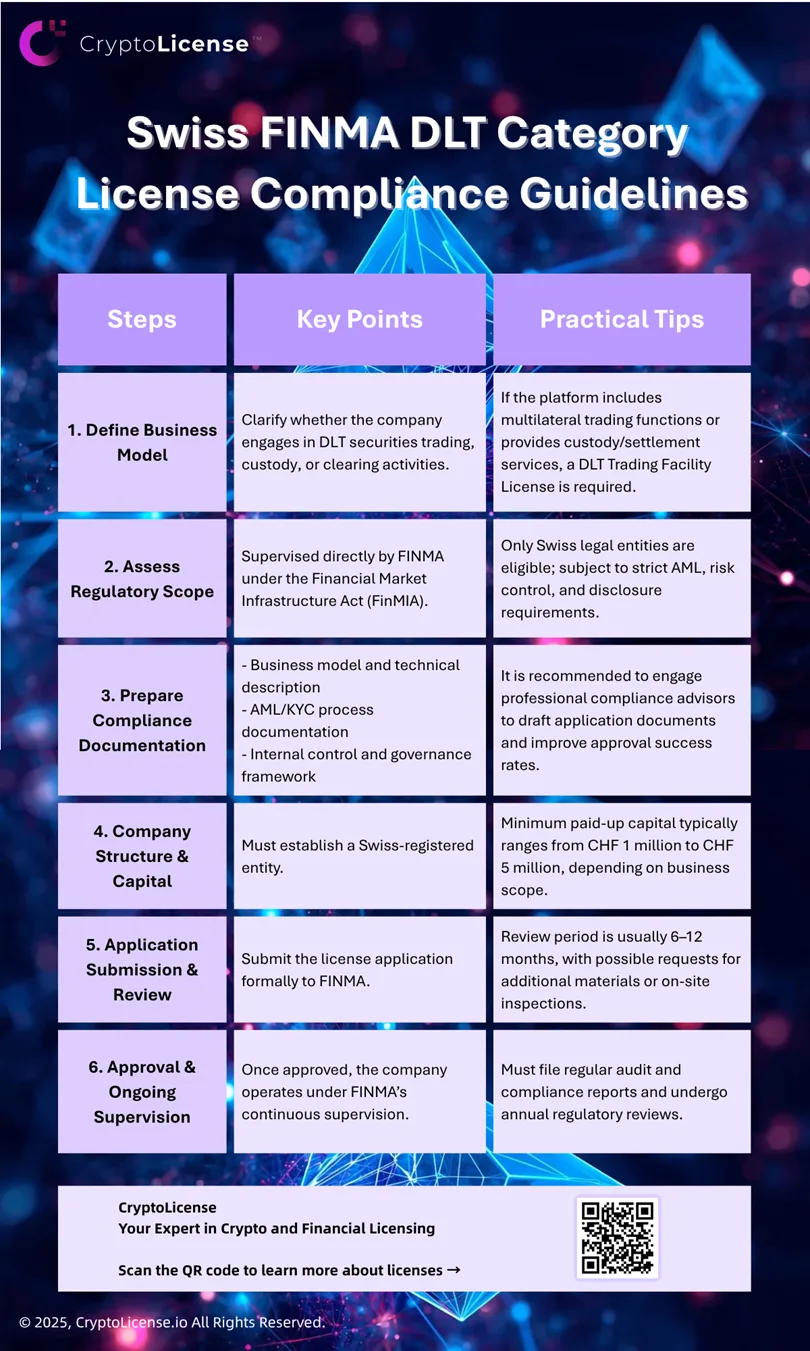
CryptoLicense — Your Trusted Partner on the Path to Swiss Licensing and Compliance
As global regulations tighten, Switzerland continues to offer one of the clearest paths for compliant crypto asset operations. However, since 2024, FINMA has strengthened its requirements for stablecoin and RWA-related businesses, placing greater emphasis on fund security, asset segregation, and transparency. Companies seeking to obtain a license must therefore conduct thorough business reviews and prepare their compliance frameworks in advance.
Based on past application experience, the success rate largely depends on three key factors: a well-defined business model, the selection of the right compliance route (for instance, determining whether the business involves DLT-related activities), and the submission of comprehensive AML/KYC and risk management documentation. For companies without local expertise, these steps can quickly become major challenges.
This is why choosing a professional compliance partner is crucial. CryptoLicense has extensive experience in Swiss licensing and regulatory implementation. We help companies communicate effectively with regulators, streamline the application process, and significantly improve their chances of approval.
If your company is planning to expand into RWA or other crypto asset businesses, CryptoLicense can guide you toward a secure and practical path to compliance.
Ready to begin your journey toward compliant crypto asset operations? Contact us today and gain a competitive edge with CryptoLicense by your side.