

Big Moves in HK Licensing: Why the Hype Requires a Closer Look
Over the recent Chinese spring festival holiday, a series of major licensing updates came out of Hong Kong.
- On one hand, the Securities and Futures Commission approved the 12th Virtual Asset Trading Platform (VATP) license, ending a silence period of more than 250 days.
- On the other, the Hong Kong Monetary Authority announced plans to issue the city’s first batch of stablecoin issuer licenses in March, signaling that the regulatory framework is moving into implementation.
The market has taken these developments as a release of policy tailwinds: more licensed exchanges, stablecoin approvals, faster product innovation. It all seems to suggest that Hong Kong is reclaiming its position as Asia’s digital asset hub.
But as excitement builds, CryptoLicense would like to suggest a pause. Before reacting to the headlines, it’s worth taking a step back and assessing the practical realities of market entry based on your actual business model.

Behind the Buzz, Access Is What Really Matters
In recent years, Hong Kong has indeed built out a comprehensive regulatory framework. From the introduction of a mandatory licensing regime, to the phase-out of transitional arrangements, to product expansion and stablecoin legislation, the structure has gradually shifted from high-level principles to real execution.
However, clarity of direction does not mean lower barriers to entry.
If you look closely at the licensing landscape over the past two years, a more important trend becomes clear: Hong Kong is building a financial-grade digital asset infrastructure, not a market designed for rapid, low-barrier startup entry.
In this system, openness and selectivity coexist:
- Openness means regulators are willing to admit compliant institutions into the framework.
- Selectivity means only institutions that meet specific thresholds are likely to pass the review process.
For large financial groups, this represents greater regulatory certainty. For small and mid-sized Web3 teams, however, it may translate into higher time costs, capital requirements, and structural expectations.
The Hidden Walls of Hong Kong Licensing: Openness and Selectivity Go Hand in Hand
Licensed Institutions: What Is the Regulator Actually Approving?
So far, Hong Kong has issued 12 VATP licenses. The number is growing, but the profile of licensed entities is highly concentrated.
Based on the institutions that have already been approved, they broadly fall into two categories:
First, firms with a clear traditional finance background. Their shareholders are often brokerage houses, listed companies, or large financial groups that have long operated within strict regulatory systems.
Second, firms with crypto-native origins that underwent significant governance restructuring during the application process. This often includes introducing licensed custodians, strengthening risk control systems, and reshaping internal structures to resemble traditional financial infrastructure.
What regulators are really assessing is whether the organization can be supervised on a sustained basis.
Under Hong Kong’s framework, a VATP is treated as a node within the financial infrastructure. Regulators focus on shareholder transparency, asset segregation mechanisms, custody arrangements, the maturity of risk management systems, and the ability to serve institutional clients.
It is clear that Hong Kong is not simply opening the door. It is selecting participants that already display the characteristics of financial institutions.
Looking at Costs: The Barrier Goes Beyond Approval
Many people think the key question is whether you can get approved. In practice, the cost structure runs through the entire lifecycle — before applying, during the application, and after obtaining the license.
1. Application Stage: Time and Capital
Time cost
Before the 12th VATP license was granted, the market went through more than 250 days of approval silence. During that period, applicants continued to submit supplementary materials and adjust their structures, while regulatory expectations were refined in practice.
This level of caution is not about inefficiency. It reflects a risk-control logic. But for Web3 teams that rely on rapid iteration, a prolonged period of uncertainty is itself a cost.
Capital cost
According to official requirements, the minimum paid-up share capital for a VATP applicant is typically HKD 5 million, with at least HKD 3 million in liquid capital to be maintained.
But this is only the regulatory floor.
In reality, substantial investment usually happens well before approval. This includes appointing compliance officers and key personnel, building AML and KYC frameworks, upgrading technology and risk management systems, arranging custody solutions, and covering legal advisory fees.
SINOHOPE, formerly known as Huobi Technology, disclosed in its public financial filings that its overall budget for advancing a Hong Kong VATP license was approximately USD 12 million, or about HKD 93.6 million. This provides some indication of the scale of systematic investment required to enter the regulated framework.
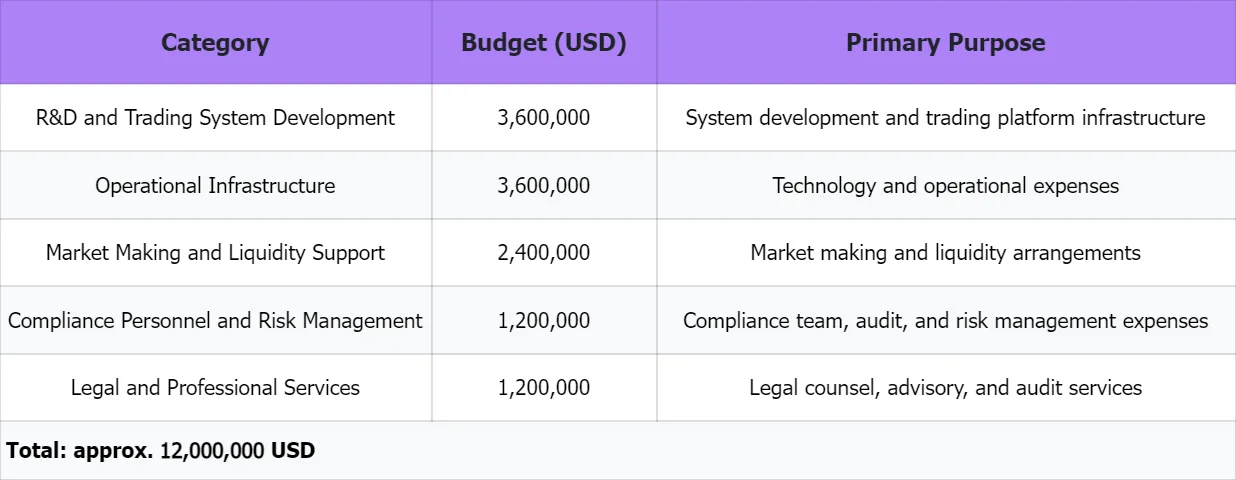
More importantly, most of these expenses are incurred before approval. If the application is ultimately unsuccessful, the sunk cost can be significant.
2. Post-Licensing Stage: Ongoing Maintenance Costs
Even after successfully obtaining a license, annual compliance and audit expenses remain substantial. Licensed firms are typically required to maintain ongoing compliance functions, staffing, audits, and system infrastructure. These are recurring fixed costs.
For example, based on Hong Kong market salary levels, a compliance and risk management team of 8 to 15 people can easily cost between HKD 10 million and HKD 30 million per year, depending on seniority and team structure.
This reality makes Hong Kong more suitable for institutions with sufficient capital and strong tolerance for long operating cycles.
In addition, firms must maintain secure operational environments, including reliable trading systems, network security, and appropriate office technology infrastructure design to support compliance monitoring and day-to-day platform operations.

Stablecoin Licensing: Financial Stability Comes First
Expectations around stablecoin licensing in Hong Kong are rising. However, based on disclosed regulatory documents and official statements, the policy direction is clearly centered on financial stability rather than rapid market expansion.
In addition to the requirement that licensed issuers maintain at least HKD 25 million in paid-up capital at all times, several structural points are worth noting:
First, the pace will remain cautious.
The initial number of licenses is expected to be limited. Regulatory review will focus on reserve management, corporate governance, and risk control. Business model innovation is not the core metric at this stage.
Second, the 100% reserve requirement defines the business boundary.
Fiat-backed stablecoins must be fully backed by highly liquid assets, subject to ongoing audits, and supported by clear redemption mechanisms. Structurally, this resembles a “narrow banking” model more than an asset operation platform.
Third, banking partnerships are not automatic.
Under the current capital regulatory environment, crypto-related activities generally carry higher risk weightings. Banks tend to adopt a cautious approach when it comes to account opening, clearing services, and treasury support.
From practical experience, most local banks in Hong Kong still maintain a relatively conservative stance toward crypto-related businesses. Even with clear policy direction, banks’ internal risk assessment frameworks have not fully loosened in parallel.
At the same time, regulators emphasize look-through supervision and risk identification capabilities. This means issuers must demonstrate:
- A clear ownership and control structure
- A comprehensive internal control and compliance framework
- The operational capacity to undergo ongoing audits and regulatory inspections
Without support from the banking system, it is difficult for a stablecoin issuer to form a complete operational loop across issuance, reserve management, and redemption mechanisms.
Beyond Hong Kong: What Other Compliance Options Are There?
Discussing other jurisdictions is not about comparison for its own sake. It brings us back to a more practical question: does the regulatory structure match your company’s current stage of development?
Different stages require different institutional environments. Some companies need a highly financialized regulatory endorsement to strengthen institutional trust. Others care more about approval timelines and policy predictability in order to reduce time costs.
Switzerland: Integration Within the Financial System
Switzerland has long handled digital asset activities within its existing financial law framework and is often seen as a high-standard model for digital asset compliance.
Regulation is coordinated by the Swiss Financial Market Supervisory Authority, commonly known as FINMA, with anti-money laundering obligations connected through the SRO mechanism. The system is stable, with clearly defined boundaries. It carries strong global credibility while retaining a degree of operational flexibility.
Minimum capital requirements are relatively manageable, and the approval pathway is well defined. This makes Switzerland suitable for institutions that intend to operate long term within a compliant framework and gradually integrate into the broader European financial system.
CryptoLicense has previously published detailed guides on Swiss licensing requirements and key considerations for applicants:
How to get a Crypto License in Switzerland: Benefits, Challenges, and What It Takes to Succeed
Switzerland Proposes New Crypto Licence Categories and Strengthens Regulatory Safeguards
El Salvador: Policy-Driven Execution Efficiency
Unlike Switzerland, El Salvador offers a more modular and clearly structured digital asset licensing system.
At the center of its framework is the National Commission of Digital Assets (CNAD). The regime distinguishes between two tracks: BSP, which is limited to Bitcoin-related activities, and DASP, which covers a broader range of digital assets beyond Bitcoin. The regulatory boundaries are relatively clear.
The advantage of this system lies less in deep integration with traditional financial infrastructure and more in policy clarity, predictable approval timelines, and supporting measures such as tax exemptions for digital asset businesses.
For teams looking to complete compliance setup efficiently and test their business models in a defined regulatory environment, El Salvador may represent a more pragmatic option.
CryptoLicense has also explored how this small Pacific-facing country became a compliance choice for major players such as Tether and Binance, analyzing the structural logic behind those decisions:
Why El Salvador Has Become a Regulatory Hub for Tether and Binance?

An Alternative Path: Acquiring an Existing License
In real-world business practice, applying for a license is not the only option.
For teams that are still in the product validation or user growth stage, entering a full licensing process means taking on time costs, structural build-out expenses, and ongoing regulatory pressure upfront. In jurisdictions where approval cycles are long, supplementary submissions are frequent, or regulatory inquiries are particularly detailed, the new application route can involve significant uncertainty.
In such cases, acquiring an existing, well-maintained license may be a more stage-appropriate choice.
Compared with a fresh application, an existing license typically already has its legal entity established, regulatory registration completed, and baseline compliance framework in place. If the license is in good standing and has no history of violations, a company may be able to move into operations more quickly after completing the equity transfer and updating regulatory filings.
If you are considering acquiring an existing license, several key points require careful attention:
- License status review: Confirm that the license remains valid, that its permitted business scope aligns with your model, and that there are no suspensions, restrictions, or hidden compliance issues.
- Comprehensive due diligence (DD): Review past regulatory records, penalties, outstanding reporting obligations, and potential legal risks to avoid inheriting hidden liabilities.
- Control and disclosure updates: Most regulators require timely updates of directors, beneficial owners, and compliance officers after a change of ownership. Failure to complete these filings may invalidate the license.
- Rebuilding and aligning compliance systems: Existing AML, risk control, and internal procedures often need to be adjusted to match your actual operations. Otherwise, the license may be formally compliant while operationally misaligned.
Conclusion: Set Aside the Emotional Reactions
What Hong Kong is building today is an institutional-grade digital asset market. Its regulatory logic is closely aligned with traditional financial systems, emphasizing stability, transparency, and sustainable supervision rather than experimental space for startups.
For well-capitalized institutions with mature governance structures and the ability to integrate banking resources, this environment offers long-term strategic value. The more stable the system, the easier it is for large players to build durable competitive advantages.
For teams still in the exploratory stage, however, the more important question is alignment. Does the jurisdiction match your company’s current rhythm and development phase? There is no need to rush. Move at your own pace.
If you have questions about applying for a license or acquiring an existing one, feel free to reach out to CryptoLicense. Compliance becomes much clearer once you break it down properly.