

How to get a Crypto License in Switzerland: Benefits, Challenges, and What It Takes to Succeed
The crypto world is expanding at an unprecedented pace, with the total market capitalization surpassing $4 trillion earlier this year.
Although decentralization lies at the heart of crypto’s philosophy, the industry is now entering a critical phase of integration with global regulatory frameworks.
For crypto companies aiming to go global, obtaining a recognized regulatory license is not just a compliance requirement — it’s a strategic asset that builds market trust and opens doors to international opportunities.
To help businesses navigate this complex landscape, CryptoLicense has launched a new content series — “Global Regulatory License Fast-Track Guide” — offering clear, practical insights into the world’s key licensing jurisdictions.
In this first edition, we spotlight the “Compliance Hub of Crypto” — Switzerland. Why is Switzerland regarded as the top choice for regulatory compliance? How can companies efficiently obtain the Swiss SRO (Self-Regulatory Organization) membership and establish a credible foundation for global operations?
Scroll down for the full breakdown — packed with essential insights and practical takeaways.
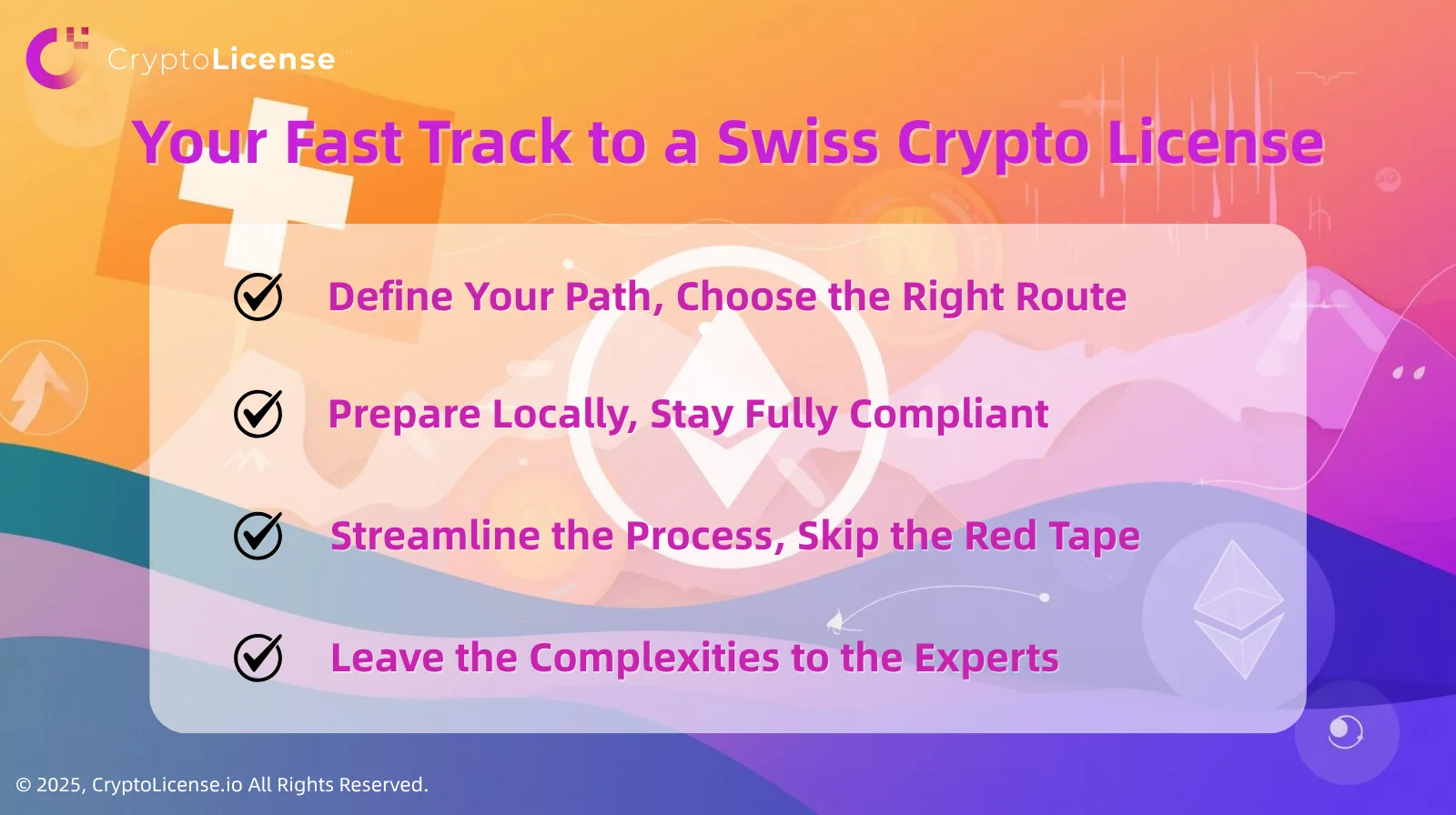
Stay tuned to our License Application Guide Series and gain an early advantage in the race toward global crypto compliance.
Swiss Crypto License: Where Stable Regulation Meets Efficient Compliance
Why Switzerland Is the Top Choice for Crypto Businesses
Switzerland is renowned for its stable financial system and transparent regulatory environment, with Geneva ranking among the world’s top ten financial centers. The Swiss Financial Market Supervisory Authority (FINMA) oversees banks, securities, insurance, and distributed ledger technology (DLT) trading venues, ensuring a compliant and resilient financial ecosystem.
For institutions that do not require a full FINMA license, Switzerland allows compliance through membership in Self-Regulatory Organizations (SROs) — such as VQF and SO-FIT — which operate under FINMA’s authorization and supervision. In March 2025, crypto payment company Alchemy Pay announced it had successfully obtained VQF compliance certification, demonstrating the accessibility and credibility of the Swiss SRO model.
Under the Swiss Anti-Money Laundering Act (AMLA), any entity that accepts, holds, or transfers client assets is deemed a financial intermediary and must join an SRO to meet AML compliance obligations.
Key Advantages of the Swiss Compliance Framework: Stable Regulation, Flexible SRO System
1. A Mature and Reliable Regulatory System
- FINMA and AMLA together form a robust multi-tier regulatory framework that ensures transparency and security.
- Swiss licenses carry strong global credibility — often regarded as a true “seal of financial trust.”
2. Lower Compliance Costs Compared to the EU (No MiCA Burden)
- As a non-EU member, Switzerland is not subject to the stringent MiCA framework
- Minimum capital requirements are relatively low: CHF 100,000, with only CHF 50,000 needed upfront.
- Compared to the hundreds of thousands of euros often required in the EU, Switzerland offers a much more accessible entry point for crypto firms.
3. Flexible and Efficient SRO Regime
- Faster processing: for instance, VQF approvals typically take around six months.
- Lower fees: initial membership fees start at CHF 2,000, with flexible annual dues.
- High credibility: SROs are FINMA-authorized and AMLA-compliant, earning broad international recognition.
Navigating Swiss SRO Membership: Key Requirements, Practical Challenges, and Success Factors
Obtaining Swiss SRO (Self-Regulatory Organization) membership is a crucial step for any crypto or fintech company aiming to operate within Switzerland’s regulatory framework. It allows businesses to comply with Swiss Anti-Money Laundering (AML) standards without being directly supervised by FINMA, offering a more flexible path for conducting crypto and financial technology activities.
Main Business Activities Covered
- Fiat and Crypto Payments: Including asset transfers, electronic payments, and settlement services
- Crypto Asset Custody: Support for both segregated and co-managed wallets
- Trading and Exchange: Operation of CEX/FX platforms and crypto-to-fiat exchanges
- Asset Management and Market Making: Management of client crypto portfolios or market-making activities
- Card and Deposit Services: Issuing payment cards and accepting public deposits up to CHF 1 million
Core Application Requirements
- Qualified Members: Must provide identity and source-of-funds documentation
- Document Preparation: Business plan, AML/KYC policies, Articles of Association, and shareholding structure
- Local Presence: Appointment of Swiss-based directors and AML compliance officers, with a physical office address
- Minimum Capital: CHF 20,000 for GmbH/Sàrl entities, CHF 100,000 for AG/SA entities
Practical Challenges and Key Success Factors
While the SRO application process is transparent and well-defined, there are three major practical challenges applicants often face:
- Complex entity setup: A Swiss-registered company and physical office presence are mandatory.
- Strict compliance qualifications: Local directors and AML officers must demonstrate strong familiarity with the Swiss regulatory framework.
- Regulatory coordination: Applicants must understand the interplay between AMLA, FINMA, and various SROs.
Failure to manage these details properly can lead to delays or rejections during review.
The keys to success include:
- Selecting the right corporate structure and SRO (e.g., VQF, SO-FIT)
- Developing a comprehensive AML policy and business plan early in the process
- Partnering with a local professional advisor who can manage documentation and regulatory communication end-to-end
Application Process Overview
- Preparation Phase: Incorporate the company, inject capital, and prepare the business plan and AML documents
- Application Phase: Submit materials, engage with the SRO, and respond to follow-up inquiries
- Post-Approval Phase: Receive membership credentials, establish ongoing compliance, and open operational bank accounts
The full process typically takes 5–6 months, but working with an experienced Swiss compliance team can significantly shorten the timeline and ensure a smooth approval and stable post-license operation.
Partner with CryptoLicense and Stay Ahead in the Global Compliance Race
While a Swiss license stands as a symbol of trust and regulatory excellence, the path from application to approval can be challenging. From setting up a Swiss entity and appointing qualified directors and compliance officers to preparing detailed AML and KYC documentation, the process demands a deep understanding of Swiss regulations and extensive compliance expertise.
If you are planning to apply for Swiss SRO membership or exploring the most suitable licensing route, CryptoLicense can help. With extensive experience in Swiss and multi-jurisdictional compliance, we provide comprehensive licensing support including company registration, legal advisory, document review, AML and KYC policy drafting, and coordination with external auditors. Our goal is to simplify the process and significantly increase approval success rates.
Contact CryptoLicense to accelerate your global expansion with confidence and compliance.
Frequently Asked Questions
What is Swiss SRO membership?
Swiss SRO membership means joining a self-regulatory organisation, such as VQF or SO-FIT, that operates under FINMA’s authorisation and supervision. The SRO supervises a member’s anti-money laundering duties, so the firm can meet Swiss AML rules without being supervised directly by FINMA. It covers AML duties only and is not a full FINMA licence.
Who has to join an SRO in Switzerland?
Under the Swiss Anti-Money Laundering Act (AMLA), a business that holds or transfers client assets is a financial intermediary. A financial intermediary has to join an SRO to meet its AML duties, unless FINMA supervises it directly. This catches many crypto businesses, such as crypto payment and custody firms.
How much does it cost to join VQF in Switzerland?
VQF, one of Switzerland’s self-regulatory organisations, charges an administration fee of CHF 2,000 plus VAT to join. Further fees depend on the work involved and the admission audit, and members then pay yearly dues. The full budget also includes setting up the Swiss company and hiring local staff.
What documents do you need for Swiss SRO membership?
An SRO applicant prepares a business plan, AML and KYC policies, its Articles of Association and its shareholding structure. The people behind the company must provide identity and source-of-funds documents. The company also needs Swiss-based directors and AML officers who know Swiss rules, along with a physical office in Switzerland.
What are the steps to get Swiss SRO membership?
First, set up the Swiss company with its capital paid in, and prepare the business plan and AML documents. Next, submit the application to the SRO and answer its follow-up questions. After approval, the firm runs ongoing AML compliance and can open its operating bank accounts.