

Why El Salvador Has Become a Regulatory Hub for Tether and Binance?
Why has El Salvador, a small Central American country, emerged in recent years as a jurisdiction of choice for major crypto players such as Tether, Binance, and Bitget?
Is it simply a first-mover advantage created by a favorable policy window, or does El Salvador offer a more compelling mix of regulatory clarity, licensing accessibility, and compliance cost structure? For market participants looking to operate on the same regulatory footing as these institutions, key questions quickly arise:
How should one choose between the BSP and DASP licenses?
What does the application process actually involve?
Which critical details are most often underestimated or overlooked?
Drawing on regulatory analysis and practical licensing experience, CryptoLicense provides a structured overview of El Salvador’s digital asset licensing framework. This article examines the underlying regulatory logic, applicable use cases, and core compliance considerations, helping institutions assess whether El Salvador is the right jurisdiction for their business—and how to design a compliant and sustainable licensing strategy.
I. Why El Salvador Chose a Different Path: The Bitcoin Context
On the map, El Salvador is easy to overlook.
As the smallest country in Central America, it has long faced structural constraints: high population density, limited natural resources, a narrow export base, and persistent income inequality. For decades, economic growth relied heavily on coffee exports and remittances, while political instability throughout the 20th century repeatedly disrupted development.
After the civil war ended in 1992, peace returned—but sustained economic momentum did not. A weak industrial base and limited domestic employment pushed large segments of the population to seek work abroad, deepening the country’s dependence on remittance inflows.
In 2001, El Salvador fully dollarized its economy, abandoning its national currency in favor of the U.S. dollar. While this move stabilized inflation, it also eliminated monetary policy flexibility, binding fiscal and economic cycles tightly to the U.S. dollar system. Structural challenges remained unresolved.
Against this backdrop, El Salvador began searching for an alternative growth strategy.
In 2021, Bitcoin was adopted as legal tender alongside the U.S. dollar. This was not merely a technological experiment, but a national policy initiative. The government aimed to reduce remittance costs, attract crypto-native capital, and reposition El Salvador on the global economic map through digital assets.
What followed was a rapid and highly visible pivot: sovereign Bitcoin purchases, a state-backed wallet, and an explicit effort to brand the country as a “Bitcoin nation.” Although subsequent negotiations with the IMF led to adjustments—most notably shifting Bitcoin acceptance from mandatory to voluntary—the broader direction remained intact. Digital asset legislation, regulatory frameworks, and licensing regimes were progressively established.
Tax policy played a critical supporting role. Under the Digital Assets Issuance Law (LEAD), entities licensed as Digital Asset Service Providers (DASPs) benefit from extensive tax incentives on digital asset activities, including 0% corporate income tax on digital asset revenues, 0% capital gains tax, and exemptions from transfer tax, dividend withholding tax, and VAT on qualifying services. These incentives apply specifically to digital asset operations; fiat-related services remain subject to the standard 30% corporate tax rate.
Within this policy environment, Tether was among the first to secure a local license, followed by major global exchanges such as Binance and Bitget completing their regulatory positioning in El Salvador.
From a fiscally constrained economy to an active policy laboratory for digital assets, El Salvador’s approach is not without controversy—but it is strategically coherent. That clarity is precisely why an increasing number of leading crypto institutions now view the jurisdiction as a viable and deliberate compliance base.
II. El Salvador’s Licensing Framework: The Logic Behind Its Compliance Design
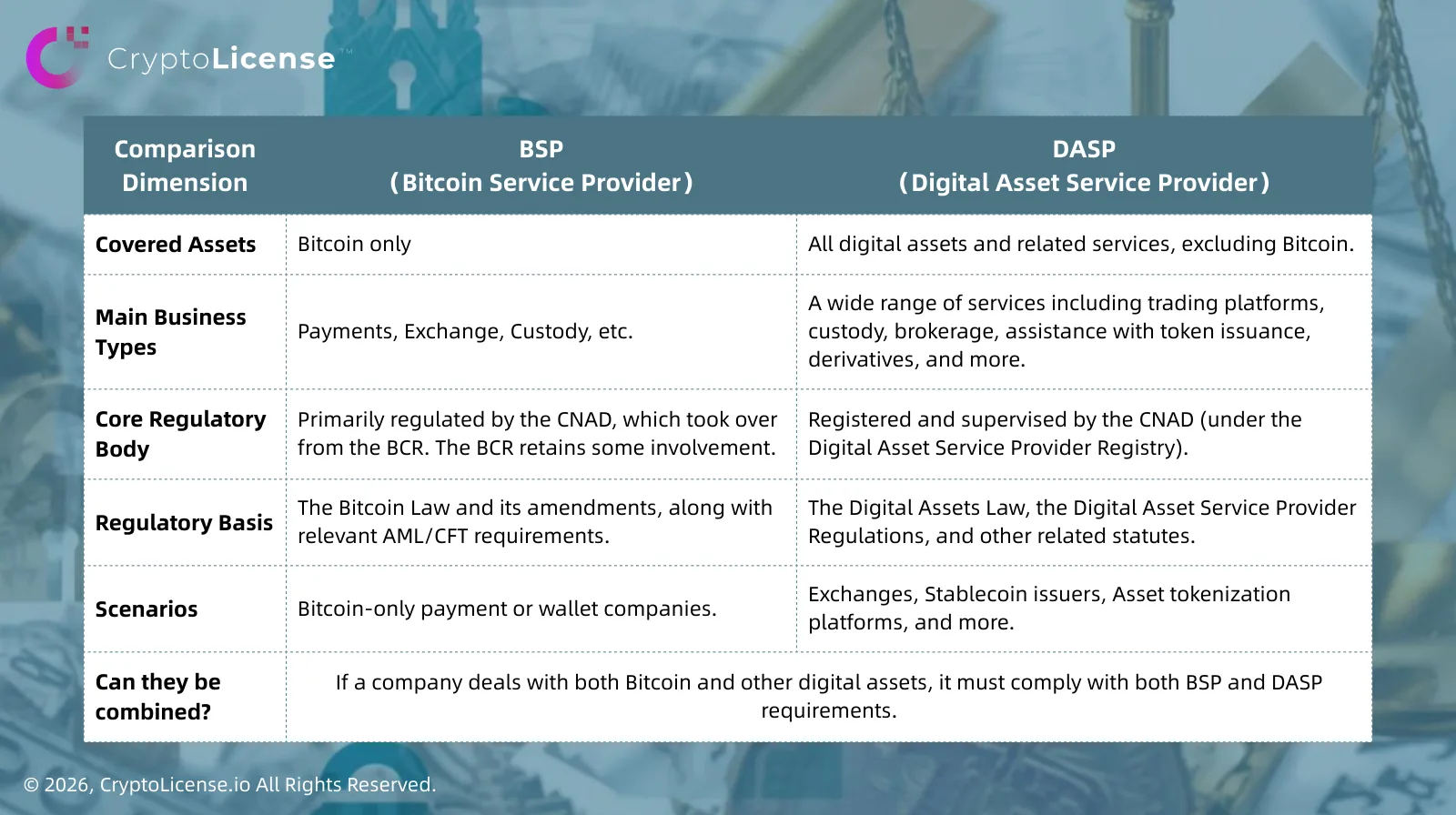
At first glance, El Salvador’s licensing regime can feel confusing, especially with its mix of acronyms. In practice, however, the regulatory logic is straightforward and can be summarized in one sentence:
From a structural standpoint, El Salvador divides crypto-related activities into two distinct regulatory tracks.
1. BSP: A Dedicated Regime for Bitcoin-Only Activities
The first track applies exclusively to Bitcoin-related services and operates under the Bitcoin Service Provider (BSP) license.
If a business is narrowly focused on Bitcoin—such as BTC payments, Bitcoin wallets, BTC custody, BTC–USD exchange services, or even funds that invest in or manage Bitcoin-only portfolios—it falls squarely within the BSP regime.
This pathway is designed for entities whose activities remain strictly within the Bitcoin ecosystem.
2. DASP: The Core License for the Broader Digital Asset Market
The second track covers all digital asset activities beyond Bitcoin, regulated under the Digital Asset Service Provider (DASP) license.
DASP is the central license within El Salvador’s digital asset framework. It applies to a wide range of activities, including multi-asset trading platforms, brokerage and matching services, token issuance, NFTs, real-world asset (RWA) tokenization, asset management, investment advisory services, and stablecoin-related structures.
In practice, once a business involves multiple digital assets, platform-based trading, or tokenized products, DASP licensing is almost always required.
How to Read the Framework
At a high level, the system can be understood as follows:
- BSP governs the “Bitcoin-only” economy
- DASP governs the broader digital asset market
From a supervisory perspective, both licenses fall primarily under the authority of the National Commission of Digital Assets (CNAD), the dedicated regulator responsible for licensing, ongoing supervision, and enforcement in the digital asset sector.
However, due to Bitcoin’s unique legal status in El Salvador, BSP-related activities typically also involve coordination with the Central Reserve Bank (BCR), particularly on AML and compliance matters under the Bitcoin Law.
Overall, the model is best described as CNAD-led supervision with BCR coordination for Bitcoin-specific activities.
III. Licensing Strategy: A Clear Division Between BSP and DASP
The allocation logic between BSP and DASP is deliberately simple:
A few practical examples make this distinction clear:
- If your business focuses solely on Bitcoin—such as BTC payment networks, Bitcoin wallets, BTC custody services, or Bitcoin-only funds—and does not touch any other tokens, BSP is typically sufficient from a regulatory perspective.
- If your business involves multi-asset exchanges, wallets that support ETH or stablecoins, NFT platforms, RWA projects, token issuance, or crypto asset management, DASP is the core license you will need.
- If a platform supports both BTC and other digital assets, compliance is not a matter of choosing one license over the other. In practice, such models often need to meet the requirements of both BSP and DASP.
This clear separation is one reason El Salvador’s licensing framework is relatively easy for Web3 projects to understand. Rather than relying on a single, overly broad license, the system is designed to segment different types of crypto activities and place them into distinct regulatory lanes.
With the country’s policy context and licensing structure now clear, the more practical questions come into focus:
How are these licenses—already obtained by major players such as Binance and Bitget—actually applied for? What does the process look like, what do regulators focus on, and where do applicants most commonly run into issues?
That is where the real execution begins.

IV. Licensing in Practice: A Step-by-Step Guide to BSP and DASP Applications
Which license you need ultimately depends on your business model. From CryptoLicense’s experience, it is best to view El Salvador’s licensing regime as two distinct but often intersecting compliance tracks:
- BSP (Bitcoin Service Provider), focused exclusively on Bitcoin-related activities
- DASP (Digital Asset Service Provider), covering broader digital asset services and supervised directly by CNAD
In practice, BSP and DASP are not always an either-or choice. For many projects, especially platforms with expanding product scopes, the two licenses are planned together and pursued in parallel.
Different business models also imply very different preparation priorities and review focus. Understanding this early is critical to avoiding delays.
1. DASP Licensing Process: CNAD’s Official Path, Explained
DASP is the most comprehensive digital asset license in El Salvador. It is administered by the National Commission of Digital Assets (CNAD) under the Digital Assets Law (LEAD) and its implementing regulation, the Regulation for Digital Asset Service Providers (RPSAD).
Based on practical experience, a DASP application typically takes 7 to 9 months. The clarity of positioning and documentation during the early preparation and pre-registration stages often determines whether the later review proceeds smoothly.
The process generally unfolds as follows:
Step 1: Business Scoping and Pre-Application Preparation
Before any formal submission, the first task is not paperwork, but classification—determining whether your activities fall within the definition of “digital asset services” under Article 19 of the Digital Assets Law, such as trading, custody, issuance, brokerage, or settlement.
At this stage, most applicants focus on three core items:
- Defining the business model and corresponding DASP activity scope
- Establishing the corporate structure (typically a local Salvadoran entity)
- Preparing an initial business plan and compliance framework
There is no statutory timeline here, but insufficient preparation often leads to repeated follow-ups later.
Step 2: CNAD Pre-Registration
Applicants must submit a pre-registration form through CNAD’s official portal. The purpose is straightforward:
to allow the regulator to assess whether the applicant is suitable to proceed to full review.
Pre-registration typically includes:
- Basic applicant information
- Shareholding and beneficial ownership structure
- Intended digital asset services
- A high-level description of the business and compliance approach
CNAD will review the submission and may request clarifications. The outcome is a formal response of either “no objection” or “objection.”
In practice, receiving a no objection is the essential gateway to formal registration.
Step 3: Final Registration Submission
Once the no objection is granted, the application enters the formal phase. A complete and structured application package—both electronic and physical—must be submitted to CNAD.
At this stage:
- Authorized capital and proof of capital contribution are reviewed
- Market practice often references capital levels around USD 2,000
CNAD’s focus is less on the absolute amount and more on capital adequacy, authenticity, and alignment with the business scale
Step 4: CNAD Review and Approval
After confirming that the file is complete, CNAD initiates formal review:
- The statutory review period is typically 20 business days
- If deficiencies are identified, CNAD issues a rectification notice
- Applicants usually have 10 business days to respond
Upon approval, CNAD issues the DASP registration certificate and operating authorization, and notifies the Financial Intelligence Unit (FIU), bringing the entity under ongoing AML supervision.
2. BSP Licensing Process: The Practical Route for Bitcoin Services
BSP licensing is governed by the Bitcoin Law and supervised primarily by the Central Reserve Bank of El Salvador (BCR), with a strong focus on risk management and AML controls.
The typical BSP application timeline is 5 to 7 months.
Step 1: Entity Setup and Core Compliance Preparation
BSP applications are usually submitted through a local Salvadoran entity and require:
- Company incorporation and constitutional documents
- Shareholder, UBO, and management disclosures
- Documented AML/CFT, cybersecurity, and internal control policies
Much of this overlaps with DASP preparation, which is why both tracks are often developed in parallel.
Step 2: Local Compliance Personnel and Substance Requirements
BCR places significant emphasis on people and local substance:
- A compliance officer and deputy must be appointed
- These roles are typically expected to be long-term residents in El Salvador
- Senior management is subject to fitness and probity assessments
This is often the most challenging point for remotely operated projects.
Step 3: BSP Registration with BCR
The applicant submits a registration request to the Bitcoin Service Providers Registry maintained by BCR. Review priorities include:
- AML/CFT frameworks
- Bitcoin transaction monitoring and record-keeping capabilities
- Technical security of wallets, custody, or payment systems
Once approved, BCR issues confirmation of BSP registration, allowing the entity to operate as a Bitcoin service provider.
Step 4: Coordination with DASP Oversight
Where the business also involves non-BTC digital assets—such as stablecoins or tokenized products—dual compliance is typically required. In such cases, BSP and DASP obligations apply concurrently, under coordinated supervision by BCR and CNAD.

V. What Determines Licensing Success: What Regulators Actually Focus On
In practice, BSP and DASP may appear to be two separate licenses, but the regulatory logic behind them is largely the same.
Whether the review is conducted by CNAD or BCR, the outcome ultimately depends on whether the application materials present a clear, consistent, and executable compliance framework grounded in the actual business.
1. Is the compliance logic internally coherent?
Regulators first assess whether the business, its risks, and the proposed controls form a complete loop.
Successful applications typically share one trait:
- Business plans, operational scope, and risk descriptions
- AML/CFT frameworks, technical architecture, and internal controls
are aligned with each other and clearly mapped to legal and regulatory requirements. Reviewers should not need to infer how compliance will work—the structure should already be evident.
2. Are business boundaries clearly defined from the outset?
Whether at the DASP pre-registration stage or during BSP review, early clarity often determines the overall timeline.
Many applications are not rejected outright but become stalled due to repeated follow-ups, commonly caused by:
- Mismatches between actual operations and written descriptions
- Unclear division between in-house activities and outsourced functions
- Ambiguous allocation of compliance responsibility across entities
Clearly defining scope and structure early is far more effective than correcting misunderstandings later.
3. Is the AML/CFT framework genuinely operational?
This is a core review point for both BSP and DASP.
Regulators focus on whether:
- KYC/KYB processes are practically enforceable
- Transaction monitoring enables traceability and meaningful analysis
- Suspicious activity reporting is clearly defined and actionable
Generic templates with no ownership or operational depth are among the most frequent reasons for extended scrutiny or resubmission.
4. Can technical and operational safeguards withstand detailed review?
Where wallets, custody, exchange, or matching services are involved, regulators will examine:
- Hot and cold wallet segregation
- Key management and access controls
- Logging, risk controls, and disaster recovery mechanisms
These are not formalities. Review questions often go directly into implementation details.
5. Is there credible, sustainable operating capability?
Capital, local personnel, and physical presence all feed into one central question:
Is the entity prepared for long-term, regulated operation?
Regulators assess:
- Ongoing financial viability
- The existence of a real operating team and communication interface
- Willingness and readiness to engage in continued supervision post-licensing
Licensing approval marks the beginning—not the end—of regulatory engagement.
El Salvador Compliance Journey, Accompanied by CryptoLicense
Overall, El Salvador does not offer a “one-size-fits-all” licensing solution. In practice, applications must be tailored to the specific business model, with careful alignment to BSP, DASP, or dual-license structures. Compliance priorities and execution paths will vary accordingly.
If you are assessing El Salvador as a potential jurisdiction, or evaluating license strategy, entity structuring, and regulatory expectations, CryptoLicense can support you with a practical, experience-driven approach—helping clarify feasible paths and identify key risk points.
For further discussion on licensing strategy and regulatory considerations, please contact us.