

Which Layer of Crypto Payments Belongs to Banks? 4 Operational Blueprints from Lead Bank to Revolut
In the previous piece, the CryptoLicense team looked at how Visa and Mastercard are connecting to stablecoins: the card networks are changing the settlement layer by embedding on-chain capabilities into existing payment networks.
This piece turns to banks.
For banks, the question is more fundamental than it is for card networks. Stablecoins are not merely changing banks’ payment processes. They touch deposits directly. Deposits are banks’ cheapest source of funding. If stablecoins replace deposits, the spread-based banking model is hollowed out at the root.
That is why banks’ responses are more complex than those of the card networks. Looking across the market, the models that have already worked in practice enter from different points:
- Some provide fiat banking services to crypto companies without going on-chain themselves;
- Some embed stablecoin minting, redemption and conversion directly into bank clearing networks;
- Some bring stablecoins to ordinary users from the retail side while moving toward issuance.
These are not three mutually exclusive paths. They are better understood as different slices of the stablecoin value chain. The deeper the bank cuts into the chain, the wider its moat becomes.
The shift is already under way, and banks are positioning themselves for a place in the future of payments.
This article looks at four banks in four jurisdictions. Each jurisdiction has a different regulatory environment, and each bank enters the stablecoin stack at a different layer and depth of integration. Viewed together, they show how banks are taking different forms around stablecoins in different regulatory soils.
I. Lead Bank (United States): The Fiat Lifeline of the On-Chain World
Lead Bank is a nearly century-old community bank based in Kansas City, Missouri. In 2022, former Square executive Jackie Reses acquired and restructured it for USD 56 million.
1. Why Would a Square Executive Buy a Community Bank?
The acquisition was not a random choice.
Reses spent five years working on banking infrastructure at Square and had seen a core pain point first-hand: fintech and crypto companies wanted to work with banks, but traditional banks’ core systems were still running on 1970s COBOL mainframes. COBOL is an old programming language that still powers most banks’ core ledgers worldwide. The systems were batch-based: a card transaction made today might not settle until the bank closed and ran its overnight process. Each new product launch could spend months stuck between a bank’s compliance department and technology department.
She initially wanted to build a bank from scratch. The FDIC, one of the core U.S. banking regulators, told her that this would be equivalent to applying for a newly chartered bank and would require a full approval process. She changed course: acquire an already licensed bank, then rebuild the technology stack from the ground up.
Reses brought over much of a core team from Square: CTO Ronak Vyas, Chief Legal Officer Erica Khalili, Chief Product Officer Homam Maalouf, and former Meta design director Albert Song. Together they covered the full loop of engineering, compliance and risk control, and product experience. The acquisition was approved quickly by the Federal Reserve and Missouri regulators, in large part because of Reses’s regulatory relationships.
There is another, less-discussed background point. Reses’s brother, Jacob Reses, previously served as JD Vance’s chief of staff in the Senate and remained a key aide after Vance became Vice President. Under the regulatory pressure of Chokepoint 2.0, this channel into Washington gave Lead Bank a smoother communication mechanism and made it willing to touch businesses that other banks avoided.

2. Fiat Only, No On-Chain Exposure
Lead Bank’s business is essentially Banking-as-a-Service, or BaaS. In plain terms, it “rents” its bank charter and fiat capabilities to non-bank companies. Stablecoin payment companies such as Bridge, owned by Stripe, BVNK, later acquired by Mastercard, Brale and Nala are all Lead Bank customers. Through Bridge, Lead Bank’s fiat rails indirectly connect to end-user wallets such as Coinbase Wallet, Phantom and World App.
How does it work in practice?
Take Bridge as an example. A merchant wants to receive U.S. dollars, while the user holds USDC. Bridge receives the user’s USDC payment on-chain and redeems it with Circle for U.S. dollars. In other words, Bridge returns USDC on a 1:1 basis and Circle releases dollars from reserves. The dollars enter Bridge’s account at Lead Bank, and Lead Bank then pays the merchant. Across the entire flow, Lead Bank only holds and transfers fiat. All on-chain operations are handled by the customer.
In a May 2026 interview, Reses said that “the fastest-growing fintech companies want to work with a bank that can move at their speed without compromising risk or compliance.” In other words, the market needed a bank that understood crypto while still taking regulation seriously.
In fact, Lead Bank has not only opened accounts for crypto companies; it has moved to the front of the pack itself. In September 2025, Lead Bank completed a USD 70 million Series B at a USD 1.47 billion valuation, with participation from a16z, Coatue and Khosla. In December of the same year, it became one of the first U.S. banks to settle with Visa in USDC over Solana, and it was also one of the 85 participating companies in Mastercard’s MTN project.
3. The Bank the Stablecoin Industry Cannot Do Without
Lead Bank still performs traditional banking functions: account opening, fiat receipts and payments, and compliance review. Customers handle all on-chain activity; Lead Bank does not touch it. Its uniqueness lies in the fact that traditional U.S. banks systematically refused to open accounts for crypto companies in recent years, a practice the industry calls de-risking. Lead Bank moved in the opposite direction.
Why were large banks unwilling to touch the sector? It was not necessarily because they did not want to. The regulatory posture kept swinging. A brief timeline makes this clear:
- 2020-2021: The OCC, which charters and supervises national banks, issued a series of interpretive letters, IL 1170, 1172 and 1174, expressly permitting banks to custody crypto assets, hold stablecoin reserves and participate in distributed-ledger payments.
- 2021: The OCC issued IL 1179, requiring banks to obtain a “non-objection” before engaging in the above activities.
- January 2023: The Federal Reserve, FDIC and OCC issued a joint statement warning banks to pay attention to risks in crypto-asset activities. The FDIC issued FIL-16-2022, an institutional letter requiring banks to provide prior notice before engaging in crypto activities. The conclusion for large-bank compliance teams was simple: stay away.
- Early 2023 to early 2025: A vacuum. Fiat access for the U.S. stablecoin industry became highly concentrated at Lead Bank.
- March 2025: The OCC rescinded IL 1179, shifting from prior approval to ex post supervisory review.
- July 2025: The GENIUS Act, the Guiding and Establishing National Innovation for U.S. Stablecoins Act and the first dedicated U.S. stablecoin legislation, passed, giving statutory clarity to stablecoin issuance rules for the first time.
- November 2025 to April 2026: SoFi restarted its crypto business, issued SoFiUSD and launched an enterprise settlement platform; Anchorage Digital launched a stablecoin channel for international banks. The situation began to loosen.
The swings of these years reflect a structural issue in the U.S. regulatory system: the OCC, the Fed and the FDIC repeatedly took inconsistent positions on crypto banking. Large banks would not move, and the gap was naturally filled by smaller banks.
For a long time, the fiat inflows and outflows of more than 100 stablecoin companies rested on a community bank with USD 2 billion in assets. By the end of 2025, Lead Bank had begun tightening compliance standards, limiting customer sources, and extending settlement and account-opening timelines. In a December 2025 interview with The Information, Nic Carter, founding partner of Castle Island Ventures, said: “For a long time, Lead was almost the only option. If they decide to tighten their compliance program, that will have material knock-on effects for every stablecoin company using their services.” SoFi and Anchorage Digital have now entered the market and the situation is improving, but Lead Bank remains the bank most relied upon by core stablecoin infrastructure companies such as Bridge, BVNK and Brale.
The USD 1.47 billion valuation says the same thing. A community bank with USD 2 billion in assets being valued at USD 1.47 billion means the market is pricing its strategic position, not its balance sheet. It controls one of the most important fiat entry points for the U.S. stablecoin industry.

So why exactly have the large banks stayed away? One common term in the industry is “debanking,” meaning that traditional banks systematically refuse to open accounts for crypto companies. Reses herself does not agree with that framing. In a May 2026 interview, when asked whether there was mass debanking of lawful crypto companies in the United States, she answered: “Bullshit.”
In her view, most bank executives still cannot distinguish Bitcoin from stablecoins. They are not malicious; they simply do not understand the sector, so it is hard to call it suppression. Whether that judgment is right is a separate question. But it at least explains why Lead Bank exists: the industry needs an institution that understands both banking and crypto.
Lead Bank only works on the fiat side and leaves all on-chain operations to its customers. SGB chose another path: it embeds on-chain capabilities directly into the banking system, allowing customers to convert between fiat and on-chain assets inside the bank.
II. Singapore Gulf Bank (Bahrain): Embedding Stablecoins into the Bank Clearing Network
SGB was initiated by Singapore’s Whampoa Group. Its name contains “Singapore,” but its license and operations are entirely in Bahrain.
The reason is straightforward: Bahrain offered certainty.
The Central Bank of Bahrain, or CBB, introduced the Crypto-Asset Module, or CAM, as early as 2019. It was one of the first dedicated regulatory frameworks for crypto-assets anywhere in the world.
The CASP, or crypto-asset service provider, license is categorized by business type. If a bank wants to conduct stablecoin clearing or custody of tokenized assets, there are corresponding license categories, and the business boundaries are written into regulation. The bank does not need to confirm each activity with the regulator one by one.
In July 2025, the CBB added an SIO module, Stablecoin Issuance and Offering, allowing stablecoins to be issued locally on a compliant basis.
When SGB launched corporate banking services in November 2024, the announcement was made jointly with the CBB and the Bahrain Economic Development Board.
Taken together, these conditions allowed SGB to conduct on-chain operations directly within the banking system.
How does it work?
SGB’s route is to connect the on-chain and fiat ends itself.
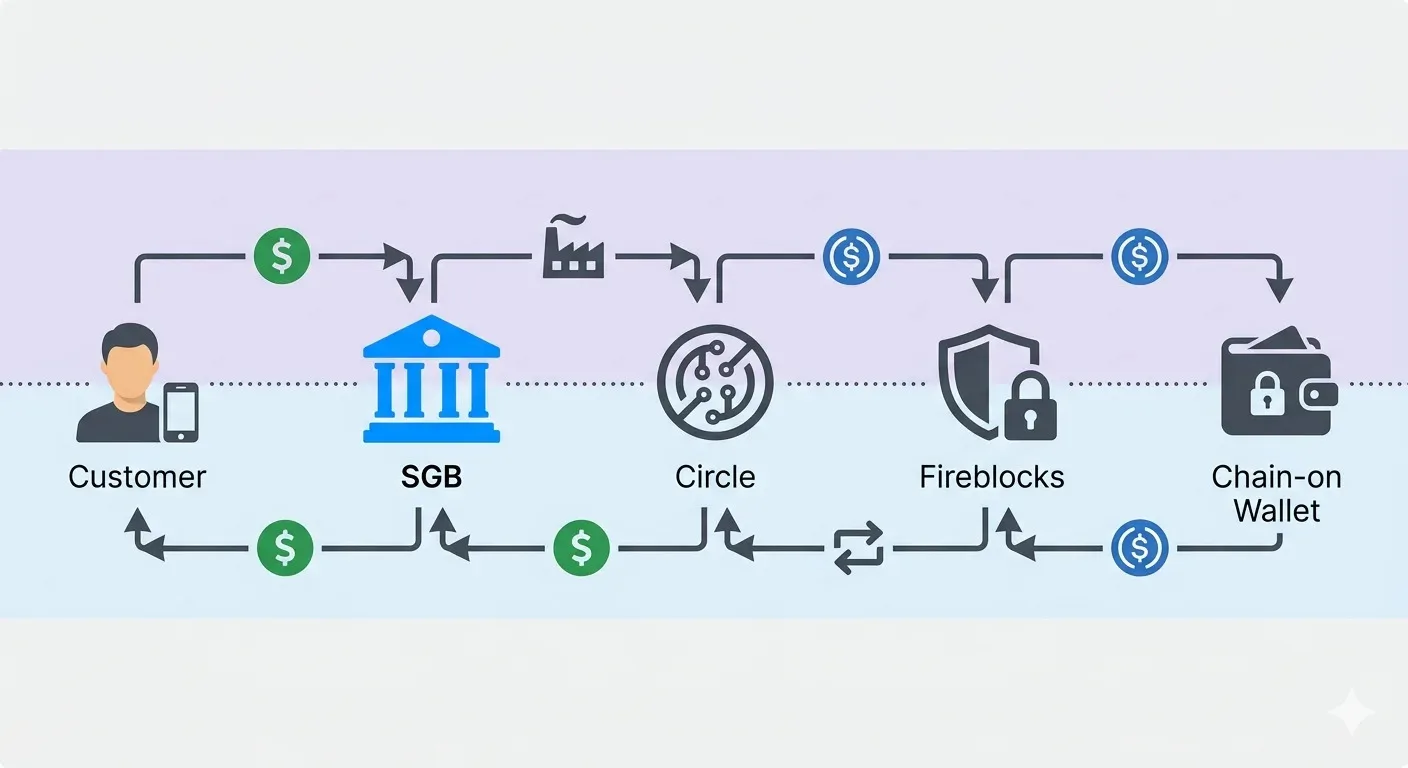
An account at SGB is different from an ordinary bank account: it combines a bank account with an on-chain wallet, custodied by Fireblocks, and connects the two. To convert dollars into USDC, the customer gives an instruction, SGB calls Circle for minting, and USDC enters the on-chain wallet. To convert USDC back into dollars, the process is reversed through redemption. Settlement is real-time, 24/7, with no gas fees or service fees. The service officially launched in April 2026, with a USD 100,000 minimum. Earlier data showed that by February, SGB’s monthly fiat transaction volume was about USD 2 billion.
SGB’s core approach is this: it does not build its own on-chain infrastructure, relying instead on Fireblocks for custody and Circle for minting and redemption; it does not change bank deposit products, so it is not issuing tokenized deposits; and it does not issue its own stablecoin. Instead, it embeds existing stablecoins directly into the bank clearing network. This is the lightest path and has the lowest replication threshold.
Customers are gradually coming in. In August 2025, crypto service provider Aquanow was the first to connect, offering compliant fiat banking services to institutional customers. In September, Binance and SGB partnered to launch direct retail U.S. dollar transfer services, allowing users to link SGB accounts with Binance Bahrain accounts for instant dollar deposits and withdrawals.
The product has been iterating at the same time. In January 2026, SGB connected to JPMorgan’s correspondent banking network and launched Wire 365, enabling year-round U.S. dollar clearing. In February 2026, it upgraded the SGB Net clearing network to support USDC and USDT settlement on Ethereum and Solana. It plans to support USDe from Ethena and USDG from Global Dollar, and to open to individual users in Q2. The team is also split across both sides of the market: a former Goldman Sachs Saudi Arabia CFO serves as the bank’s CFO, and a former Sygnum executive serves as COO, giving it both traditional finance and crypto talent.
SGB provides enterprise-facing on-chain banking services. Customers can convert between fiat and on-chain assets within the SGB system without finding a third party. The regulatory foundation is Bahrain’s dedicated legislation, which expressly authorizes the activity and provides high certainty, although the market size is limited.
Lead Bank and SGB are both B2B services for enterprises and institutions. Revolut approaches from the other end: bringing stablecoins to ordinary users.
III. Revolut (United Kingdom / European Union): Bringing Stablecoins to 75 Million Users
Revolut started from a very specific pain point: hidden markups in bank foreign exchange.
Co-founder Nikolay Storonsky was previously a derivatives trader at Credit Suisse. While traveling for work, he found that banks claimed to charge no fees, but embedded a 3% to 5% margin in the exchange rate. In 2015, he invested GBP 300,000 of his savings and, together with former Deutsche Bank engineer Vlad Yatsenko, built a multi-currency prepaid card that converted at the interbank rate with no fees. In the first six months it gained 100,000 users without spending a penny on marketing.
That starting point shaped the logic behind everything Revolut later built: remove hidden costs and pass the efficiency of financial infrastructure directly to users.
That was true for foreign exchange. It is also true for crypto.

1. Every Step in Crypto from 2017 to 2026
In 2017, just two years after the company was founded, Revolut launched cryptocurrency trading. Crypto was not a new business added later to chase a trend. It was a product decision made in the company’s third year, part of a broader financial super-app alongside stock trading, insurance and savings.
From 2017 to 2026, Revolut’s crypto business advanced step by step:
- 2017: Basic in-app trading for cryptocurrencies such as Bitcoin and Ether.
- February 2024: Launch of Revolut X, a standalone desktop crypto exchange for professional traders, with 0% maker fees, 0.09% taker fees and more than 100 tokens listed.
- March 2024: Partnership with MetaMask, currently the largest self-custodial crypto wallet by user base, to launch Revolut Ramp. Users can top up their MetaMask wallet directly from fiat balances in their Revolut account, simplifying the last step from fiat into on-chain assets.
- November 2024: Revolut X expanded to 30 countries in the European Economic Area, with the token count rising to more than 200.
- October 2025: Obtained a MiCA license in Cyprus. MiCA, the EU Markets in Crypto-Assets Regulation, allows a firm licensed in one member state to operate across 30 European countries on a compliant basis. Revolut’s crypto business therefore received an EU passport.
- October 31, 2025: Launched 1:1 U.S. dollar conversion into USDC and USDT, supporting six chains, with a 30-day limit of USD 578,000 and zero fees and zero spread.
- November 2025: Integrated Polygon as the main infrastructure for stablecoin transfers, payments and trading. By the end of 2025, it had processed more than USD 690 million in stablecoin transaction volume.
- February 2026: Selected for the UK FCA’s stablecoin regulatory sandbox to test a sterling stablecoin.
Viewed as a line, the path runs from basic in-app trading to a professional exchange, from a self-custodial wallet on-ramp to 1:1 zero-spread conversion, and from a MiCA license to testing a sterling stablecoin. Each step reduces friction between fiat and on-chain assets.
The results validate the strategy. In 2024, Revolut’s wealth and crypto division generated GBP 506 million in revenue, up 298% year on year. In October 2025, the company disclosed that 14 million of its 65 million users, or 22%, had passed crypto KYC and completed registration. In other words, one in five Revolut users was using crypto services. For Revolut, crypto is a growth engine, not a decorative add-on.
For full-year 2025, Revolut generated USD 6 billion in revenue and USD 2.3 billion in profit before tax, marking its fifth consecutive profitable year. Its valuation reached USD 75 billion, putting its market value in line with legacy bank Barclays. A substantial part of those numbers came from crypto. A prepaid-card company that began with an FX pain point was valued above a century-old bank ten years later; crypto was one of the key variables.
2. 1:1 Zero-Spread Conversion Removes the Last Barrier Between Fiat and On-Chain Assets
The 1:1 U.S. dollar to stablecoin conversion launched in October 2025 is the most information-rich step in Revolut’s crypto strategy. Previously, every crypto exchange had a spread when converting fiat into stablecoins. The spread, the difference between the buy price and sell price, is one of an exchange’s main sources of revenue. Revolut reduced the spread to zero: USD 1 converts into 1 USDC, and the reverse is also true, with no fee.
Leonid Bashlykov, Revolut’s Head of Crypto Product, wrote on LinkedIn: “Today, we have removed all anxiety and friction in moving between fiat and crypto. 1:1 Stablecoins by Revolut. One dollar is one dollar.”
Zero-spread conversion does not make money and may even lose money, because Revolut absorbs on-chain gas fees and liquidity costs. But the strategic meaning is clear: for 75 million users, there is no longer a price difference between fiat and stablecoins. The only difference is whether the dollars sit in a bank account or an on-chain wallet. Once that psychological barrier disappears, stablecoins stop looking like an “investment” and become “another form of dollar.” That is what Revolut is really doing: turning stablecoins from a crypto-native tool into an everyday payment option for ordinary people.
In 2024, stablecoin payment volume on Revolut’s platform grew 156% year on year to USD 4.1 billion. Total payment transaction volume over the same period grew 38.5%, so stablecoins grew four times faster than the overall business. The pace is fast, but the share remains small: USD 4.1 billion versus USD 1.3 trillion in total transaction value, or 0.3%. There is still substantial room to grow.

3. If Revolut Issues Its Own Stablecoin
So far, Revolut’s stablecoin business has been to help Circle and Tether sell USDC and USDT to 75 million people, while earning transaction volume and user stickiness. But multiple signs suggest it is preparing to issue its own stablecoin, moving from distribution toward vertical integration.
In February 2026, Revolut was selected for the FCA stablecoin sandbox to test a sterling stablecoin. The test concerns payment infrastructure, consistent with the logic of SoFiUSD: the stablecoin is a settlement instrument and does not compete with bank deposits for interest margin. EU crypto lawyer Sadri Sali previously said that once the MiCA issuer regime is fully in place, Revolut would have a compliant path to issue its own stablecoin by 2026.
If Revolut issues its own stablecoin, it will have three things other stablecoin issuers do not have at the same time: 75 million users, a banking license with insured deposits, and a MiCA compliance passport. With these three conditions combined, issuance, distribution and settlement can all happen within its own system. Revolut could become Europe’s version of Circle plus a bank.
On licensing, Revolut obtained a European banking license from Lithuania in 2018 and operates as a bank in parts of the EU. In March 2026, after a three-year approval process, it finally obtained a full UK banking license. Customer deposits are protected up to GBP 85,000 under the Financial Services Compensation Scheme, the UK’s deposit insurance system, and consumer credit and mortgage lending were fully approved. In the same month, Revolut filed an application with the U.S. OCC for a national bank charter. Interestingly, Revolut’s current fiat accounts and payment services in the United States are provided through Lead Bank. Two of the cases in this article are upstream and downstream of each other in the U.S. market.
Of course, Revolut’s current stablecoin business also has structural risks. When DeFi activity returns and on-chain yields far exceed bank savings rates, users have an incentive to bypass Revolut and go directly on-chain. Wallet-native stablecoins, such as MetaMask’s mUSD and Phantom’s CASH, are also trying to bypass intermediaries. If Revolut only distributes other issuers’ products, its moat depends on external variables that it cannot control. But if it issues its own stablecoin, it shifts from distributing someone else’s product to vertical integration, and the risk structure changes completely.
The first three banks enter different layers. Lead Bank provides fiat infrastructure. SGB embeds fiat-to-on-chain conversion inside the banking system. Revolut enters from the retail side while moving toward issuance. Greenlink’s entry point is closer to Lead Bank: fiat banking for crypto companies.
IV. Green Link Digital Bank (Singapore): The Fiat Bank for Crypto Companies
Green Link Digital Bank was one of the first digital wholesale banks approved by the Monetary Authority of Singapore in 2020 and began operations in 2022. The key word is “wholesale”: the bank serves corporate customers only and does not engage in retail banking.
In terms of shareholding, Greenland Financial holds 75% and Linklogis holds 25%. The SGD 250 million initial investment gave it sufficient capital buffer from the start. The shareholder combination itself signals the bank’s DNA:
1. The Fiat Side Is Already Working
In crypto payments, Greenlink is doing something very similar to Lead Bank: providing fiat infrastructure for on-chain companies. Stablecoin companies need a bank willing to open accounts and receive inflows and outflows connected to on-chain funds. In Singapore, Greenlink is that bank.
According to Greenland Holdings’ 2025 annual report, Green Link Digital Bank “plans to issue trade tokens, digital payment tokens and other innovative products, and has become a highly reputable friendly bank in the industry.” Greenland Group’s official wording is “Web 3.0-friendly bank.” The label itself is a customer-acquisition strategy:
The disclosed financials also validate the path. In the first three quarters of 2025, revenue grew 64% year on year and net profit grew 173% year on year, with profitability for ten consecutive months. In July 2025, Greenlink was selected as one of the first 20 core enterprises in MAS’s Pathfinder AI program, and it was the only digital bank among more than 1,200 financial institutions based in Singapore.
2. Supply-Chain Finance Gives Stablecoins a Real Use Case
There is a key difference between Greenlink and Lead Bank. Behind Greenlink is a full set of supply-chain finance on-chain assets in operation, and stablecoins have genuine settlement demand in those scenarios. Bridge and BVNK, served by Lead Bank, are pure crypto companies whose asset side is on-chain. Greenlink’s asset side consists of real trade receivables, and stablecoins are used here for cross-border trade settlement, not crypto trading.
The core provider of this capability is Greenlink shareholder Linklogis.
In 2023, Linklogis participated in Project Dynamo, led jointly by the BIS Innovation Hub and the Hong Kong Monetary Authority. It pioneered the programmable Digital Trade Token, or DTT, which tokenizes trade receivables into digital assets that can circulate and be financed on-chain, using smart contracts to automate payments under trade conditions.

In the same year, Linklogis participated in MAS-led Project Guardian and, together with Standard Chartered, issued the industry’s first tokenized product backed by trade assets, known as ABT, which was listed on the Singapore Exchange digital bond sandbox platform.
In 2025, Unloq, the cross-border trade platform jointly established by Linklogis and Standard Chartered, launched the SC+ platform and won a Web 3.0 supply-chain finance platform project for a central state-owned enterprise. Its ecosystem customers increased by 451 net new customers year on year to 1,550.
At the 2025 interim results meeting, Linklogis founder Song Qun said: “The integration of AI and compliant stablecoins not only reshapes the underlying logic of cross-border capital flows, but also provides a new solution for building resilience in the financial system.”
In theory, Linklogis provides the asset side and on-chain technology, while Greenlink provides the bank license and compliance channel. Together they could complete the loop of “assets on-chain -> stablecoin settlement -> bank-side fiat conversion.” At present, however, there is no public case of product-level collaboration between the two.
3. One Step Still Missing: Its Own Stablecoin
Greenlink currently provides the fiat side for other issuers’ stablecoins. The annual report’s reference to “plans to issue digital payment tokens” points to issuing its own stablecoin. But that step does not yet appear to have been taken.
Linklogis is also a partner of AnchorX. AnchorX was established in 2024, obtained a stablecoin license from Kazakhstan’s AFSA, the Astana Financial Services Authority, and in July 2025 issued AxCNH, a stablecoin pegged to offshore renminbi, with 1 CNH converting into 1 AxCNH. Its technology stack uses Ethereum and Conflux. Linklogis’s relationship with AnchorX and its relationship with Greenlink are parallel; they are not a direct “Greenlink -> AxCNH” issuance chain as some articles have suggested.
But AxCNH is still a useful reference point for Greenlink.
If Greenlink does issue a “digital payment token” in the future, its use case is likely to resemble AxCNH: peg to a fiat currency, support cross-border trade settlement, and run on a public chain. The difference is that Greenlink would be issuing as a licensed bank, giving it a more complete compliance path.
The conditions for this step are forming. In November 2025, MAS finalized all elements of its stablecoin regulatory framework, clarifying core rules on reserve assets, redemption mechanisms and disclosure. The framework took effect in December 2025. In 2026, under the “Blue Initiative,” MAS will support settlement tests involving tokenized bank liabilities and regulated stablecoins. Singapore’s three local banks, DBS, OCBC and UOB, have already completed the first real-environment overnight interbank lending pilot using a Singapore dollar wholesale CBDC. MAS is moving from sandbox experimentation to rule implementation.
For Greenlink, only when the compliance path is clear can “planned issuance” become “issued.”
V. Different Regulatory Soil Produces Different Paths
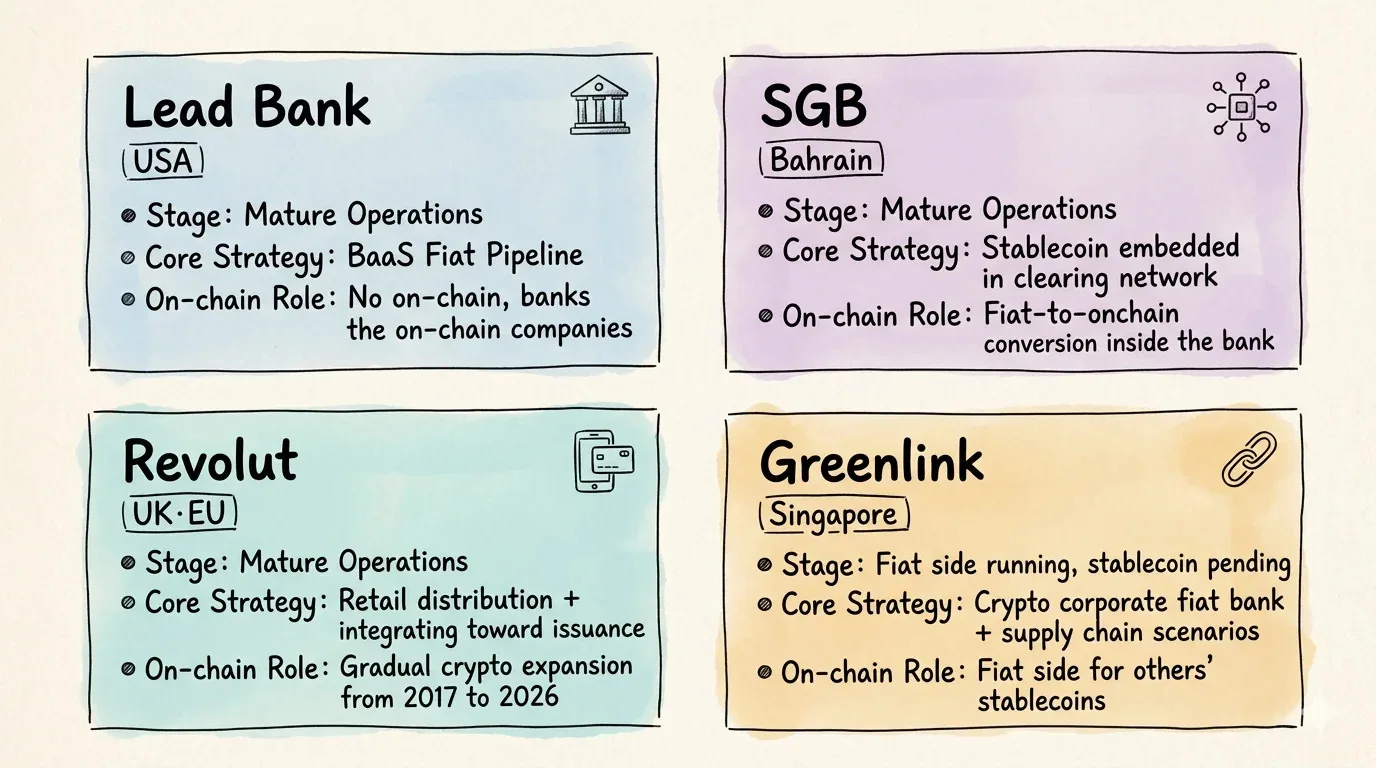
Put these four cases together and several common patterns emerge:
1. The Regulatory Environment Determines the Path
The United States has no dedicated legislation for crypto banking. Lead Bank follows a traditional bank charter plus BaaS model, finding room inside the existing framework.
Bahrain has the CBB’s Crypto-Asset Module and CASP licensing system. SGB operates directly under a dedicated legal framework.
The EU has MiCA. Once Revolut obtained its license, it gained a passport across Europe.
Singapore follows a gradual path: sandbox first, rules next, product implementation last. Greenlink’s fiat-side business is already operating, but a self-developed stablecoin must wait for greater clarity in MAS rules.
Whether banks want to do this is one thing. Whether regulators permit it, and how they permit it, is decisive.
2. The Deposit Fight Is the Underlying Logic
Returning to the opening point: stablecoins touch bank deposits. No matter which layer a bank enters, its response ultimately answers the same question: who gets the interest?

In a May 2026 report, McKinsey described a three-layer architecture: stablecoins at the top, tokenized deposits in the middle, and central bank money at the base. Both forms of on-chain money appear to be “digital dollars,” but their commercial logic is entirely different. Stablecoin reserves are short-term U.S. Treasuries; the issuer earns the spread, and holders receive no interest. Tokenized deposits remain on the bank balance sheet, can pay interest, and are backed by FDIC insurance. The GENIUS Act prohibits stablecoins from paying interest, while tokenized deposits are not subject to that restriction. This institutional difference determines where funds flow.
JPMorgan is the clearest example. In its April shareholder letter, it listed tokenization, stablecoins and smart contracts as “direct competitors” to banks. In June, it launched JPMD, a tokenized deposit token on Coinbase’s Base chain that can pay interest and has FDIC insurance. On one side, it opposes interest-bearing stablecoins; on the other, it issues an interest-bearing tokenized deposit of its own.
The GENIUS Act’s interest prohibition applies only to issuers; exchanges are outside its scope. Coinbase relies on that distinction to continue offering 3.5% yield on USDC balances, and Coinbase said this explicitly in its November 2025 letter to the Treasury. Section 404 of the CLARITY Act would close the gap by extending the prohibition to all digital asset service providers. The Senate Banking Committee passed it by a 15-9 vote on May 14, but the legislative process is not complete. Banks are pressing to close the gap, the crypto industry is resisting, and the outcome is not yet settled.
With that background, the choices of the four banks are easier to understand:
Lead Bank and Greenlink enter at the fiat infrastructure layer. They help crypto companies with the fiat side, do not touch on-chain activity, and earn tolls.
SGB cuts one layer deeper by embedding fiat-to-on-chain conversion into the bank clearing network. Customers complete conversion inside the banking system, so deposits do not leak out.
Revolut cuts deepest, moving from retail distribution to 1:1 zero-spread conversion and testing its own sterling stablecoin in the FCA sandbox. If issued, it would become a financial institution with both a banking license and stablecoin issuance capability.
The more layers a bank enters, the stronger its control over the on-chain money value chain and the wider its moat.
VI. Closing Thoughts
To return to the beginning: stablecoins are touching bank deposits, and banks’ responses are more complex than those of card networks. After reviewing these four paths, the point is already clear:
- Lead Bank became the fiat lifeline of the on-chain world during a vacuum created by regulatory swings;
- SGB embedded stablecoins into the bank clearing network under the certainty of Bahrain’s dedicated legislation;
- Revolut used an eight-year crypto strategy to reduce friction between fiat and on-chain assets for 75 million users to the lowest possible level;
- Greenlink provides fiat banking for crypto companies in Singapore and is waiting for clearer rules before taking the next step toward a self-developed stablecoin.
The regulatory environment determines which road a bank can take. The bank’s choice determines what the fiat entry point into the on-chain world looks like.
At this point, it is useful to step back to the bigger picture. The previous article covered card networks; this one covers banks. Card networks are changing the settlement layer: Visa is settling in USDC, and Mastercard is building MTN to connect multiple forms of digital money. Banks are changing the deposit layer by opening the channels between fiat and on-chain assets. The two layers are moving in different ways, but toward the same endpoint: on-chain settlement. When both the card-network settlement layer and the bank deposit layer have been rebuilt for on-chain settlement, stablecoins will move from being an external option in the payment system to being a built-in capability.
One other role appears repeatedly in this article but never fully steps to the front: payment companies. Lead Bank’s on-chain operations are performed by Bridge. SGB and Revolut rely on Circle for stablecoin minting and redemption. In the United States, Revolut is even a customer of Lead Bank.
Banks control the deposit layer, card networks upgrade the settlement layer, but the day-to-day on-chain execution is left entirely to payment companies.
In our next piece, we’ll look at exactly how these payment processors run their playbooks. If you have any questions about the licensing or payment compliance issues we’ve broken down so far, don’t hesitate to get in touch. Follow along, and let’s master the compliance game together.