

"Regulatory Momentum Accelerates: U.S. Government Ramps Up Action as CZ Speaks Out—Compliance Can No Longer Be Overlooked"
In recent years, the U.S. government has steadily deepened its oversight of the cryptocurrency industry. Since 2023, the regulatory approach has shifted from a focus on enforcement to one centered on structured development, aiming to establish a clear and predictable framework through legislation and formal policy. This trend has become even more evident since Trump returned to the White House, with regulatory efforts accelerating significantly.
This shift not only answers long-standing calls from within the industry but also creates new opportunities for compliant businesses. Regulations covering areas such as stablecoins, exchanges, staking services, and pension fund investments are gradually being introduced, signaling the crypto industry’s rapid integration into the mainstream financial system.
In this changing environment, compliance is no longer a nice-to-have—it is becoming the key entry point to the market. For companies planning to enter the crypto space, now is a crucial time to revisit their licensing strategies and align with the evolving regulatory landscape.
As U.S. Crypto Regulations Take Shape, Compliance Becomes a Non-Negotiable
Over the past three years, U.S. crypto regulation has steadily expanded across a growing number of sectors, with the overall framework becoming increasingly well-defined. Recent policy efforts have largely focused on the following key areas:
1. “The GENIUS Act”: A Regulatory Framework for Compliant Stablecoins
The GENIUS Act requires stablecoin issuers to hold 100% high-quality, liquid, and regulated reserve assets, and to operate within a federal or state regulatory framework. Issuance is limited to regulated entities, reflecting a clear intent to bring stablecoins under formal oversight. The Act also outlines core requirements around prudent operations, conduct standards, anti-money laundering (AML) compliance, and bankruptcy resolution.
As the U.S. framework solidifies, similar regulatory models are appearing globally. For instance, Hong Kong has proposed a Stablecoins Ordinance, and more jurisdictions are expected to follow with their own stablecoin regulations.
2. “The CLARITY Act”: Defining the Legal Status of Tokens
The new legislation introduces, for the first time, a definition for a “mature blockchain,” offering a practical standard for determining whether a token qualifies as a security. The jurisdictional boundaries between the CFTC and SEC are gradually becoming clearer, and services such as staking, decentralized exchanges (DEXs), and liquid staking tokens (LSTs) are beginning to see viable compliance pathways. However, once a project involves elements of an investment contract, it still falls under the scope of securities law.
3. Investor Protection and Market Access Reform
The U.S. Department of Labor has moved to allow 401(k) retirement plans to allocate a portion of funds to crypto assets—signaling that digital assets are beginning to enter the multi-trillion-dollar pension market. At the same time, the definition of a qualified investor is also set for reform. Rather than being based solely on asset thresholds, investor eligibility may soon be determined through a knowledge-based exam, significantly broadening the potential investor base for crypto-focused private funds.
In addition, the BITCOIN Act has proposed the establishment of a U.S. strategic Bitcoin reserve. The SEC has already approved spot Bitcoin and Ethereum ETFs and is gradually easing restrictions on applications for staking-based funds. These developments point toward a future in which a growing number of mainstream financial products are linked to compliant crypto assets.
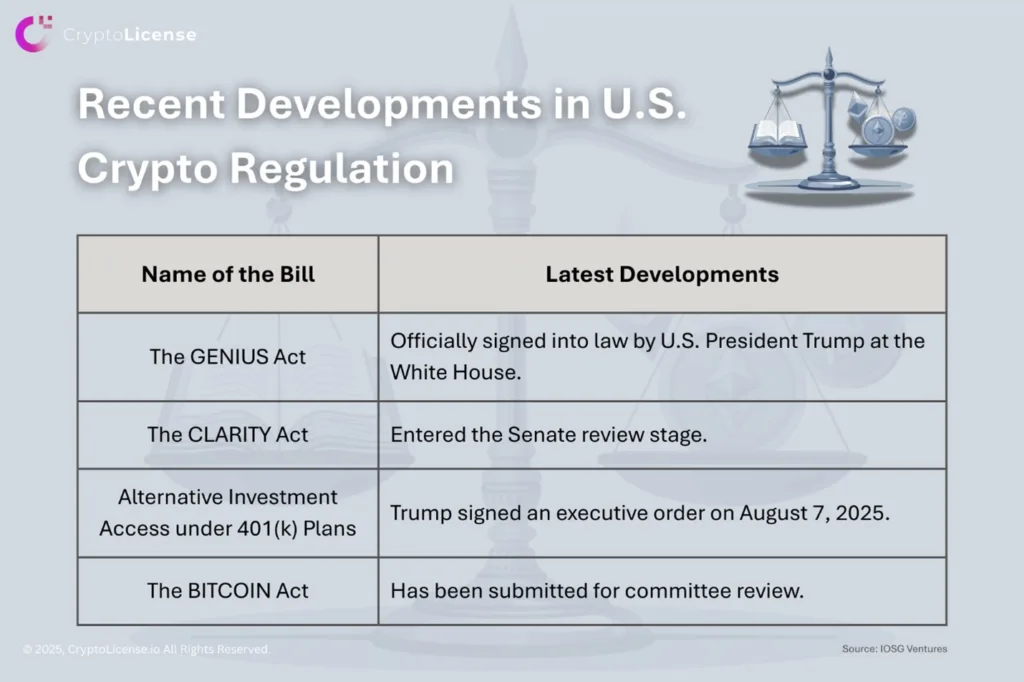
These developments send a clear message: the U.S. is institutionalizing the crypto industry and integrating it into the mainstream financial system. In this new landscape, those who secure regulatory licenses early will be best positioned to lead.
From NFTs to Family Tokens: The Trump Family’s Full-Scale Move into Crypto
As the U.S. regulatory framework around crypto becomes clearer, the Trump family’s repeated public support for the industry is also sending a strong political signal.
According to Bloomberg, the Trump family has already ventured into multiple areas of the crypto space—including non-fungible tokens (NFTs), Bitcoin mining, and even the launch of a personal cryptocurrency. Donald Trump himself has repeatedly emphasized the importance of blockchain and Bitcoin. In speeches, he has suggested that the U.S. should consider building a strategic Bitcoin reserve to hedge against inflation and geopolitical risks.
Donald Trump Jr. has also publicly endorsed Bitcoin on several occasions, calling it a new form of financial sovereignty. His vocal support is widely seen as an extension of the Trump family’s growing involvement in crypto.
These political signals highlight a key shift: crypto assets are now firmly on the U.S. policy agenda. For businesses looking to capitalize on future regulatory tailwinds, early planning around compliance and licensing is essential in order to seize first-mover advantages as new policies roll out.
CZ’s Latest Speech in Hong Kong: Navigating the Challenges of Regulatory Complexity
At the industry level, Binance founder CZ recently made a rare public appearance in Hong Kong, where he spoke about the challenges posed by regulatory complexity.
He noted that the rapid adoption of stablecoins is largely due to their ease of circulation and strong user experience. However, some countries may take a stricter stance on regulation and oversight.
Looking ahead to the future of exchanges, CZ emphasized that from a technical perspective, there is no fundamental difference between trading crypto-native assets and real-world assets (RWAs). The real dividing line lies in compliance: which regulatory body you need to apply to for a license, and whether you’re able to obtain approval. Once licensing is secured, technical barriers become relatively minor.
CZ’s insights make one thing clear. Compliance is not a hurdle — it’s a competitive advantage. Whether it’s stablecoins, DEXs, staking, or lending services, only those who prepare early on the licensing front will be positioned for long-term survival and growth in a highly competitive and uncertain regulatory environment.
Lead with compliance — Start your licensing strategy today with CryptoLicense.
From both a policy and market perspective, the U.S. regulatory landscape is accelerating rapidly:
- Stablecoins now depend on licensed issuance to access mainstream payment and clearing systems.
- Exchanges and custodians are clearly required to undergo registration and regulatory review.
- Staking, lending, and yield-bearing products fall under securities law if they exhibit characteristics of investment contracts.
- Pension funds, ETFs, and investment banks are entering the space—but only through fully licensed, compliant channels.
This marks a fundamental shift: compliance licensing is no longer a nice-to-have, but a basic prerequisite for entering the U.S. market. For payment-focused stablecoin issuers, DEX platforms, cross-border payment providers, and digital asset management firms, operating without a license will soon be unsustainable under tightening regulatory pressure.
More importantly, now is the optimal window for early movers. While the U.S. framework is becoming clearer, the competitive landscape is still forming. Companies that secure licenses early will be among the first to legally interface with institutional capital, serving as critical “bridges” between crypto innovation and mainstream finance. This first-mover status will translate into a lasting competitive edge.
At this pivotal moment, choosing a trusted compliance partner is essential. CryptoLicense has deep expertise in the regulatory logic and licensing requirements of all major jurisdictions. We offer end-to-end compliance solutions—from early-stage planning and document preparation to efficient execution and approval. Our focus isn’t just on getting clients any license, but on securing the right license that aligns with your business goals.
The sooner you act, the more control you gain. Contact us today to begin your licensing journey. With CryptoLicense by your side, you’ll enter the market with confidence, scale with compliance, and position your business to lead in the next wave of crypto innovation.