
On-Chain US Stocks Are Taking Off: 10 Compliance Issues You Need to Know
Since June 2026, the on-chain U.S. equities sector has become crowded fast.
- Binance launched trading services for 7,000 U.S. stocks in Abu Dhabi and introduced bStocks as on-chain tokens;
- Bitget opened 24/7 U.S. stock trading during the same period. Its rToken assets exceeded USD 50 million within two weeks, while its Pre-IPO product line surpassed USD 110 million in aggregate size, linked to SpaceX and OpenAI;
- Robinhood launched tokenized U.S. stocks in the EU, while Kraken integrated xStocks, covering more than 60 underlying assets.
The market is heating up, but the models differ sharply. Binance is using the FSRA prospectus route in Abu Dhabi. Bitget relies on Alpaca as broker and custodian for the underlying shares. Kraken connects to Backed Finance’s xStocks for on-chain circulation on Solana. Bitfinex chose El Salvador’s DASP license. Robinhood deployed in the EU on Arbitrum. All of these are described as “on-chain U.S. equities,” but their underlying logic is very different.
If you plan to enter this market, there are 10 compliance questions worth answering first.
The sequence matters. Start with the business model and the legal nature of the product. Then work through the asset structure, legal setup, jurisdiction, role allocation, custody of the underlying assets, and geographic restrictions. Only after that should you decide on the technical stack and any expansion of the business scope.
In this article, each question is unpacked through real cases and translated into practical judgments.
I. Is It Stock Tokenization, or a Stablecoin On-Ramp for Buying U.S. Stocks?
This is the first question to answer, because it determines every compliance path that follows.
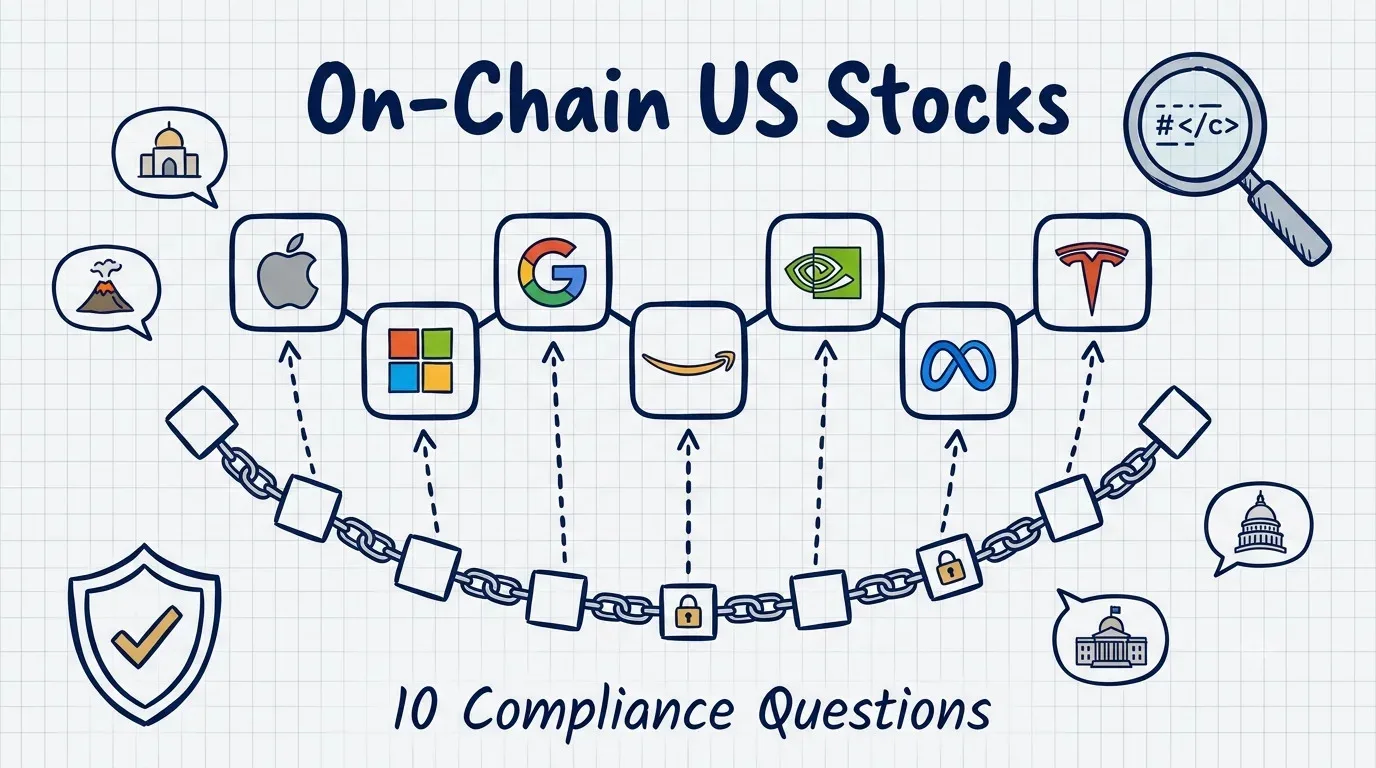
Putting stocks on chain means turning real equity interests into on-chain tokens, with each token backed by real shares. Kraken’s xStocks follows this model. It is issued in Switzerland by Backed Finance, with each token corresponding to one real share custodied by a Swiss licensed custodian. The core issue is asset tokenization, and the compliance chain to solve is issuance, custody, registration and redemption.
A stablecoin entry point for buying U.S. stocks means users fund with USDT or USDC, but the underlying transaction still runs through a traditional brokerage channel. The stock itself is not on chain; only the funding entry point is. BIT follows this model: users place orders with stablecoins, the orders are executed through Alpaca Securities LLC, and the shares are custodied by a licensed clearing company under Alpaca. Users hold real equity interests; the stablecoin is only the funding tool.
The two models have different compliance paths. Putting stocks on chain requires securities issuance compliance: prospectus, issuer, custody and transfer restrictions. A stablecoin entry point for buying U.S. stocks requires cross-border securities brokerage compliance: broker-dealer licensing, segregation of client assets, AML for stablecoin funding and foreign-exchange compliance. If you mix them up, many avoidable problems may follow.
II. What Is the Legal Nature of the Product Given to Users?
The same phrase, “on-chain US equities” can leave users holding three very different things.
- Real equity ownership: the user directly holds shares, appears on a shareholder register, and has voting and dividend rights. BIT gives users this type of exposure: users place orders with stablecoins, and real shares are held through a licensed broker underneath. Binance’s U.S. stock trading service also falls into this category. Trades are matched through Nest Trading, Alpaca Securities handles clearing and custody, and users hold real equity interests.
- Tracker certificates: issued by a third party and backed by real shares, but the user does not hold equity. The user holds a debt claim against the issuer. xStocks follows this model. Kraken’s product documentation makes clear that xStocks holders do not enjoy traditional shareholder rights and only obtain price exposure to the underlying asset. Backed Finance uses a tracker certificate legal structure in Switzerland, which is essentially a form of structured note. Binance’s bStocks also fall into this category: users mint on-chain tokens from the real shares they hold, but the tokens are issued by BTech Holdings Limited and are legally categorized as “certificates representing specified financial instruments.” Users do not enjoy traditional shareholder voting rights.
- Derivative contracts: the user enters into a contract with the platform that tracks movements in the stock price, without delivery of real shares. Robinhood’s Stock Tokens in Europe follow this model. Robinhood defines the product in the EU as a derivative. The advantage is a clearer compliance boundary; the downside is that the token does not represent real equity ownership.
These three product types require different licenses. Real equity ownership requires broker-dealer licensing and a transfer agent. Tracker certificates require issuance documents and prospectus approval. Derivatives require a MiFID II investment services license. You must first decide what you are giving the user before you can determine which licenses are required.
III. What Is the Difference Between DLT Registration and a Token Wrapper?
This is a question many people have asked, and it is also one of the easiest concepts to confuse.
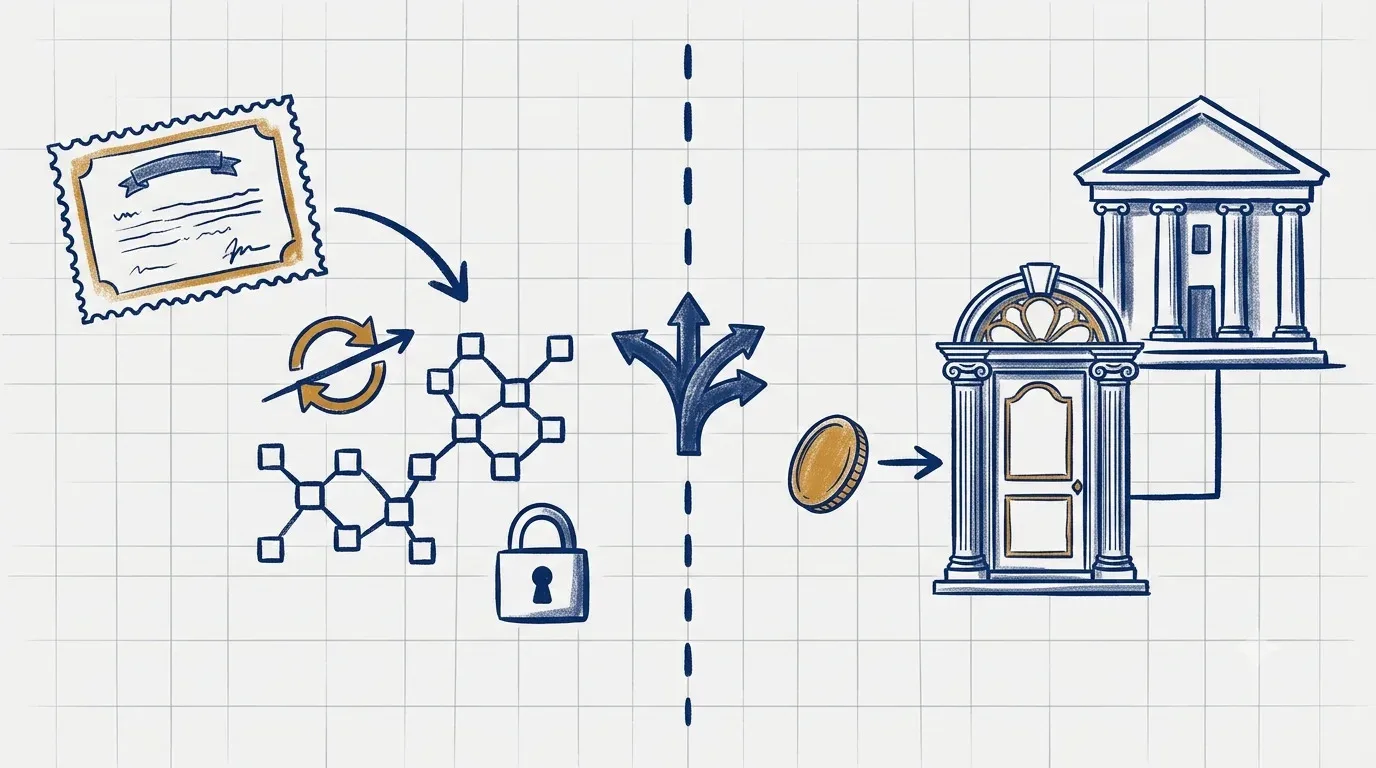
- DLT (distributed ledger technology) registration means the blockchain itself is the ownership register. Transfers, holdings and changes in ownership of shares are recorded on chain, and the on-chain record is the legally recognized evidence of title. This is the route being tested by the UK Financial Market Infrastructure Sandbox, or FMI Sandbox, and by the Nasdaq and NYSE tokenized settlement pilots approved by the U.S. SEC: the exchange registration system itself moves on chain, and clearing and settlement of shares are completed on chain.
- A token wrapper means the on-chain token is only a legal or technical wrapper; the actual ownership register is maintained elsewhere. Backed Finance’s bTokens follow this model: the on-chain token can be transferred freely, but ownership of the underlying shares is recorded in the issuer’s traditional books and maintained by a transfer agent. Tokenholders have a debt claim against the issuer, not direct ownership of the shares.
The compliance level is different. DLT registration must answer whether blockchain records have legal effect, which involves fundamental changes to registration rules and securities law. A token wrapper follows the traditional securities issuance path, with an additional layer of on-chain circulation.
Most entrants are in fact building token wrappers, not DLT registration. Once you understand this point, you will know that the compliance focus is on issuance documents and issuer qualifications, not on changing registration law.
IV. What Does an SPV Solve, and Does It Equal Compliance?
An SPV, or special purpose vehicle, is the most common legal structure for on-chain U.S. equities, but it is not a cure-all.
The core problem an SPV solves is asset segregation. The issuer sets up an SPV, places the underlying shares into it, and then has the SPV issue tokens. In theory, if the issuer becomes insolvent, the shares inside the SPV are not affected. xStocks has this layer in its structure: Backed Finance holds the underlying shares through an SPV, and tokenholders have a debt claim against the SPV.
But an SPV does not solve the following issues:
- Sales licensing: the SPV may hold the shares, but where you sell the product and to whom you sell it still requires an investment services license or distribution authorization.
- Investor suitability: MiFID II in the EU requires suitability or appropriateness assessments for retail investors. An SPV cannot bypass that requirement.
- Cross-border enforcement: if your SPV is in the Cayman Islands and tokens are sold to Hong Kong users, the Hong Kong SFC can still assert jurisdiction. An SPV segregates asset risk; it does not segregate cross-border regulatory risk.
- Redemption mechanism: whether users can redeem, how they redeem, and who is responsible if redemption fails must all be stated clearly in the issuance documents. Some SPVs provide redemption paths with high thresholds, such as minimum quantities, cooling-off periods and renewed KYC. Others do not provide redemption at all.
An SPV is necessary, but far from sufficient. It is an asset container. It does not solve sales licensing, investor suitability, redemption or cross-border enforcement.

V. How Should You Choose a Jurisdiction and Licensing Path?
At present, only a limited number of jurisdictions have truly workable paths for on-chain U.S. equities. Four are worth highlighting, each with different routes and thresholds:
- El Salvador: the threshold is relatively low. Bitfinex Securities and Bitget both obtained DASP, or digital asset service provider, licenses there. It is suitable for getting started quickly, but if you want to cover European or Asian users, the cross-border recognition of an El Salvador license may not be enough.
- Abu Dhabi (ADGM): the jurisdiction chosen by Binance. ADGM has clear classifications for tokenized securities, including Approved, Recognised and Regulated routes. Binance built two layers there. The first layer is traditional U.S. stock trading, providing real equity exposure through Nest Trading and Alpaca Securities. The second layer is bStocks, where BTech Holdings Limited issues on-chain tokens through the FSRA prospectus route, with tokens deployed on BNB Chain. The threshold is higher than in El Salvador, but the compliance depth is also stronger.
- European Union (MiCA + MiFID II): the jurisdiction chosen by Robinhood. Robinhood obtained a brokerage license in Lithuania, defines Stock Tokens as derivatives, and issued more than 500 U.S. stocks on Arbitrum. xStocks follows another route: distribution across Europe in the form of tracker certificates under a Base Prospectus approved by the Liechtenstein FMA, the Financial Market Authority. EU compliance costs are the highest, but once the path works, it covers 30 EEA, or European Economic Area, countries.
- Switzerland: the jurisdiction chosen by Backed Finance. Switzerland’s DLT Act was among the first laws globally to recognize the legal effect of blockchain-based registration. Backed issues bTokens in Switzerland and distributes them across Europe through a Liechtenstein prospectus. Switzerland mainly serves as the place of issuance, not the primary market.
The core logic for choosing a jurisdiction is usually to first identify where your target users are, then work backward to determine which jurisdiction’s license can cover that market. In practice, avoid doing it the other way around by getting a license first and then looking for users. That wastes time.
VI. Who Is the Issuer, and Who Bears Distribution Liability?
Many CEX and wallet platforms ask: if I am only an entry point and the token is issued by someone else, can I avoid liability?
The answer is: not necessarily.
Look at Bybit. The issuer of xStocks is Backed Finance, not Bybit. Bybit’s role is “distributor.” But in this chain, Bybit assumes at least four responsibilities: user access and KYC, marketing and promotion, trading and liquidity, and refunds and customer support. In that situation, regulators are likely to view Bybit as a “financial product distributor” or “investment services provider,” even if Bybit is not the issuer.
The SpaceX token subscription incident illustrates the point. When the SpaceX token subscription on Bybit was oversubscribed, users went to Bybit for refunds and allocation issues. No one went to Backed Finance. Bitget’s situation in El Salvador is similar: the platform displays rToken products at the front end, and users’ first point of contact and trust anchor are both Bitget.
The compliance bottom line is this: if you provide user access, KYC, marketing and customer support, it is difficult to say, “I am only a technology provider.” Distribution responsibility must be considered in advance. Do not wait for problems before discussing allocation of liability
VII. How Do You Solve Custody and Verification of the Underlying Shares?
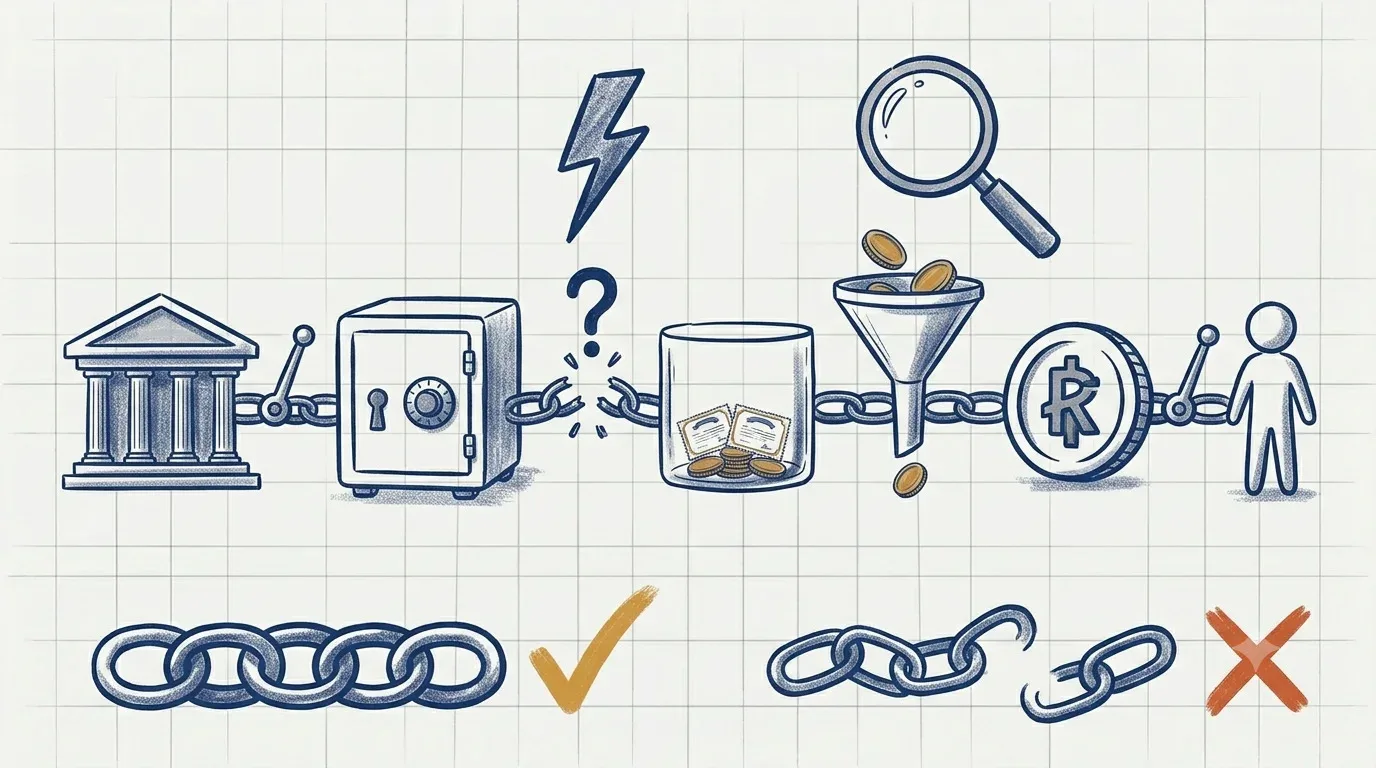
“1:1 backed” is not a conclusion that can be proven by one sentence. It must be assessed across four layers:
- Who is the custodian: is it a licensed third-party custodian? The underlying shares for xStocks are custodied by a licensed custodian in Switzerland, separated from the issuer, Backed Finance. If the underlying shares are held by the platform itself, the shares may enter the insolvency estate if the platform goes bankrupt.
- In whose name is the custody account held: is it an SPV account or the platform’s own account? An SPV account is currently relatively safer because the assets are segregated. A platform proprietary account is the riskiest structure, because users are only ordinary creditors of the platform.
- Is there third-party proof: is there an independent audit or attestation proving that the underlying shares really exist? Backed Finance’s approach is to publish regular comparisons between underlying holdings and on-chain token supply. Without third-party proof, “1:1 backed” is only the platform’s own statement.
- What are the redemption rules: can users redeem tokens for real shares or cash? xStocks provides a redemption mechanism, but only qualified investors can redeem directly through Backed Finance; retail users can only sell on the secondary market. Gate.io’s tokenized stocks do not have publicly available redemption-rule documents.
If any of these four layers is missing, the claim of being “1:1 backed” may not stand on very solid ground.
VIII. How Do You Enforce Geographic Restrictions On Chain?
Kraken’s xStocks expressly exclude users in the United States, Canada, the United Kingdom and Australia. That geographic exclusion list is itself a compliance signal: these are the jurisdictions with the strictest regulation and the highest likelihood of pursuing cross-border sales liability.
But on-chain tokens create a problem that traditional securities do not have. Once a token is on chain, in theory anyone can obtain it through a DEX or a non-custodial wallet. The Wall Street Journal reported that xStocks could circulate on anonymous platforms or platforms subject to weaker regulatory standards, raising concerns about market manipulation and regulatory arbitrage.
Entrants must solve geographic restrictions at two levels:
Platform level: implement IP restrictions, KYC verification and geolocation checks in your CEX or app. This is basic.
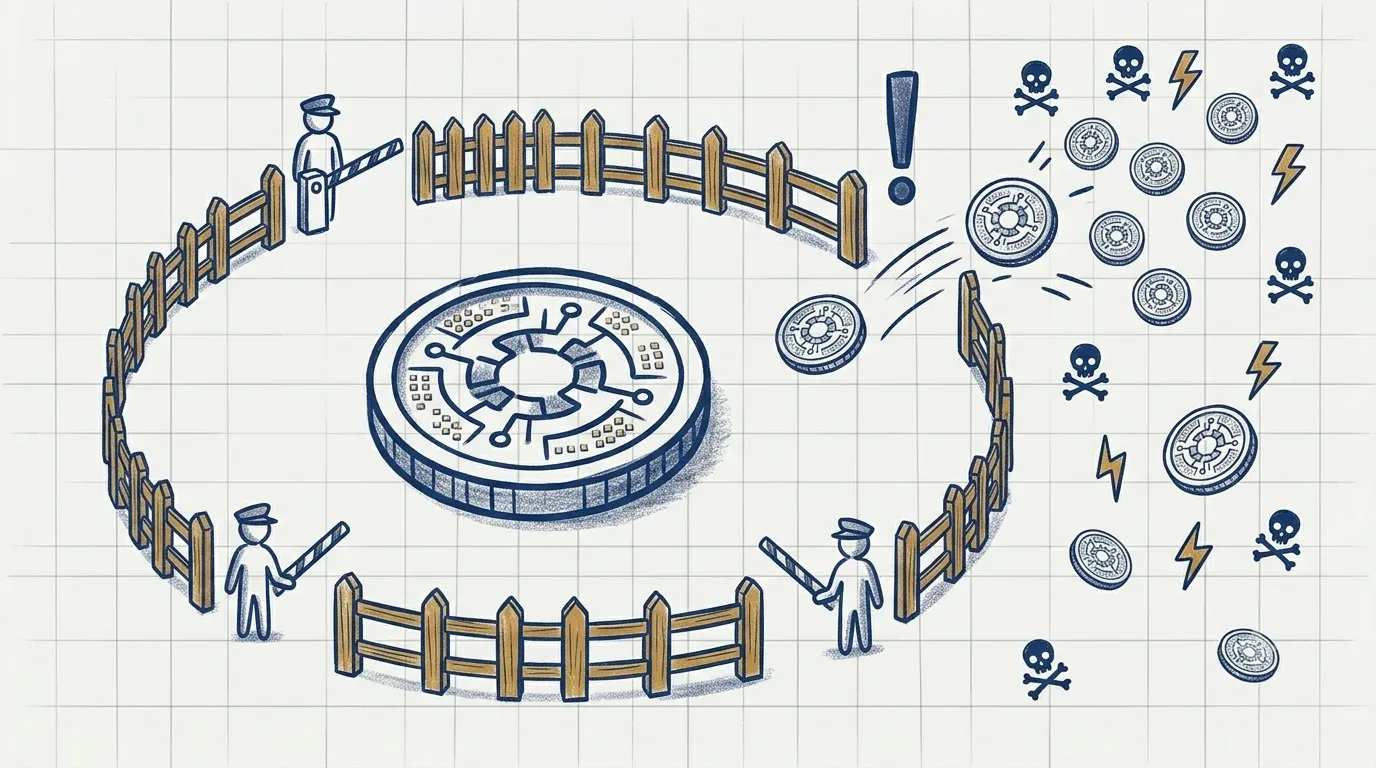
Token level: does the token itself have a transfer restriction mechanism? For example, a whitelist contract could allow only KYC-approved addresses to receive tokens. Backed Finance’s bTokens implement transfer restrictions at the technical level. If your token has no on-chain transfer restrictions, geographic restrictions are only a thin layer at the platform level. Once the token circulates on chain, you lose control.
Geographic restriction is not a checkbox that says “exclude users from certain regions.” It is a technical compliance issue that must be considered from the product design stage.
IX. Does Using Alpaca or Dinari Make You Compliant?
Many people ask: if I use licensed infrastructure such as Alpaca or Dinari, does that mean I do not need my own license?
Alpaca Securities LLC is a U.S.-registered broker-dealer that provides securities trading APIs. BIT uses Alpaca: users place orders with stablecoins, orders are executed through Alpaca, and shares are custodied by Alpaca’s licensed clearing company. Dinari follows a different path: it obtained SEC transfer agent registration and uses blockchain for stock registration and transfer, following a complete broker-dealer plus transfer agent route.
Using this infrastructure is indeed closer to traditional regulatory language than building everything from scratch. But several key points matter:
What is your relationship with the infrastructure provider: are you their introducing broker, or merely an API customer? If you are the former, you may need your own brokerage license. If you are the latter, underlying securities compliance sits with the infrastructure provider, but your front-end access point and funds compliance remain your own responsibility.
Where are your users: Alpaca’s license is with the U.S. SEC, but if your users are outside the United States, you still need to satisfy cross-border business requirements in the users’ jurisdictions. Alpaca’s license covers underlying securities execution and custody. It does not cover your distribution and marketing activities in the user’s jurisdiction.
Stablecoin funding: even if you use Alpaca for the underlying securities layer, stablecoin funding is itself a separate compliance issue. If a user funds with USDT, the movement of funds from the user to the Alpaca account may trigger payment, foreign exchange, AML or capital control compliance.
Using infrastructure helps solve the underlying securities execution and custody issues. But front-end access, distribution and funds compliance remain your own licensing and compliance responsibilities.
X. Can You Offer Pre-IPO or Unicorn Exposure?
The OpenAI and SpaceX token incidents served as a warning to the whole industry.
The SpaceX token on Bybit was oversubscribed, but the final allocation was far below user expectations, leading to many complaints about refunds and compensation.
Earlier, Robinhood launched OpenAI tokens in Europe, claiming to give ordinary investors Pre-IPO exposure. OpenAI then publicly stated that Robinhood’s OpenAI token did not represent OpenAI equity and had not been authorized or endorsed by OpenAI.
Offering Pre-IPO exposure requires answers to three questions:
- Has the company authorized it: private company equity is subject to shareholder agreements, and transfers usually require consent from the company and other shareholders. If a platform issues an “equity token” without company authorization, it is essentially selling a derivative with no underlying asset support. The OpenAI incident is the classic example: the company directly denied the token, and the token price fell immediately.
- Where does the valuation come from: private companies do not have continuous prices in a public market. OpenAI and SpaceX valuations come from pricing in non-public financing rounds, but valuation changes between two rounds are a black box. Is the “valuation” provided by the platform its own judgment, or has it been verified by a third party?
- What does the user hold during the subscription stage: before the token is actually minted and allocated, the user’s subscription request is only a pending order. The SpaceX incident shows that at the subscription stage, the user has not received shares or tokens, only a place in an allocation queue. If the final allocation is insufficient, how are refunds handled and what happens to interest on the funds?
Pre-IPO exposure can be offered, but it must have company authorization, a reliable valuation source and clear disclosure to users about the status of their rights during the subscription stage. Without those three elements, the product is only selling a concept with no underlying support.

XI. Closing Thoughts
On-chain U.S. equities are one of the RWA categories closest to money, and also one of the categories where technical narratives can most easily obscure compliance risk. The sector is still too new for many questions to have ready-made answers, but the direction is clear:
First decide the legal nature of the product being given to users, then determine the underlying architecture and structural design, then choose the jurisdiction and allocate roles, and only then move to technology selection and business expansion.
If the order is reversed, the result may be twice the effort for half the outcome.
The regulatory environment is also changing quickly. The UK FMI Sandbox is testing the legal effect of DLT registration, EU MiCA is fully in force, Abu Dhabi’s ADGM is refining classifications for tokenized securities, and the SEC is advancing tokenized settlement pilots. Each regulatory change is redefining the compliance boundary.
If you are already building, or preparing to build, an on-chain US stocks business, CryptoLicense can work with you to think through the product structure, licensing path, and compliance setup needed to bring it to market. Feel free to reach out if you would like to discuss.