

Bhutan's GMC: The Emerging Crypto Jurisdiction Quietly Gaining Ground
When most people think about crypto-friendly jurisdictions, Singapore and Dubai come to mind first. But a smaller, less obvious name has been quietly entering the conversation this year: Bhutan.
This is a country that was once the world’s third-largest sovereign holder of Bitcoin, has established a Special Economic Zone with a 0% corporate tax rate, and has already seen Matrixport become the first company to obtain a local Financial Services Permit (FSP). Whether you are looking at national-level crypto reserves or at practical routes for business incorporation, Bhutan deserves a closer look.
This article provides a comprehensive overview of Bhutan’s crypto regulatory landscape, including its distinctive dual-track system, the genuine appeal of its tax structure and legal transplant mechanism, and the risks and uncertainties that any serious operator needs to understand before making a decision.

Ⅰ. From 'Gross National Happiness' to Sovereign Bitcoin Mining
Most people’s first association with Bhutan is the Gross National Happiness (GNH) index, a country that enshrined wellbeing in its constitution. Nestled along the southern slopes of the Himalayas, with a population of under 800,000 and an economy long anchored by agriculture and hydropower, it has hardly looked like a crypto hub.
And yet, this is the country that once held more Bitcoin than almost any sovereign entity on earth. The story starts with electricity.
Over 90% of Bhutan’s power comes from hydroelectricity. During high-flow seasons, the country generates more power than it can use, and mining cryptocurrency with that surplus is one of the most direct ways to monetize it. Bhutan’s sovereign wealth fund, DHI (Druk Holding and Investments), partnered with Bitdeer to establish a mining operation, accumulating approximately 13,000 BTC by October 2024. Since early 2025, the position has been gradually reduced to around 3,954 BTC, with market speculation linking some of the sell-off to a royal pledge to allocate funds toward GMC Special Economic Zone development.
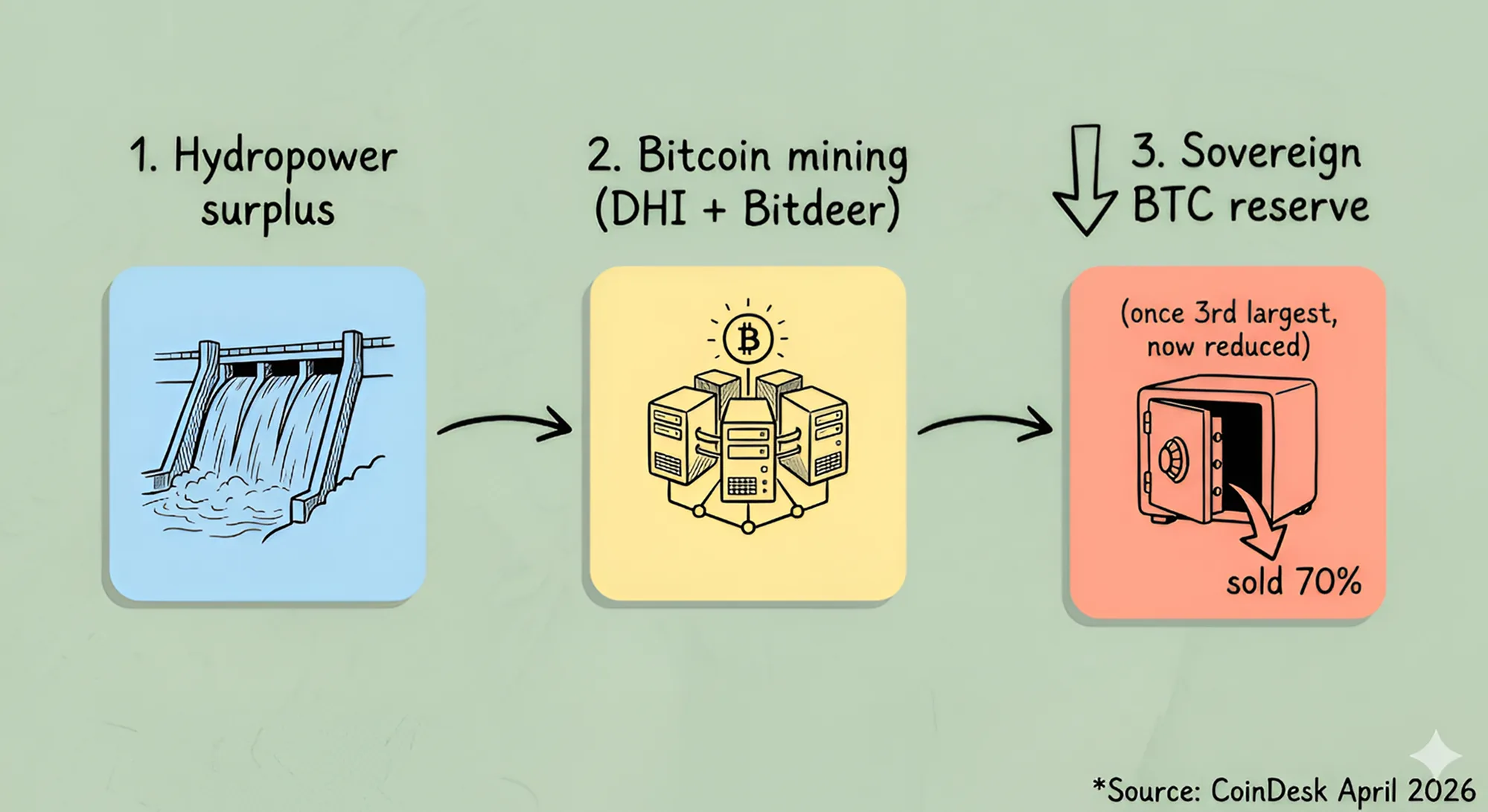
But sovereign mining alone is not enough to attract international businesses. Companies do not relocate because a country holds a lot of Bitcoin. What Bhutan has built is a structured institutional vehicle for crypto businesses to enter, operate, and scale compliantly. That vehicle is the Gelephu Mindfulness City, or GMC.
Located in southern Bhutan, the GMC received its Royal Charter in 2024 and operates with a high degree of administrative, legislative, and judicial autonomy. The defining features are concentrated within the GMC: 0% corporate tax, an FSP licensing framework, and a legal system directly transplanted from Singapore and ADGM. Once you understand those structural features, the pattern of who is already building there starts to make sense.
Ⅱ. Who Is Already Operating in Bhutan
Based on publicly available information, the following entities have established or are actively building a footprint in Bhutan’s crypto ecosystem.
- Matrixport
Currently the only company to have formally obtained an FSP license from the GMCA, Matrixport received In-Principle Approval (IPA) in December 2025 and converted to a full license in February 2026. The approved scope covers structured products, real-world assets (RWA), prime brokerage, and custody services.
Its RWA platform MatrixDock has also been appointed by the GMCA as a technical partner for TER, a tokenized gold product currently in development.For firms evaluating this path, Matrixport’s journey is the only end-to-end precedent available, from submission through to license issuance. That said, Matrixport is a large, well-resourced institution with an established compliance infrastructure. Its approval timeline should not be taken as a reliable benchmark for smaller applicants.
- OxPay Financial
A Singapore-listed company focused on crypto payments and B2B financial services, OxPay has received GMCA approval and represents the payments segment of the emerging ecosystem.
- DK Bank
A local digital bank headquartered in Thimphu, DK Bank operates as an onshore entity with a structurally unique role: it functions as the bridge between fiat currency and crypto assets. When tourists use Binance Pay for purchases, DK Bank handles the settlement on the back end, converting crypto to Bhutanese Ngultrum (BTN) or Indian Rupee (INR) before it reaches the merchant. The merchant never touches the crypto. This design is worth examining more closely, and we return to it in the dual-track section below.
Bitdeer and DHI Joint Mining Operation
Operating facilities in Gedu and Jigmeling, this venture is not connected to the FSP licensing framework, but any serious discussion of Bhutan’s crypto ecosystem has to acknowledge it. It is worth noting that the mining operation has shown signs of a slowdown in recent months.
Taken together, the Bhutan crypto ecosystem is still in early formation:- Two licensed entities (Matrixport, OxPay)
- On active technical collaboration (MatrixDock / TER)
- Two core operational entities (DHI mining, DK Bank)
The coverage spans trading, custody, payments, RWA, fiat channels, and mining. The scaffolding of an ecosystem is visible, but the distance from here to a mature market remains significant.
Ⅲ. The Dual-Track System: Strict Control Alongside an Open Zone
Understanding Bhutan’s crypto regulatory architecture requires grasping one central concept: the dual-track system.
First-time observers often find Bhutan’s approach contradictory. How can a country simultaneously hold sovereign Bitcoin reserves and restrict crypto access for its own residents? The answer lies in the fact that Bhutan has built two structurally separate systems, and the separation is deliberate.
(A) The Onshore Track: Not Banned, But Tightly Controlled
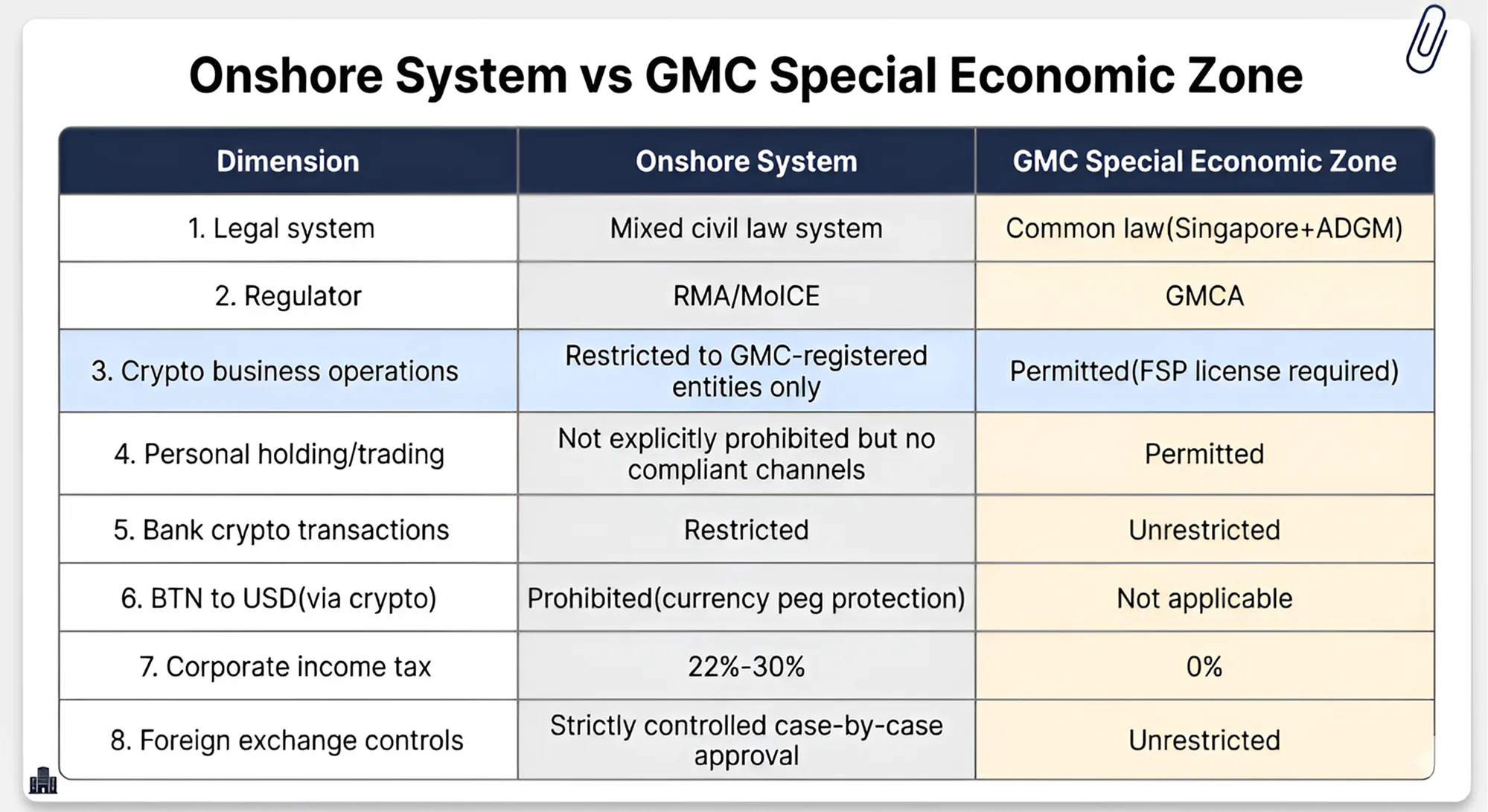
The onshore regulator is the Royal Monetary Authority (RMA). On 30 May 2025, the RMA published its formal regulatory position on crypto assets, establishing two key constraints: crypto mining and trading activities are restricted to entities registered in the GMC and their approved counterparties, and crypto transactions conducted through RMA-regulated domestic banks will continue to face restrictions.
In practical terms, this means:
- Domestic banks cannot facilitate crypto transactions, so there is no onshore fiat on-ramp or off-ramp
- Crypto activity is limited to the GMC, with no compliant exchanges or OTC desks operating onshore
There is an additional layer: the Bhutanese Ngultrum (BTN) is pegged 1:1 to the Indian Rupee (INR), and the RMA prohibits residents from using crypto to convert BTN into USD, in order to protect the currency anchor.
The practical result is that while individual ownership or trading of crypto is not legally prohibited, the channel-level restrictions make meaningful, compliant participation nearly impossible for onshore residents. The RMA’s objective is to protect monetary sovereignty and financial stability, not to prohibit personal crypto ownership.
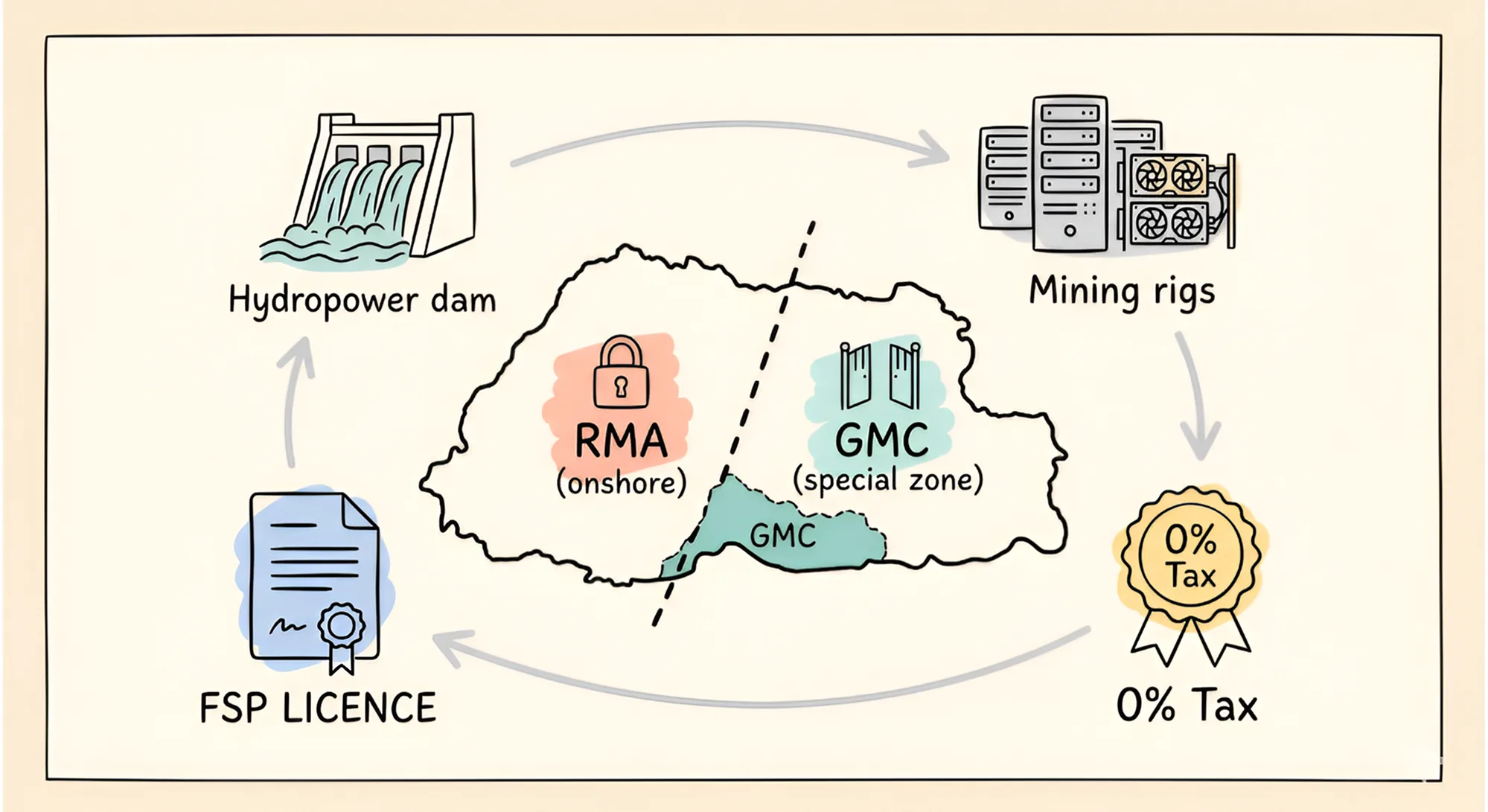
(B) The GMC Track: Fully Open, With a Licensing Requirement
The GMC operates under an entirely different framework:
- Legal foundation: 12 Singaporean statutes and 10 ADGM financial regulations, directly transplanted under common law
- Regulator: the GMC Authority (GMCA)
- Licensing requirement: any entity conducting financial services activity within the GMC must obtain a Financial Services Permit (FSP), issued under the Financial Services and Markets Regulations 2015 (FSMR), the same framework used in ADGM
The core attractions of the GMC are straightforward:
- 0% corporate income tax and 0% capital gains tax, subject to meeting substance requirements
- Free flow of foreign exchange, with support for multi-currency accounts and stablecoin settlement
- Legal framework aligned with Singapore and Abu Dhabi, providing strong regulatory certainty
- Target sectors: Web3, fintech, and DeFi
(C) The Dual-Track in Practice: The Tourism Payment Case
Bhutan’s crypto tourism payment system illustrates the underlying logic of the dual-track design better than any abstract explanation.
The full flow works as follows: a tourist pays using Binance Pay, DK Bank receives the payment, a liquidity provider executes an instant conversion in the background, and the merchant receives BTN or INR. At no point does the merchant touch a crypto asset. Local residents are not exposed to price volatility. The risk sits with DK Bank and the offshore liquidity provider.
This design satisfies tourist payment demand while preserving the RMA’s constraints on bank-level crypto activity and the currency peg. That is the GMC dual-track in its clearest form: open to innovation on one side, isolated from systemic risk on the other.
(D) The Logic Behind the Architecture
The design principle is not difficult to follow. Protect monetary sovereignty onshore, attract crypto capital through the GMC, and maintain a firewall between the two so that crypto-side risk does not transmit into the domestic financial system. The table below summarizes the key differences between the two tracks.
IV. Risks That Cannot Be Ignored
The 0% tax rate and transplanted legal framework are genuinely attractive. But there are several material risk factors that any operator must understand before committing to this path.

1. No Independent Appeals Channel Yet
Under Article 11 of the Application of Laws Act 2024, the GMC has not yet established an independent judiciary. Both administrative and judicial functions are currently exercised by the GMCA itself. If an FSP application is rejected, or if a firm disputes a regulatory action, the appeals process runs through the same authority that made the original decision.
In the near term, approvals may lean more permissive. The risk emerges in the medium to long term, when regulatory standards tighten — and firms find they lack an independent channel for recourse. This stands in contrast to ADGM, where the ADGM Courts operate independently from the financial regulator FSRA.
2. Fiat Channels Are Narrow
There are two layers of constraint here, and both matter. At the structural level, the BTN-INR 1:1 peg is foundational to Bhutan’s financial system. Any attempt to use the GMC as a workaround for onshore foreign exchange controls, or to convert BTN to USD, will not work. At the infrastructure level, DK Bank is currently the only entity capable of bridging fiat and crypto, and USD clearing depends on upstream correspondent banking relationships.
If DK Bank encounters difficulties, or if those correspondent relationships are disrupted, fiat access breaks down. Business models built on Bhutan’s GMC need to account for both layers of this constraint explicitly.
3. The GMC Is New, and Precedents Are Limited
The Royal Charter grants the GMC a high degree of autonomy, but the institution is barely a year old. The GMCA’s execution capacity and policy continuity have not had time to be tested. With only two FSP licenses issued to date, approval standards and processes are still being established, and uncertainty remains high.
It is also worth noting that the IMF has signaled a cautious view on Bhutan’s crypto strategy. Evaluations by international bodies can influence future policy direction, and that is a variable operators cannot fully control.
V. Closing Thoughts
That covers the broad landscape of Bhutan’s GMC and its crypto licensing environment. The 0% tax rate combined with Singapore-derived legal infrastructure is a real draw, and Matrixport has demonstrated that the FSP path is workable.
That said, as an emerging jurisdiction, the combination of limited precedent, a single-point-of-failure in fiat infrastructure, and an early-stage regulatory institution means the uncertainty premium here is real. If Bhutan is on your list, it is worth working through those constraints carefully before committing resources.
In Part 2, we will go deeper on the FSP application itself — the qualification thresholds, the procedural steps where applications typically get stuck, and what a realistic preparation timeline looks like.
If you are evaluating Bhutan or other emerging crypto jurisdictions as part of your compliance strategy, we would be glad to help you map the path that fits your business. Contact CryptoLicense — we will work through the details with you.