

Switzerland Proposes New Crypto Licence Categories and Strengthens Regulatory Safeguards
Table of Contents
Switzerland has signaled a pivotal move in its regulation of fintech and crypto assets.
On October 22, 2025, the Swiss Federal Council unveiled a draft amendment to the Financial Institutions Act (FinIA) and opened a public consultation process set to run until February 6, 2026. At the heart of the proposal is the introduction of two new licensing categories and the establishment of a formal supervisory regime for stablecoin issuance.
The draft centers on the creation of:
- Payment Instrument Institutions
- Crypto Institutions
Together, these new categories represent a clear intention to further institutionalize the fintech and crypto sectors, creating a more robust framework built on regulatory clarity, consistency, and predictability.
Long regarded as a global benchmark for financial regulation, Switzerland has consistently evolved its legal framework to keep pace with the rapid growth of digital assets. This proactive stance serves a dual purpose: it reduces ambiguity for market participants while bolstering the market stability and consumer trust that are vital for sustainable, long-term growth.
For any organization tracking European regulatory trends, planning crypto operations, considering stablecoin issuance, or re-evaluating its corporate structure, this proposed amendment to FinIA is a critical development. It sharpens the regulatory perimeter and provides a clearer roadmap for the future of Switzerland’s fintech and crypto ecosystem.
Below, CryptoLicense breaks down the key elements of the draft to provide a concise analysis of the essential takeaways.

Key Highlights: Two New Licence Categories and a Formal Stablecoin Framework
In step with major jurisdictions like the EU, UK, and US, the global regulatory trajectory for digital assets has crystallized. With the EU’s MiCA Regulation now in effect, the trend is clear: stablecoins and crypto financial services are on a firm path toward institutionalization and transparency.
Against this backdrop, Switzerland’s proposal introduces two new licence categories under FinIA while formally bringing stablecoin issuance into its regulatory fold:
- Payment Instrument Institutions
- Crypto Institutions
These licences provide a clearer regulatory pathway for future fintech and crypto activities in Switzerland.
1. Payment Instrument Institutions
This licence category can be viewed as an evolution of the existing FinTech licence, complemented by features tailored to payment-focused business models. Key aspects include:
1.1 Replacement of the FinTech Licence
The new licence is intended to replace the current FinTech licence. It allows institutions to accept client funds, while continuing to prohibit lending activities or the payment of interest.
In practice, the limited scope of the FinTech licence has constrained business expansion. The new structure seeks to address these structural limitations.
1.2 Eligibility to Issue Stablecoins
Only entities licensed as Payment Instrument Institutions would be permitted to issue single-fiat-referenced stablecoins redeemable at par value in Switzerland. Regulatory requirements include:
- Full and segregated reserve backing
- Complete separation between reserve assets and the issuer’s own assets
- Guaranteed redemption at nominal value at all times
- Mandatory publication of a white paper
This marks a clear shift away from regulatory ambiguity and brings stablecoin issuance firmly into a defined compliance framework.
1.3 Enhanced Client Asset Protection
In the event of insolvency, client funds are explicitly segregated and excluded from the bankruptcy estate—representing a significant strengthening of the existing regime.
1.4 Removal of the CHF 100 Million Deposit Cap
The former client fund cap applicable under the FinTech licence would no longer apply, allowing for greater scalability.
1.5 Full Application of AML/CFT Obligations
Payment Instrument Institutions qualify as financial intermediaries and must fully comply with Swiss AML/CFT requirements, particularly with respect to stablecoin issuance and redemption. Certain secondary-market obligations may be simplified.
Overall, this licence offers a clearer and more functional regulatory position, capable of supporting larger-scale and more diverse payment services.

2. Crypto Institutions
The draft formally integrates crypto asset service providers into the regulatory framework, replacing the previous case-by-case assessment approach.
The licence covers custody, trading, and related services for payment tokens (such as Bitcoin and non-Swiss stablecoins), but excludes:
- Utility tokens
- Asset tokens
- Stablecoins issued by Swiss Payment Instrument Institutions
Its scope closely mirrors the core functions of a fully regulated crypto service provider.
Key regulatory requirements include:
2.1 Regulatory Alignment
Licensing and operational requirements are largely modelled on those applicable to securities firms, with adjustments reflecting crypto-specific risks. Custody requirements follow principles set out in Swiss banking law.
Licensed banks and securities firms may provide these services without obtaining a separate Crypto Institution licence.
2.2 White Paper Obligations
Public offerings or listings of payment tokens require a white paper to enhance transparency and investor protection.
2.3 Market Integrity and Client Protection
Relevant provisions of the Financial Services Act (FinSA) apply, including disclosure obligations, suitability assessments, transparency standards, due diligence, and organisational requirements aimed at mitigating conflicts of interest and market abuse.
2.4 AML/CFT Compliance
Crypto Institutions are classified as financial intermediaries and must comply with Swiss AML and counter-terrorist financing legislation.
3. Shift in Supervisory Responsibility: FINMA’s Expanding Role
Historically, many payment token service providers were subject to the Anti-Money Laundering Act (AMLA) but operated under relatively limited supervisory oversight. In most cases, membership in a self-regulatory organisation (SRO) was sufficient, without direct prudential supervision by FINMA.
This structure is expected to change. Newly established Payment Instrument Institutions and Crypto Institutions are likely to fall under FINMA’s direct supervision. This shift extends beyond licensing and reflects a broader transfer of AML oversight from SRO-led supervision to FINMA.
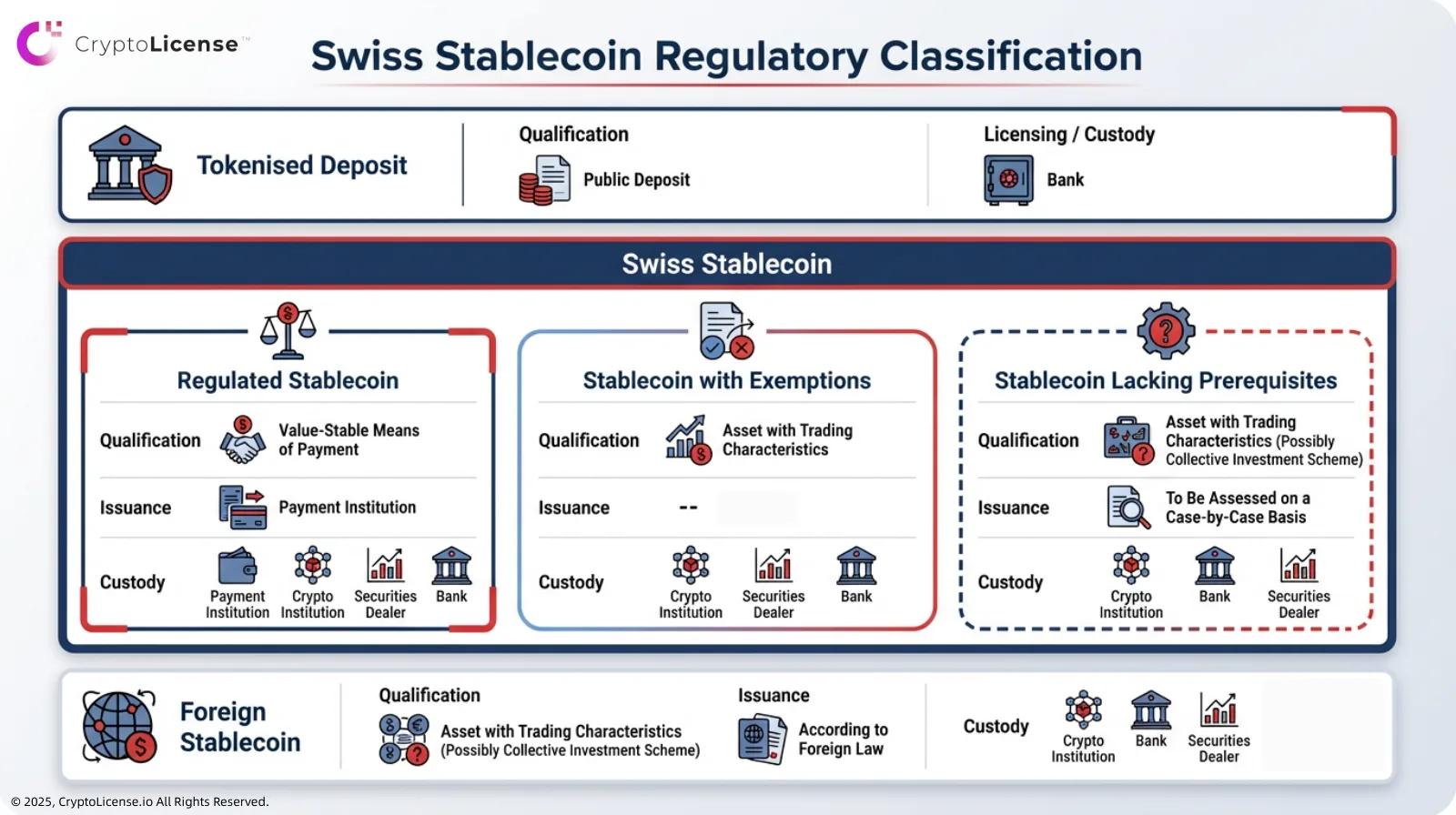
Given the volume and complexity of the regulatory changes discussed above, the official stablecoin classification framework provides a clearer structural overview of the new regime.
3.1 “Strong Compliance” Requirements for Regulated Stablecoins
Issuers of regulated stablecoins will be subject to comprehensive AML obligations, including customer due diligence, robust transaction monitoring, and compliance with the travel rule.
Key requirements include:
- Risk assessment prior to issuance, with appropriate mitigation measures
- Global monitoring, reflecting the borderless nature of blockchain transactions and secondary market risks
3.2 Technical Compliance Obligations
To ensure enforceability, issuers must demonstrate technical capabilities to:
- Maintain wallet blacklists
- Freeze and reclaim stablecoins when required, including without holder consent pursuant to legal orders
- Fully comply with instructions from competent (including criminal) authorities
These technical and organisational measures significantly enhance transparency, security, and regulatory effectiveness.
Why Switzerland Is Advancing Its Regulatory Framework
Swiss financial regulation has long been characterised by a measured and deliberate approach. Rather than reacting to short-term market developments, regulatory reforms tend to be incremental, carefully sequenced, and strategically aligned with long-term policy objectives.
Since 2018, Switzerland has methodically laid the groundwork for fintech and distributed ledger technology. Key milestones include the introduction of the FinTech licence and the enactment of the DLT Act reforms in 2021. At the time, these initiatives placed Switzerland among the most progressive jurisdictions globally.
However, from 2022 onwards, market conditions have evolved at a markedly faster pace. Stablecoins have increasingly moved into institutional use cases, demand for crypto custody and trading services has expanded, and international expectations around governance, AML, and investor protection have intensified.
Against this backdrop, the current reform is not a departure from Switzerland’s existing regulatory philosophy. Instead, it represents a logical next step: consolidating and systematising requirements that were previously dispersed across different regulatory layers, and aligning them into a more coherent framework capable of supporting modern, technology-driven business models.

Legislative Timeline and Transition Considerations
Following its publication on 22 October 2025, the draft entered a public consultation phase lasting until 6 February 2026. The Swiss Federal Council will then review submissions and submit a revised proposal to Parliament.
Based on assessments from multiple legal and compliance firms, the new regime is expected to enter into force between late 2026 and early 2027, subject to legislative progress.
However, the final allocation of supervisory responsibilities between SROs and FINMA, as well as the effective dates and scope, may still be adjusted. With several thousand crypto-related entities currently operating under the SRO framework, a rapid transition to direct FINMA supervision would be operationally challenging.
CryptoLicense therefore expects a transitional period of approximately six months to two years for existing licence holders.
From a strategic perspective, establishing compliance via the SRO route ahead of implementation may be advantageous. Early regulatory focus is likely to prioritise transitional cases, while new applications may initially progress more slowly.
For licensed FinTech firms and teams planning crypto or stablecoin activities, securing a compliant position early and adjusting once final rules are in place may be the more practical approach.
What This Means for Crypto Market and Financial Institutions
Crypto and FinTech Firms
The reform fundamentally clarifies regulatory boundaries. Stablecoin issuance, wallets, custody, trading platforms, and payment services will all follow defined regulatory pathways, reducing uncertainty and supporting long-term operations.
Banks and Traditional Financial Institutions
While increased competition is expected, the clearer framework also enables collaboration opportunities in custody, settlement, risk management, and compliance outsourcing.
Users and Investors
Enhanced segregation of client assets, redemption safeguards, and transparency requirements should materially improve consumer protection and market confidence.
Preparing for Switzerland’s Next Regulatory Chapter with CryptoLicense
Viewed over the long term, this reform is not a minor adjustment but a structural step in aligning traditional finance with crypto assets. It strengthens institutional foundations while improving stability and predictability across the ecosystem.
For businesses considering entry into Switzerland or the wider European market, now is an opportune time to assess the draft, review business models, and optimise compliance structures.
CryptoLicense will continue to monitor developments and provide updates at key milestones. For further discussions on regulatory strategy, licensing pathways, or operational planning, feel free to contact us.
Frequently Asked Questions
What is the crypto institution licence in Switzerland’s FinIA draft?
The crypto institution licence is a new category proposed in a draft amendment to Switzerland’s Financial Institutions Act (FinIA), and it is not in force yet. It would cover custody, trading and related services for payment tokens such as bitcoin and non-Swiss stablecoins. Utility tokens, asset tokens and stablecoins issued by Swiss payment instrument institutions fall outside it, and crypto institutions would be supervised directly by FINMA.
What would a payment instrument institution be allowed to do in Switzerland?
Under Switzerland’s FinIA draft, a payment instrument institution would replace the current FinTech licence. It could accept client funds but could not lend or pay interest, and the FinTech licence’s CHF 100 million cap on client funds would no longer apply. Only these institutions could issue single-fiat-referenced stablecoins redeemable at par in Switzerland.
What rules would Swiss stablecoin issuers face under the FinIA draft?
A Swiss stablecoin issuer would need full reserve backing, kept separate from its own assets, and would have to guarantee redemption at nominal value at all times. It would also publish a white paper and carry out full AML checks, including customer due diligence and the travel rule. On the technical side, it must be able to blacklist wallets and freeze or reclaim stablecoins when a legal order requires it.
When will Switzerland’s new crypto licences come into force?
No start date has been set for Switzerland’s new crypto institution and payment instrument institution licences. The public consultation on the FinIA draft opened on 22 October 2025 and closed on 6 February 2026, and the Federal Council plans to send its proposal to Parliament in the second half of 2026. Several Swiss law firms expect the new rules in 2027 at the earliest, though that is their own estimate and has no official status.
What happens to SRO members when Switzerland’s crypto institution licence starts?
Under the FinIA draft, firms that already do crypto institution work, such as custody or trading for clients, under an SRO would have one year from the start of the new law to apply for the FINMA licence. They could keep working while the application is pending, as long as they stay in an SRO. Parliament can still change this transition period and the scope.