

Canadian MSB License Guide: How to Easily Secure Your MSB License in Canada
As the crypto industry continues its rapid expansion, regulatory compliance has become a central theme across global markets. For any business hoping to operate sustainably and earn long-term trust, holding a credible license is no longer optional — it’s the foundation of legitimacy and international growth.
That’s why CryptoLicense is launching the Global Crypto License Playbook, offering clear, practical insights into obtaining major crypto regulatory licenses around the world.
This article is part of the CryptoLicense Global Crypto License Playbook, where we break down major licensing regimes across the world. After covering Swiss SRO and Australia’s DCE registration, we now turn to one of the most widely adopted licenses among fintech and Web3 companies: Canada’s MSB license.
In this guide, you will learn:
- What the Canadian MSB license is
- Key advantages and possible limitations you should know
- The types of business activities an MSB license legally allows
- The complete application process from preparation to approval
- A more efficient alternative: acquiring an existing MSB license
Whether you’re preparing to enter North America or building a multi-jurisdictional compliance matrix, this guide will give you the clarity you need to make informed decisions.
What Is the Canadian MSB License?
In Canada, businesses dealing with foreign exchange, remittances, virtual currency, or crowdfunding services must register with the Financial Transactions and Reports Analysis Centre of Canada (FINTRAC) under the Proceeds of Crime (Money Laundering) and Terrorist Financing Act (PCMLTFA).
FINTRAC, Canada’s financial intelligence unit, was established in 2000 to collect, analyze, and assess financial activity across the country. Its goal is to strengthen financial system safety and integrity. Registering as an MSB demonstrates that your business adheres to strict AML/KYC obligations and operates transparently under FINTRAC’s oversight.
By 2020, MSB registration had become the primary regulatory gateway for businesses engaged in currency exchange, remittances, foreign exchange, and virtual currency activities. Holding an MSB license not only fulfils your legal obligations — it significantly boosts your credibility in banking, fintech partnerships, and global expansion.
Why Are Web3 Teams Paying Close Attention to Canada’s MSB License?
In March 2025, after the Financial Action Task Force (FATF) strengthened regulation on virtual asset service providers, Canada, one of FATF’s core members, took the lead in tightening oversight. This instantly elevated industry attention toward the MSB regime.
Canada’s MSB license is now recognized as a cost-effective, flexible, and internationally respected license for Web3, fintech, and cross-border payment startups.
Here’s why:
1. Strong International Recognition and a Solid Regulatory Position
In March 2025, after the Financial Action Task Force (FATF) strengthened regulation on virtual asset service providers, Canada, one of FATF’s core members, took the lead in tightening oversight. This instantly elevated industry attention toward the MSB regime.
Canada’s MSB license is now recognized as a cost-effective, flexible, and internationally respected license for Web3, fintech, and cross-border payment startups.
Here’s why:
2. Low Entry Barriers & Highly Transparent Process
For early-stage teams, Canada’s MSB requirements are among the most accessible worldwide:
- No mandatory local office (virtual address accepted)
- Fully online application
- Clear documentation standards
Unlike jurisdictions requiring system walkthroughs or onsite inspections, Canada’s digital process enables global teams to complete registration smoothly and efficiently.
3. A Key Structural Advantage: Foreign Companies Can Apply Directly (fMSB)
Canada’s MSB framework includes two categories:
- MSB – For entities incorporated in Canada
- fMSB – For foreign companies serving Canadian customers without a local entity
For non-Canadian companies, the ability to apply directly as an fMSB is a major advantage. You can operate legally under Canadian oversight without:
- Establishing a local subsidiary
- Creating additional corporate structures
This significantly reduces operational costs and time to market.
However, applicants should note:
- fMSB submissions typically undergo more rigorous due diligence
- Tax obligations vary depending on whether your company creates a “permanent establishment” in Canada
- If offering goods or services within Canada, GST/HST obligations may apply
4. High Approval Rate & Low Maintenance Costs
FINTRAC’s review focuses on AML/CTF documentation, not on intrusive system testing. As long as your business model is clear and your AML program is well-prepared, approval rates are generally high.
Ongoing obligations — such as reporting, updates, and audits — are structured and manageable, making long-term operation efficient and cost-effective.
Limitations of the Canadian MSB License: Realities to Know Before Applying
The MSB license offers numerous advantages, but it is not a perfect fit for every business model. To avoid misaligned expectations, consider the following:
1. High Registration Volume = Lower Relative “Prestige”
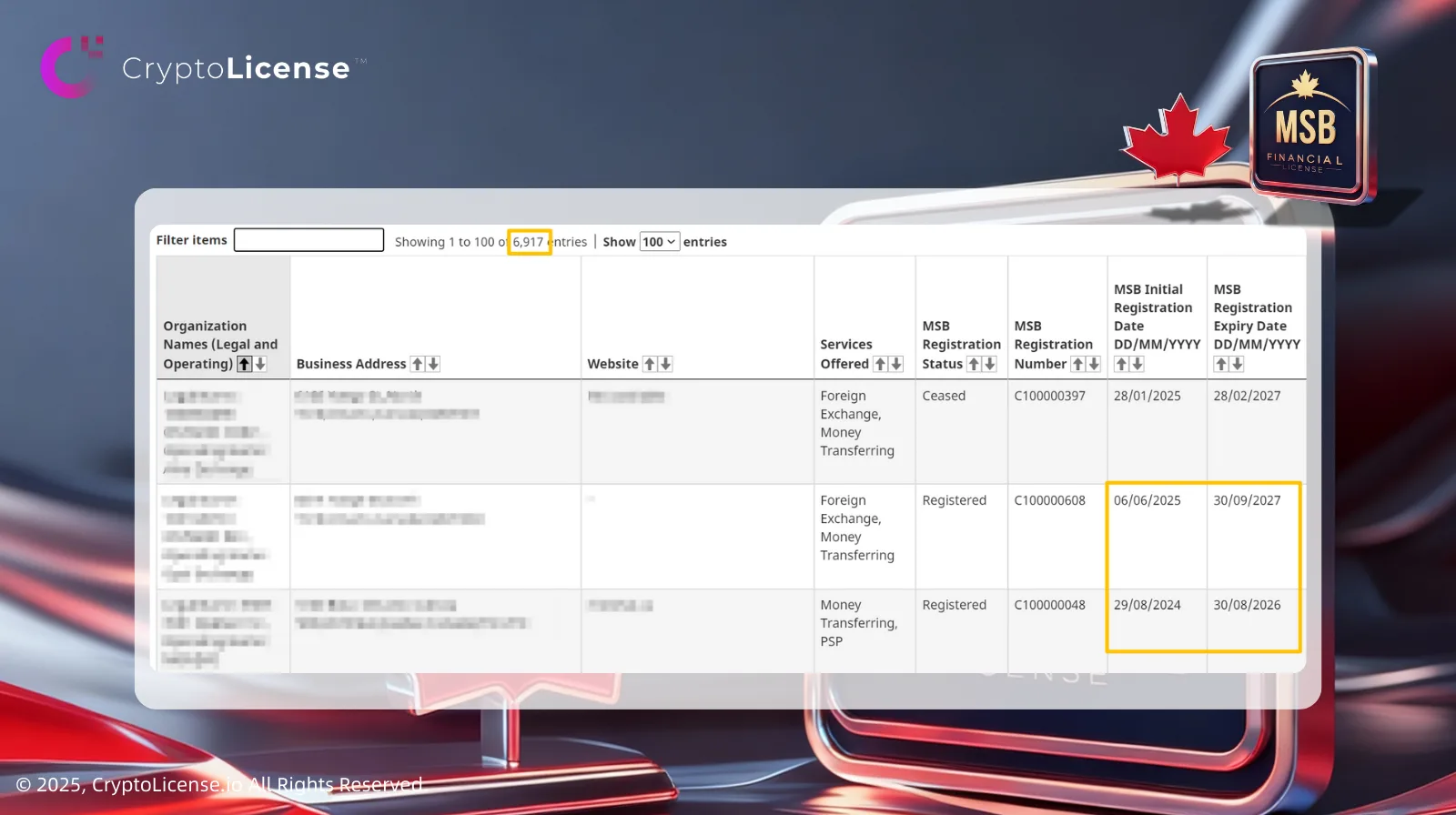
FINTRAC reports more than 6,900+ active MSB registrations, illustrating that while the application process is accessible and transparent, it also means the MSB license carries limited exclusivity or premium regulatory weight. For teams seeking a “high-tier regulatory endorsement,” this license may not fully satisfy expectations.
2. Some Banks and Financial Institutions May Not Accept MSB Holders
Because MSB oversight is lighter compared to other regulated financial licenses, certain banks do not automatically accept MSB entities when opening business accounts. Additional documentation or enhanced due diligence may be required.
3. Historical Misuse Has Impacted Market Perception
In past years, MSB entities were occasionally used in scams or unlicensed financial schemes. While Canada has since tightened oversight, some institutions remain cautious.
This also means:
- MSB licenses do not significantly boost company valuation compared to high-regulation jurisdictions
- Teams seeking strong investor confidence may require additional, stricter licenses

What Can You Do with a Canadian MSB License?
Once registered with FINTRAC, MSB license holders can legally operate a wide range of fiat and virtual asset services. Core authorized business activities include:
- Currency Exchange
Provides services for exchanging different fiat currencies. - Virtual Currency Trading Services
Covers buying and selling cryptocurrencies, brokerage services, and trade matching. This is currently one of the most widely used licenses in the crypto ecosystem. - Issuance or Redemption of Payment Instruments
Licensed businesses can issue or redeem various payment instruments, such as drafts, traveler’s checks, and bank drafts, supporting both domestic and cross-border payment scenarios. - Funds Transfer Services
Acts as an officially recognized intermediary to help clients transfer funds between accounts or institutions. - Digital Payment Processing
Companies can serve as payment processors, providing gateways, collection and disbursement, and transaction settlement services for online merchants, corporate clients, or platforms. - Cross-Border Remittance
MSBs can carry out international remittances, offering compliant cross-border fund transfer services for individuals and businesses.
Key Takeaway: Overall, Canadian MSBs cover the critical “on-ramp, payout, and transfer” functions between fiat and crypto assets, making them the essential license for most Web3 businesses.
The Complete Application Process for a Canadian MSB License
The MSB (or fMSB) application process is highly structured and fully online. Most applications take 2–4 months from preparation to approval.
Below is the full breakdown:
1. Preparation Phase: Determine Entity Type & Business Scope
Before filing:
- Decide whether to use a Canadian corporation (MSB) or foreign company (fMSB)
- Confirm business activities: crypto dealing, remittances, payments, etc.
- Review regulatory requirements
Important:
Starting November 2024, under the Retail Payment Activities Act (RPAA), payment service providers (including some MSBs) must also register with the Bank of Canada.
RPAA applies to any business providing payment services in Canada, including:
- MSBs: Offering services such as money transfers, foreign exchange, or virtual currency transactions.
- Payment Service Providers (PSPs): Engaged in activities like initiating or processing electronic funds transfers (EFTs).
2. Build Your AML/CTF Compliance Program
This is the core of the FINTRAC review.
Required documents include:
- AML/CTF policies
- Risk assessment framework
- KYC procedures
- Transaction monitoring methods
- Reporting processes
- AML training mechanisms
- Appointment of a Compliance Officer (no nationality requirement)
Well-prepared compliance documentation significantly increases approval likelihood.
3. Submit Your FINTRAC Online Application
The process is 100% online — no interviews, no system demonstrations.
Submit files including:
- Company details
- Business model
- AML/CTF documents
- Compliance Officer information
- Ownership and corporate structure
4. FINTRAC Review & Clarifications
FINTRAC may email follow-up questions relating to:
- Business logic
- AML controls
- Operational risks
- Compliance Officer capability
If the documentation is clear, most of the cases proceed smoothly to approval.
5. Approval & Ongoing Obligations
Once approved, FINTRAC assigns a unique MSB registration number to the business and publicly displays it on its official website. From that point, the company can operate globally as a licensed Canadian MSB in full compliance. However, obtaining the license is just the beginning—ongoing compliance is equally critical.
Licensed businesses are required to maintain long-term AML/KYC operations, submit reports on suspicious or large transactions to FINTRAC as mandated, and undergo regulatory audits when necessary. In addition, MSB registration must be renewed with FINTRAC every two years to ensure that company information and business operations remain valid and compliant.
According to publicly available data from FINTRAC, most MSB registrations are typically valid for about two years and must be renewed before expiration to maintain the license in good standing.
Want to Launch Faster? Acquiring an Existing MSB License Could Be a More Efficient Option
For teams aiming to launch products quickly, seize market opportunities, or reduce upfront preparation, going through the full MSB registration process (document preparation, compliance system setup, FINTRAC review, etc.) can extend the timeline. If your business pace is urgent and launch timing is critical, acquiring an existing, active MSB license can be a more efficient approach.
A ready-to-use MSB has already been registered with FINTRAC and can be immediately deployed after the transfer, saving the time and effort of company formation, compliance document preparation, and regulatory inquiries. For small Web3 teams in the early stages, such a license also reduces the initial compliance workload, allowing you to gradually build an internal compliance system in line with business needs.
If you are considering acquiring an MSB license, the following steps and considerations are crucial:
1. Verify License Status and Business Scope
Ensure the license is still active on FINTRAC’s official website, and confirm that its registered business categories (e.g., virtual currency trading, fund transfers) align with your intended operations. Pay special attention to avoid licenses that have been suspended, restricted, or have a history of issues.
2. Conduct Thorough Due Diligence (DD)
Make sure the license entity is clean and compliant, typically by checking:
- Any history of regulatory violations
- Existing penalties or unfinished reporting obligations
- Clear corporate governance structure
- Compliance of key roles (e.g., compliance officer)
This is a critical step to avoid potential risks.
3. Complete Ownership Transfer and FINTRAC Updates
After signing the share transfer agreement and completing the ownership transfer, update FINTRAC with information on directors, controlling shareholders, and compliance officers. This step directly affects whether the license can continue to operate normally.
4. Supplement and Rebuild the Compliance System
Once the updates are completed, the new team generally needs to take the following steps to ensure future operations meet regulatory standards:
- Update AML/CTF policies
- Appoint new compliance officers and key personnel
- Adjust internal processes to align with actual business operations
5. Officially Launch Operations
After FINTRAC confirms the updates, the license can be used to provide compliant services to clients worldwide.
Make Compliance Clearer & Simpler — With CryptoLicense
Whether you’re applying for a brand-new MSB license or acquiring an existing one, CryptoLicense provides full-spectrum support backed by deep expertise in FINTRAC interpretation and international compliance strategy.
We offer a range of services, including but not limited to:
- Canadian company incorporation
- AML/CTF program development
- FINTRAC registration and updates
- Banking onboarding support
- MSB acquisition matching and transfer assistance
If you’re entering the North American fintech market or building a global compliance framework, let us help you move forward with confidence.
Get in touch with CryptoLicense today and turn regulatory compliance into a growth driver with us.