

How Payment Networks Are Adapting to Stablecoins: Visa's Quiet Pivot and Mastercard's $1.8 Billion Bet
Recently, the CryptoLicense team attended Money 20/20 in Bangkok. The shift in conversation was unmistakable: crypto payments had become one of the dominant topics, drawing more interest than we had anticipated.
The people asking the most questions about crypto payments were compliance and business leads from traditional financial institutions. There is broad consensus that stablecoins are reshaping the payments industry. The harder question is how to take the first step.
Drawing on the discussions from that week, we have put together a series on payments. This is the first piece. It starts at the top of the stack, with the card networks.
The signals have been accumulating: Circle’s USDC being used for Visa settlement, Mastercard spending $1.8 billion to acquire BVNK. Dense signaling, but not necessarily a clear path.
Card networks, banks, and payment companies each face a different set of pressures and are making different moves. Understanding how those three layers interact is the most practical starting point for figuring out where your own first step might be.
This series will work through each layer in turn. We begin with the card networks, the rule-setters of the global payment system, whose decisions will determine how stablecoins enter mainstream payments infrastructure.

I. Why Visa and Mastercard Have So Much Say: The Underlying Structure of Payments
Before getting into specific moves, it helps to understand the basic architecture of how card payments work. The context matters for reading what Visa and Mastercard are actually changing.
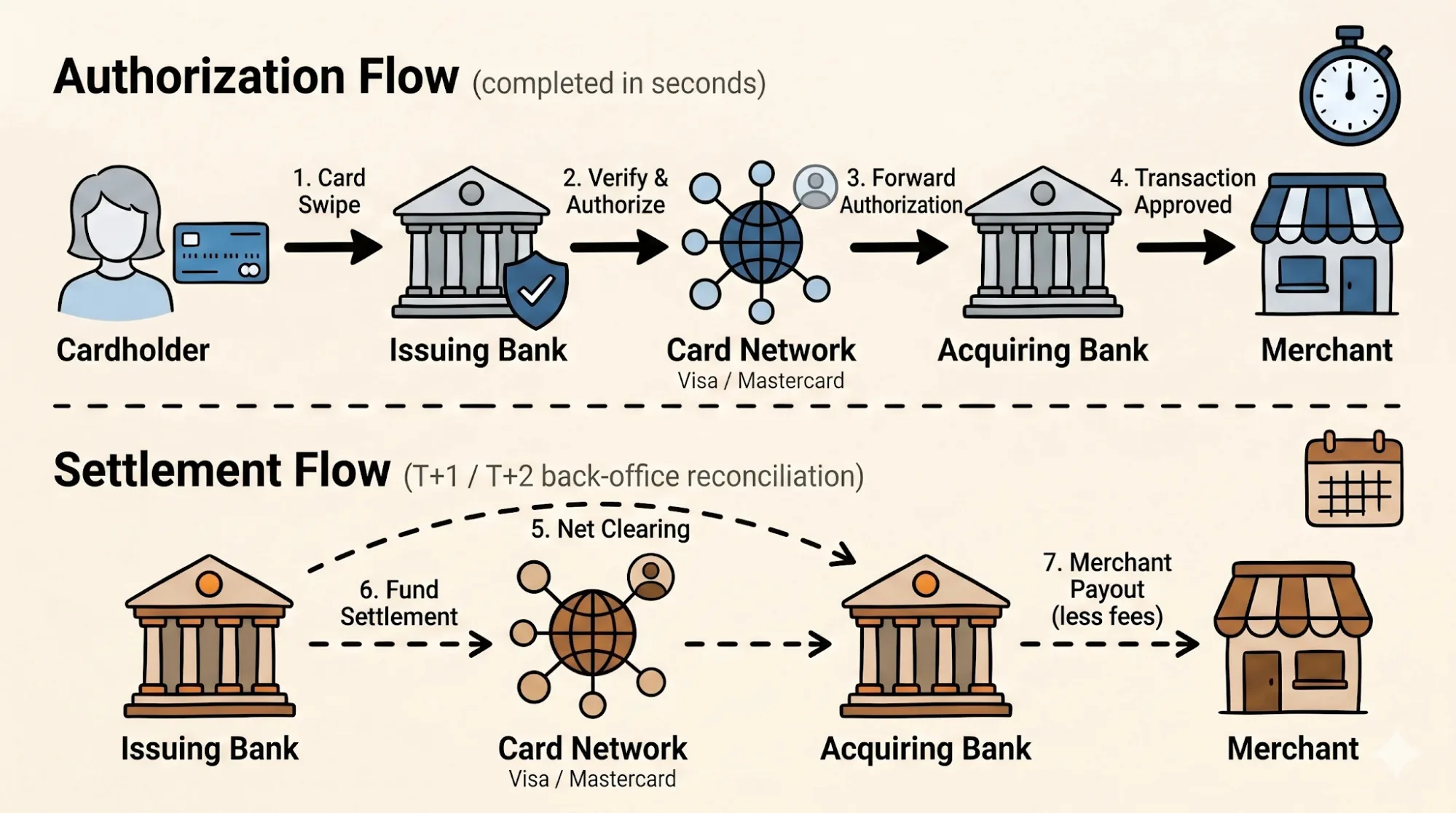
Consider a standard card transaction. You pay at a point-of-sale terminal, which sends the request to the acquiring bank (the merchant’s bank). The acquirer routes it through the card network to the issuing bank (your bank), which confirms your available credit and authorizes the transaction. This is authorization, and it takes seconds.
Later that day, the card network aggregates all transactions and calculates the net amounts owed between each bank. This is clearing. The final step, where funds actually move between banks, is settlement. Of these three, settlement is the most outdated. Cross-border settlement commonly runs T+2 or T+3, and stops entirely over weekends. This is the layer stablecoins are most directly positioned to replace.
The card networks’ revenue comes primarily from two sources:
- fees on cross-border transactions and currency conversion
- network fees charged as a percentage of transaction volume
According to estimates from Raymond James analysts, approximately 37% of Mastercard’s revenue comes from cross-border transactions and international e-commerce. Visa’s figure is similar, at around 36%.
Cross-border transactions represent a small share of total Global Dollar Volume (GDV), but because they carry substantial foreign exchange fees and cross-border surcharges, they account for roughly 40% of card network revenue. This is the margin that stablecoins most directly threaten.
The logic follows. Compare the two rails side by side:
Stablecoin settlement
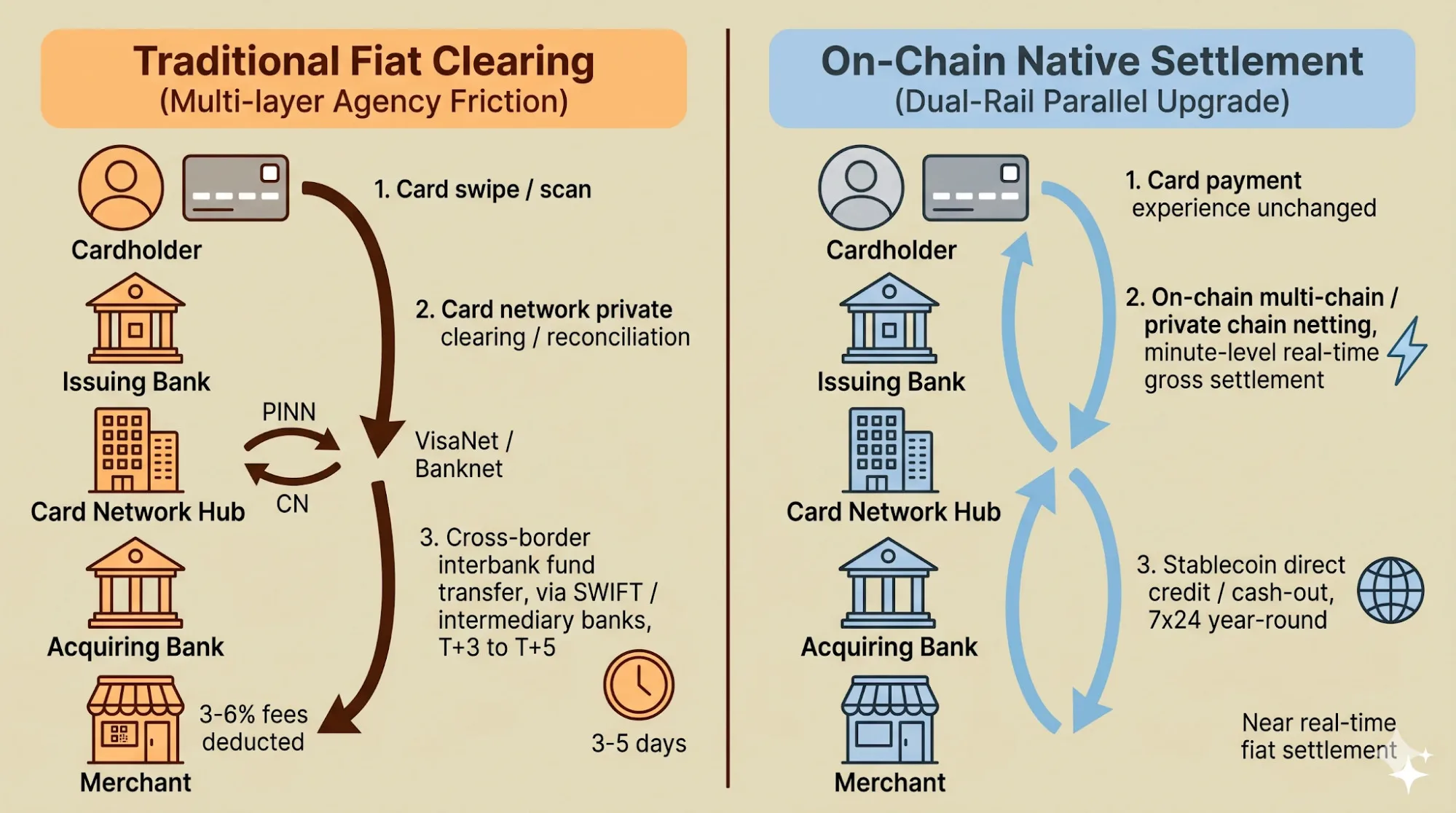
- Settles on-chain in minutes
- Transaction costs measured in cents
- Operates 24/7, no weekend cutoffs
Traditional cross-border payments (SWIFT)
- All-in costs of 3%–6% across wire fees, FX markups, and correspondent bank deductions
- End-to-end delivery remains inconsistent through complex corridors, despite SWIFT gpi improvements
The market has already started moving. According to the latest payments report from McKinsey and Artemis, stablecoin-linked card spending reached $4.5 billion in 2025, up 673% year-on-year. These cards let users spend stablecoin balances directly at any Visa or Mastercard merchant, without converting to fiat first. In effect, stablecoins are using the card networks’ own acceptance infrastructure to route around their settlement layer.
That is the core problem facing Visa and Mastercard: if stablecoins are going to be part of payments regardless, how do you want them to enter? Let them grow outside your network, or bring them inside?
The two companies have given different answers.
II. Visa's Approach: Change the Back End, Leave the Front End Alone
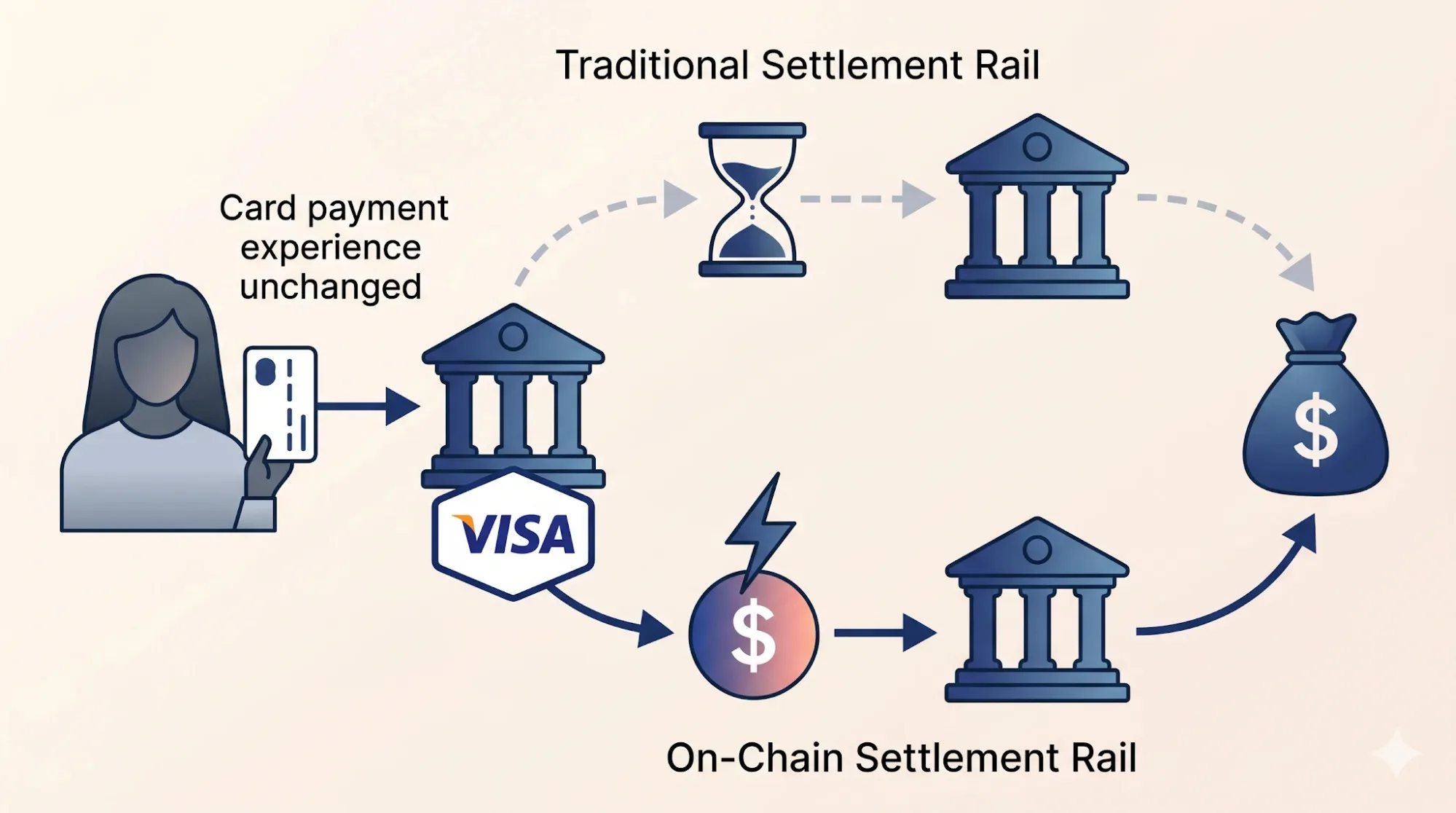
Visa’s strategy can be summarized simply: leave the consumer experience untouched, and quietly replace the settlement rail underneath.
1. From Pilot to Production: An Incremental Path
Visa began exploring stablecoin settlement in 2021, running an initial pilot with Circle’s USDC and Crypto.com for cross-border card settlement in Australia.
In September 2023, Visa expanded the scope in two ways: adding the Solana blockchain to its settlement network (previously limited to Ethereum), and bringing in acquirer-side partners Worldpay and Nuvei. This meant that both issuers and acquirers could use USDC to settle with Visa.
The timeline from there:
- October 2024: Visa launches VTAP (Visa Tokenized Asset Platform), helping banks issue tokenized deposits and stablecoins. BBVA is among the first clients, planning a pilot on Ethereum.
- September 2025: Settlement expands to additional blockchains (Stellar, Avalanche) and additional stablecoins. Visa Direct launches a stablecoin pre-funding pilot, allowing businesses to fund payment pools with stablecoins.
- November 2025: Visa Direct adds stablecoin wallet payout functionality, enabling businesses to fund in fiat while recipients elect to receive USDC.
- December 2025: USDC settlement goes live in the United States. Cross River Bank and Lead Bank become the first U.S. banks to settle with Visa via USDC on Solana. Visa also announces a design partnership with Circle for Arc, Circle’s new Layer 1 blockchain, and plans to run a validator node.
The scale of growth is visible in Visa’s own disclosures: annualized stablecoin settlement volume was approximately $1 billion in September 2025, $4.6 billion in December 2025, and $7 billion by March 2026. That is a six-fold increase in two quarters. The demand from banks for faster, cheaper settlement is already showing up in the numbers.
2. From Network to Compliance Gateway: Visa's Advisory Play
In December 2025, alongside the U.S. USDC settlement launch, Visa announced a Stablecoin Advisory offering, providing market assessment, strategy, and implementation guidance for banks, fintechs, and merchants.
This is worth paying attention to. The biggest obstacle for banks moving into stablecoins is the absence of established on-chain compliance standards. What Visa is offering, in effect, is decades of accumulated risk management and compliance infrastructure, packaged for the bank’s context.
The advisory offering also functions as a technical pre-commitment mechanism. By embedding Visa’s standards, including the VTAP platform, into a bank’s early architecture decisions, Visa positions itself as the default technical gateway when that bank eventually moves to full on-chain clearing.
3. What Visa Is Actually Doing
Visa’s moves all follow the same logic: keep the consumer experience identical (cardholders still swipe, merchants still receive fiat), and replace only the interbank settlement step, converting traditional wire transfers into on-chain USDC transactions.
The benefits are clear: no need to re-educate consumers or merchants, minimal integration burden for banks, a seven-day settlement window replacing a five-business-day one, and more flexible liquidity management.
It also manages risk carefully. Visa is building a dual-rail settlement architecture. If the on-chain network experiences serious congestion or a technical failure, the back-end can roll back seamlessly to traditional fiat wire settlement, preserving the stability of the global payment network.
The trade-off is that Visa is currently limiting stablecoins strictly to a settlement replacement function, without pushing them to the consumer-facing layer the way Mastercard is.
III. Mastercard's Approach: Building a Parallel Stablecoin Infrastructure End to End
Compared to Visa, Mastercard’s strategy is more aggressive and more distributed. If Visa is quietly swapping out the back-end rail, Mastercard is building a parallel stablecoin payment system from front to back simultaneously.
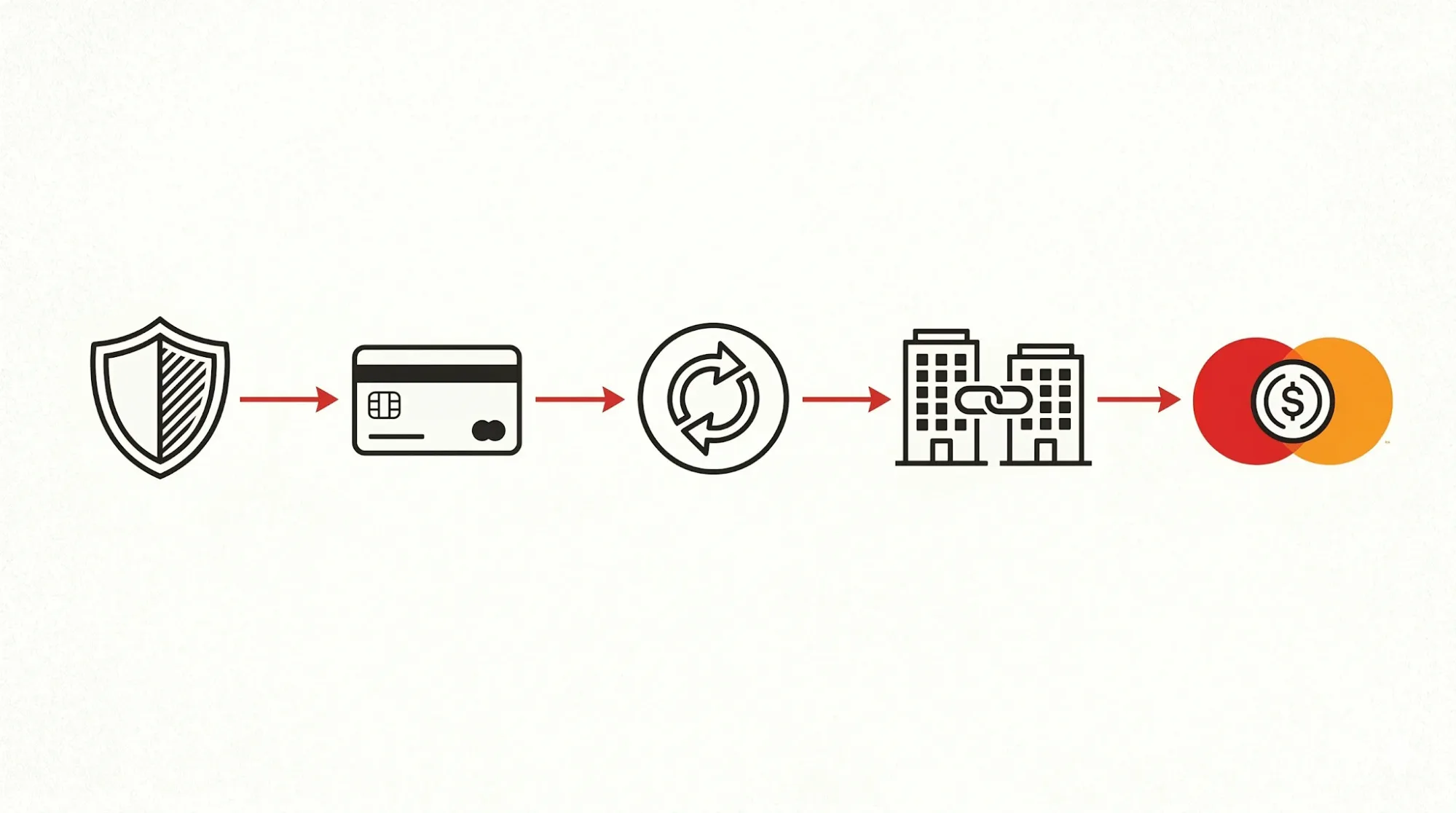
The buildout follows five connected tracks:
- Build on-chain identity infrastructure first
- Enter consumer-facing spending scenarios
- Move deeper into on-chain native transactions
- Build institutional settlement capability on the B2B side
- Internalize external capabilities through acquisition
Each track connects to the next. Here is how they fit together.
Track 1: On-Chain Identity Verification
In November 2025, Mastercard launched Crypto Credential on Polygon. The product addresses on-chain identity: partner Mercuryo handles user verification, users receive an ENS-style alias linked to their self-custody wallet, and transfers can be completed using the alias rather than a full wallet address. Mastercard verifies that the recipient’s wallet supports the relevant asset and blockchain before a transaction executes.
By April 2026, Crypto Credential had expanded to 13 countries across Latin America and Europe, with exchange partners including Bit2Me, Lirium, and Mercado Bitcoin.
In structural terms, Mastercard is translating its traditional card network rulebook into code directly on public blockchains, establishing a compliance filter at the identity and address level and positioning itself as the on-chain compliance gatekeeper.
Track 2: Consumer Spending and Merchant Settlement
It is worth noting that Mastercard SVP Christian Rau has said clearly that the primary use case for stablecoins is not consumer payments, but rather B2B flows, cross-border transactions, back-end settlement, and liquidity management. That said, Mastercard’s consumer-side moves have attracted the most attention.
On 28 April 2025, Mastercard made its largest single-day announcement in this space:
- A partnership with OKX to launch the OKX Card, allowing users to spend stablecoin balances at any Mastercard-accepting merchant (the back end sells stablecoins to fiat in real time; the merchant never touches crypto)
- Partnerships with Nuvei and Circle enabling merchants to settle directly in USDC
- A partnership with Paxos extending merchant settlement to additional stablecoins including USDP
- Stablecoin withdrawal to bank accounts via Mastercard Move
Mastercard called this a “360-degree stablecoin payments solution.” In plain terms: letting consumers use stablecoins the same way they use money in a bank account.
Track 3: Credit Card Access to DEX Trading
On 24 June 2025, Mastercard partnered with Chainlink to launch Swapper Finance, enabling users to purchase on-chain crypto assets directly through a Mastercard credit card on decentralized exchanges (DEXs). The integration involves Chainlink for oracle services, ZeroHash for compliant fiat-to-crypto conversion, Shift4 Payments for card processing, and Uniswap and XSwap for underlying liquidity.
This moves Mastercard from stablecoin consumer spending into the on-chain trading entry point. The commercial logic is significant: it opens cardholders’ revolving credit lines directly toward decentralized liquidity pools, effectively making DEXs a new category of high-margin merchant within the Mastercard network.
Track 4: B2B Infrastructure Through MTN
In mid-2023, Mastercard launched the Multi-Token Network (MTN) test platform, initially focused on tokenized bank deposits. It entered UK testing in June 2024, connected to JPMorgan’s Kinexys system in November 2024 for on-chain B2B cross-border settlement, and has since onboarded Standard Chartered for testing.
MTN shares positioning with Visa’s VTAP as a tokenized asset platform for banks. The design logic differs in one important way: rather than backing a single token format, MTN is designed as a unified interoperability layer that can accommodate tokenized deposits, stablecoins, CBDCs, and tokenized money market funds simultaneously.
Track 5: Acquiring BVNK
Consumer-side and institutional-side infrastructure were in place, but most of it was partner-dependent. Dependence on partners means dependence on others’ pricing and positioning. On 17 March 2026, Mastercard announced its acquisition of stablecoin infrastructure company BVNK for up to $1.8 billion.
BVNK’s core product is a fiat-in, stablecoin-over-chain, fiat-out pipeline: accept local currency on one end, route it as USDC on-chain, convert back to local currency at the destination. Annual processing volume runs between $25 billion and $30 billion across more than 130 countries, with clients including Worldpay, Deel, Flywire, and dLocal. Regulatory coverage includes a UK SPI license and a CASP license under MiCA, covering the full European Economic Area via passporting.

There is relevant context here. In November 2025, Coinbase entered exclusive acquisition talks with BVNK at a reported valuation of around $2 billion. Those talks broke down, and Mastercard moved quickly.
For Mastercard, BVNK fills a specific gap. The MTN private-chain settlement network was built. What was missing was the bridge between that network and on-chain public stablecoin liquidity. BVNK is that bridge. With it, Mastercard’s on-chain settlement network can connect to real public-chain liquidity pools, completing the architecture of card-at-the-front, on-chain-at-the-back.
More concretely, the acquisition brings in $25-30 billion in annual transaction volume that previously flowed through an external gateway. Pricing power and liquidity positions that sat outside Mastercard’s system are now inside it.
Before BVNK, Mastercard had also explored acquiring Zero Hash (October 2025, at a valuation of $1.5-2 billion), but Zero Hash chose to remain independent and talks ended in January 2026. The pattern is consistent: Mastercard has been actively looking for this type of infrastructure capability, and BVNK was the deal that closed.
IV. Where Visa and Mastercard Agree, and Where They Differ
Looking at both sets of moves together, there is one shared logic: the consumer-facing experience does not change. Cardholders still swipe or tap. Merchants still receive local fiat. What changes is the interbank settlement layer, where traditional wire transfers are being replaced by on-chain stablecoin transfers.
This model offers card networks three things:
- Network effects are preserved. Merchant acceptance and cardholder behavior do not change, so the core competitive moat stays intact.
- Settlement costs fall. On-chain settlement is faster and cheaper than SWIFT, especially in cross-border scenarios.
- Substitution risk is managed. If stablecoin payments are coming regardless, it is better to have them happen inside your network than outside it.
Within that shared logic, the strategic emphasis differs significantly. Visa is saying: our network is large enough; when banks are ready, we can accommodate them. Mastercard is saying: we are building a complete stablecoin payment infrastructure; banks and merchants can follow our lead.
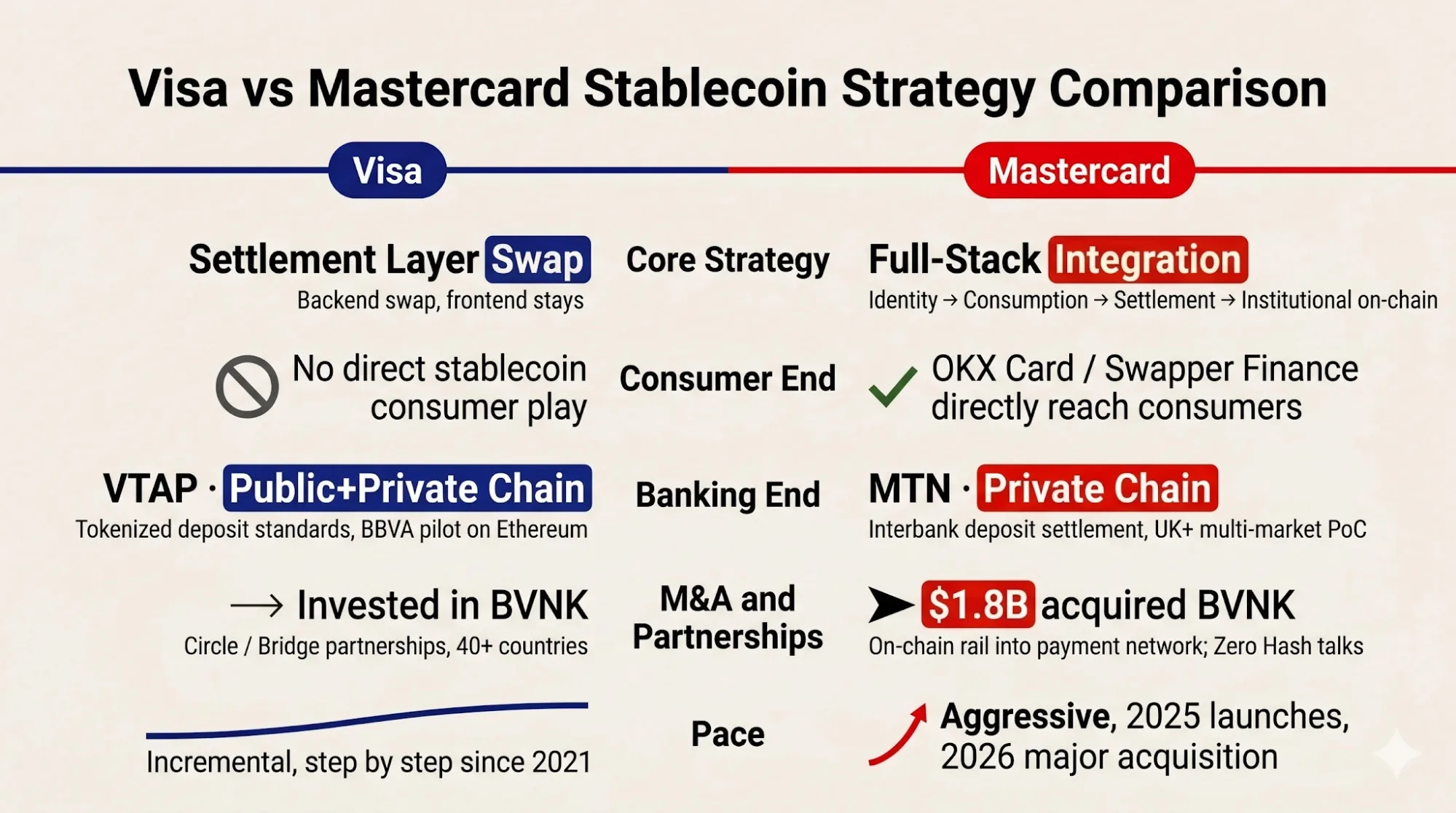
V. What This Means for the Broader Industry
Visa and Mastercard’s pivot carries a fundamental signal for the entire crypto payments industry: stablecoins are no longer a crypto-native story.
- For stablecoin issuers: Access to Visa and Mastercard’s merchant acceptance networks matters far more than building a parallel acceptance infrastructure. Circle’s USDC becoming the preferred settlement stablecoin for both networks reflects its compliance posture, transparency, and liquidity depth.
- For crypto companies: There is now a clearer route to market: rather than building payment networks from scratch, stablecoins can plug into card networks’ global acceptance infrastructure and reach existing retail spending scenarios directly. OKX Card and Bridge’s stablecoin Visa card both follow this model.
- For banks: The question is how to participate: as issuers, working within the card network framework to advance tokenized deposit programs; or as users, connecting to card network on-chain gateways for cross-border netting. Visa’s VTAP and Mastercard’s MTN are both competing to define the compliant path forward for traditional banks.
- For the card networks themselves: This is defensive offense. Mastercard’s Chief Product Officer Jorn Lambert once said, “There is nothing fundamentally broken about the card business.” He then led a $1.8 billion acquisition.
When someone says there is no problem while spending $1.8 billion, the real message is probably: the change is already here, and it is too large to sit on the sidelines.
VI. Closing Thoughts
Back to the question we started with: for traditional financial institutions looking to take a first step into crypto payments, where does that step go?
This piece suggests the answer is more concrete than it might initially seem. Visa and Mastercard are systematically embedding stablecoins into existing payment infrastructure. The integration path is becoming clearer.
Visa has focused on back-end settlement replacement, compounding quickly on annualized settlement volume while beginning to help banks issue their own stablecoins. Mastercard has advanced on four tracks simultaneously, from identity through consumer spending, on-chain trading, and institutional settlement, and then brought BVNK in-house to convert partner capabilities into proprietary ones.
For banks and payment companies, this means the barrier to a first step is lower than it might appear. There is no need to rebuild the system from scratch; connecting stablecoin settlement into existing infrastructure is the starting point. But a lower barrier does not mean the direction is obvious. Visa’s posture is one of enablement; Mastercard’s is one of self-build. How banks and payment companies position relative to each depends on their own priorities, and that is what the next two pieces in this series will work through.
If you have compliance questions related to crypto payments, please contact the CryptoLicense team. We are glad to help you work through the regulatory side of this transition.