
-scaled-e1776239050227-f23f124.webp)
Mapping Your Crypto Future: A Strategic Comparison of 6 Popular Global Licenses
At CryptoLicense, the most frequent inquiry we field is a deceptively simple one: “Which crypto license should I apply for?”
Our response is always a series of follow-up questions: Where are your users? Is your business model an exchange, a wallet, or a custody service? Where is your core team based?
In the world of Web3 compliance, there is no single best license, only the jurisdiction that best aligns with your specific operational needs. To help you navigate this complex landscape, we have analyzed the six most popular crypto licenses handled by our team.
We’ve broken them down across six key dimensions: application timeline, difficulty, cost, localization requirements, regulatory approval rigor, and brand prestige.
I. The Landscape: 6 Popular Jurisdictions Under the Microscope
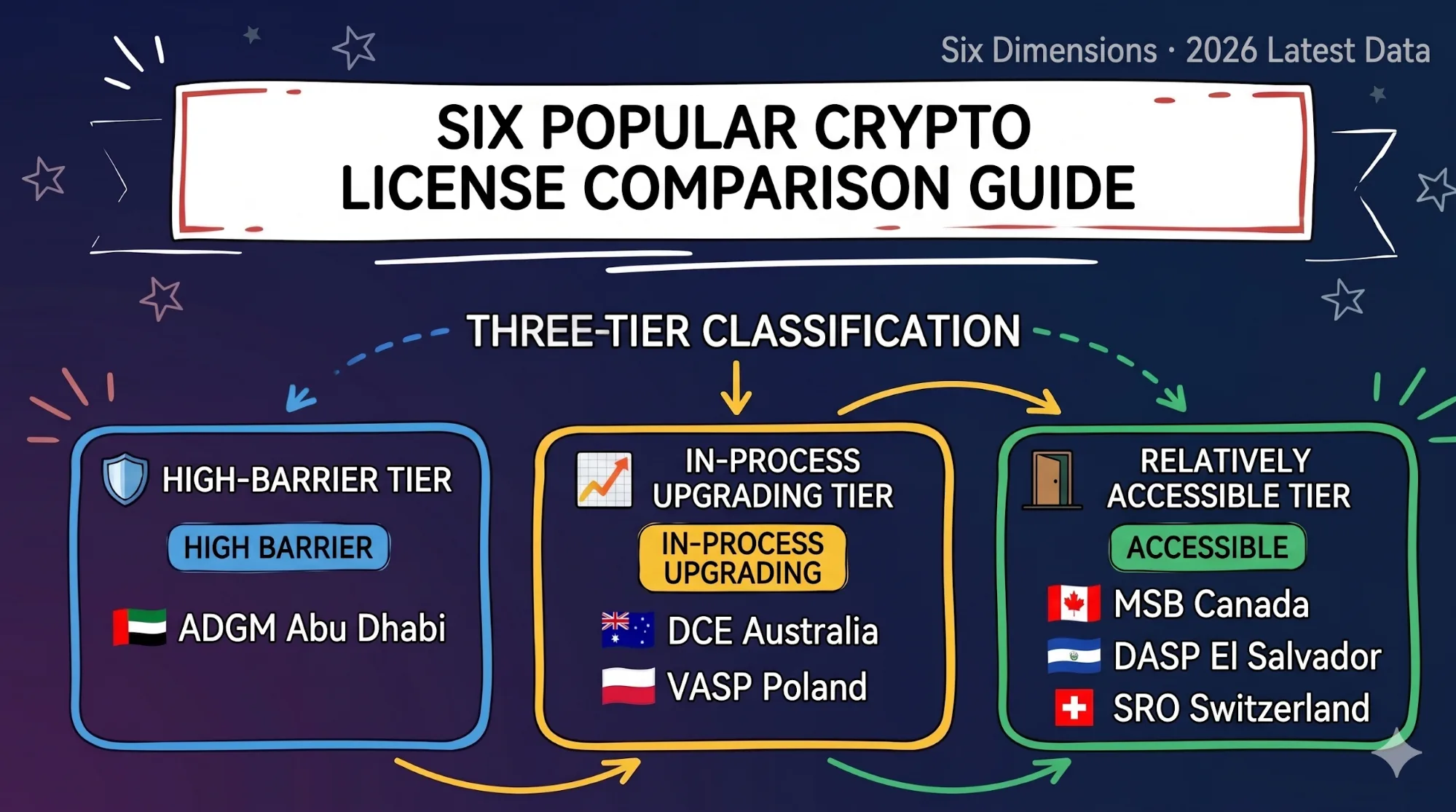
We are focusing on six jurisdictions that represent the current mainstream in global Web3 regulatory strategy:
- Abu Dhabi (ADGM): Abu Dhabi Global Market
- Switzerland (SRO): Self-Regulatory Organisation
- Poland (VASP): Virtual Asset Service Provider (aligning with MiCA)
- Australia (DCE → AFSL): Transitioning from Digital Currency Exchange to Australian Financial Services Licence
- El Salvador (BSP/DASP): Bitcoin Service Provider / Digital Asset Service Provider
- Canada (MSB): Money Services Business
Regulatory Developments to Note
Before moving into the comparison, it is worth noting that Poland and Australia are both undergoing regulatory changes:
- Poland (VASP): Legislative Stagnation. The Polish President recently vetoed the Act on Crypto-Assets for a second time. This has stalled the local implementation of MiCA (Markets in Crypto-Assets). With the MiCA transition period ending July 1, 2026, the window for using Poland as a “passporting” entry point into the EU is narrowing.
- Australia: The AFSL Migration. Australia is migrating from the old DCE registration framework to the more rigorous AFSL framework. Existing players must upgrade, and new applicants must meet significantly higher compliance standards.
II. The Six-Dimension Breakdown
1. Application Timeline
How fast can you go to market?
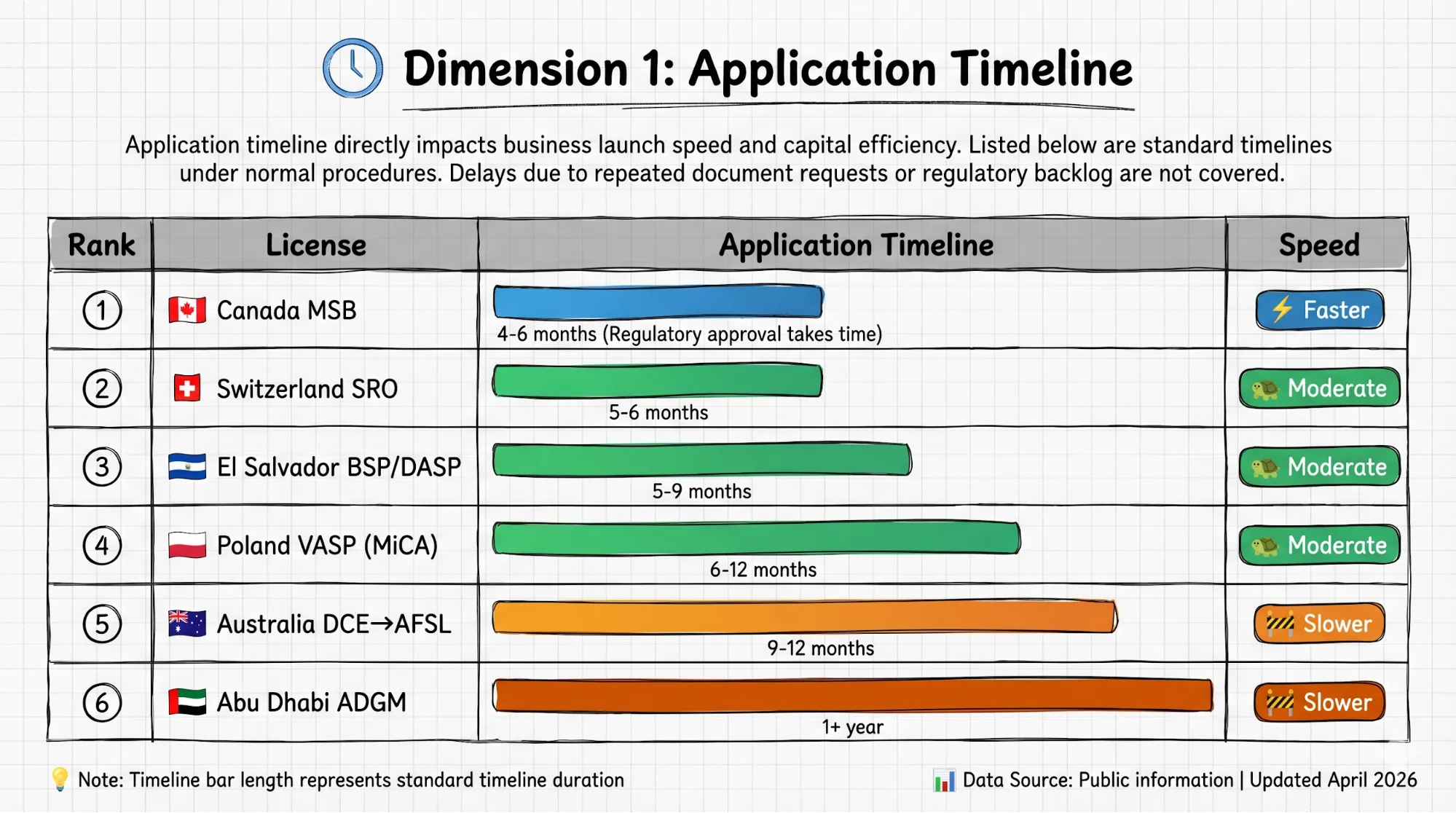
- Canada (MSB): The fastest. Typically completed within 4–6 months.
- Switzerland (SRO) & El Salvador (BSP/DASP): Moderate speed, usually taking 5–9 months.
- Poland (VASP): Historically 6–12 months, but currently unpredictable due to legislative delays.
- Australia (AFSL): Expect 9–12 months, with potential delays due to the transition period.
- Abu Dhabi (ADGM): The long game. Expect 12+ months for a full grant.
2. Application Difficulty
This measures the barrier to entry regarding corporate qualifications and compliance architecture.
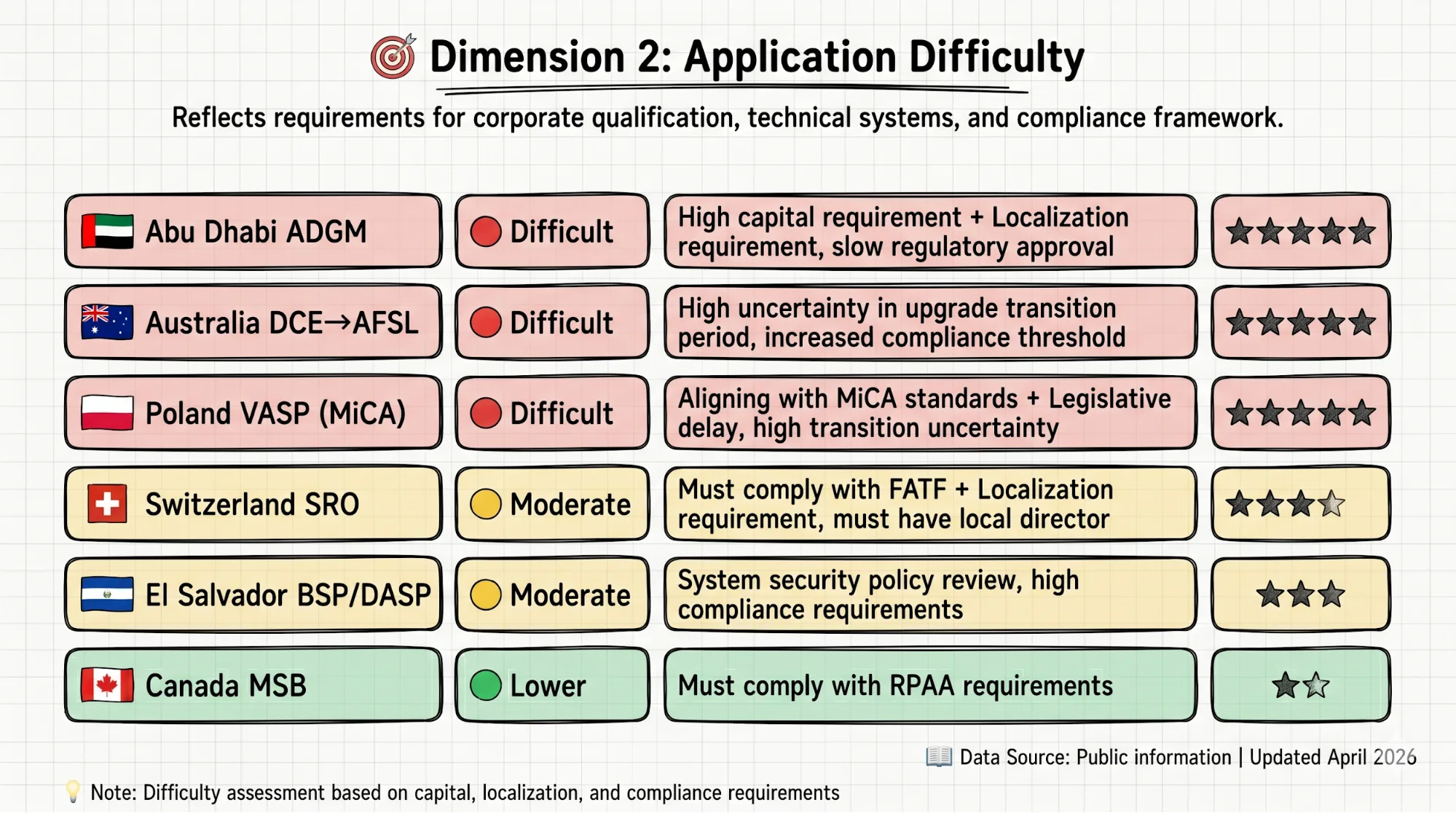
- ADGM (High Difficulty): The FSRA (Financial Services Regulatory Authority) sets a high bar for capital adequacy and requires significant economic substance.
- Australia & Poland (High Difficulty): Australia requires navigating both AUSTRAC and ASIC standards. Poland’s difficulty stems from the uncertainty of aligning with MiCA during a legislative deadlock.
- Switzerland (Medium Difficulty): Mature framework but strict on FATF (Financial Action Task Force) standards and the requirement for local directors.
- El Salvador (Medium-Low): Focuses heavily on technical security audits. Regulated by the BCR (Central Reserve Bank) and CNAD (National Commission for Digital Assets).
- Canada (Low Difficulty): The most accessible. The FINTRAC framework is straightforward, though new RPAA (Retail Payment Activities Act) requirements are adding layers.
3. Application Cost
Includes government fees, legal counsel, audits, and compliance system builds.
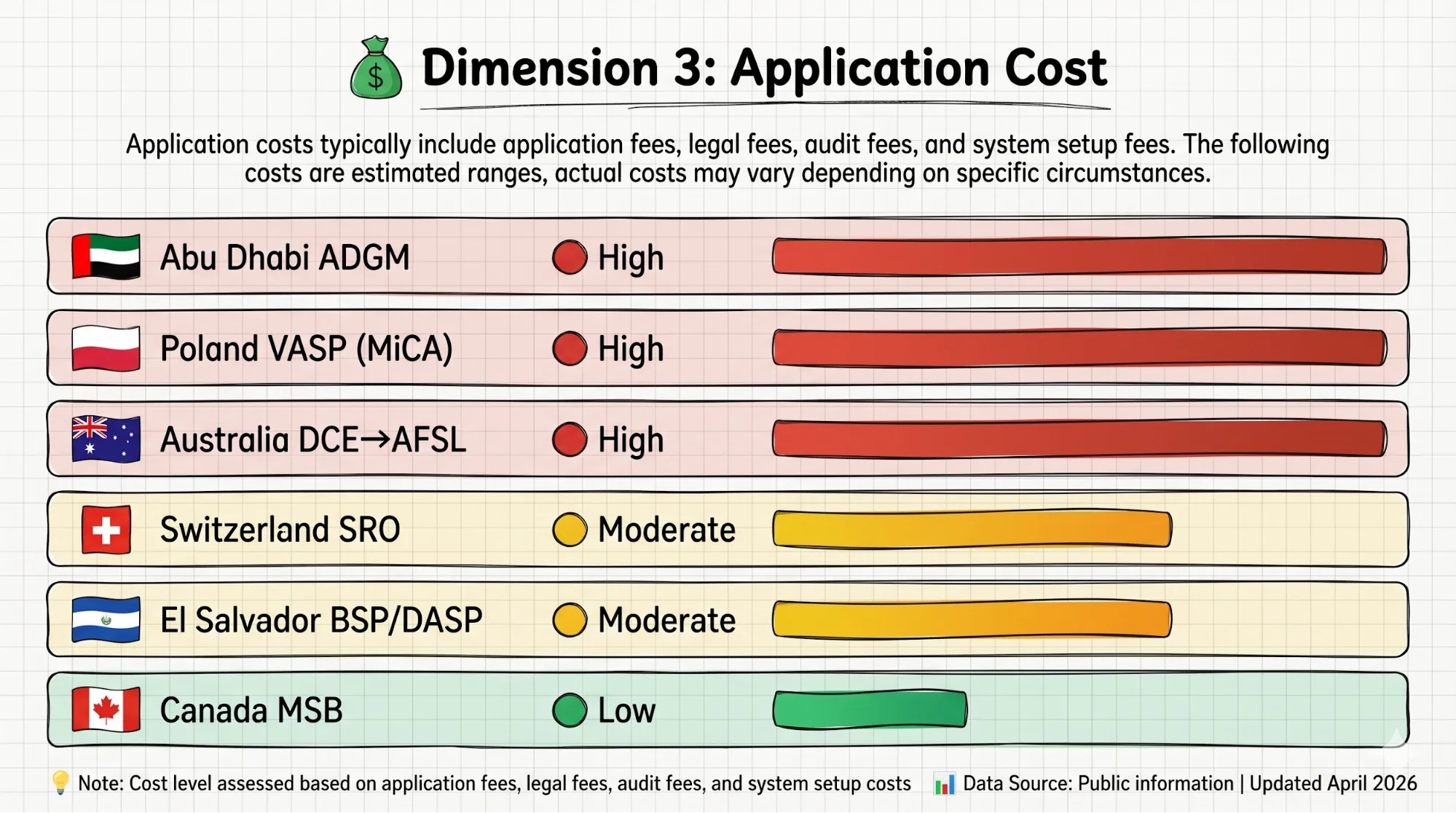
The highest-cost tier belongs to ADGM, Poland, and Australia. When you stack capital adequacy requirements on top of legal fees and the cost of building a full compliance infrastructure, the total investment is substantial.
Switzerland (SRO) and El Salvador (BSP/DASP) sit in the mid-range. El Salvador, in particular, offers exceptional cost-efficiency for exchange-type businesses. And Tether’s decision to headquarter there has created a meaningful ecosystem clustering effect for the jurisdiction.
Canada (MSB) carries the lowest overall cost, which is precisely why many early-stage projects choose it as their first compliance foothold. That said, to be candid: the lower price tag comes with a tradeoff. Market credibility is comparatively limited — especially when dealing with institutional clients — and the license’s perceived value should be assessed realistically.
4. Localization Requirements
Many teams overlook the “hidden” costs of substance requirements — local directors, compliance officers, and physical offices.
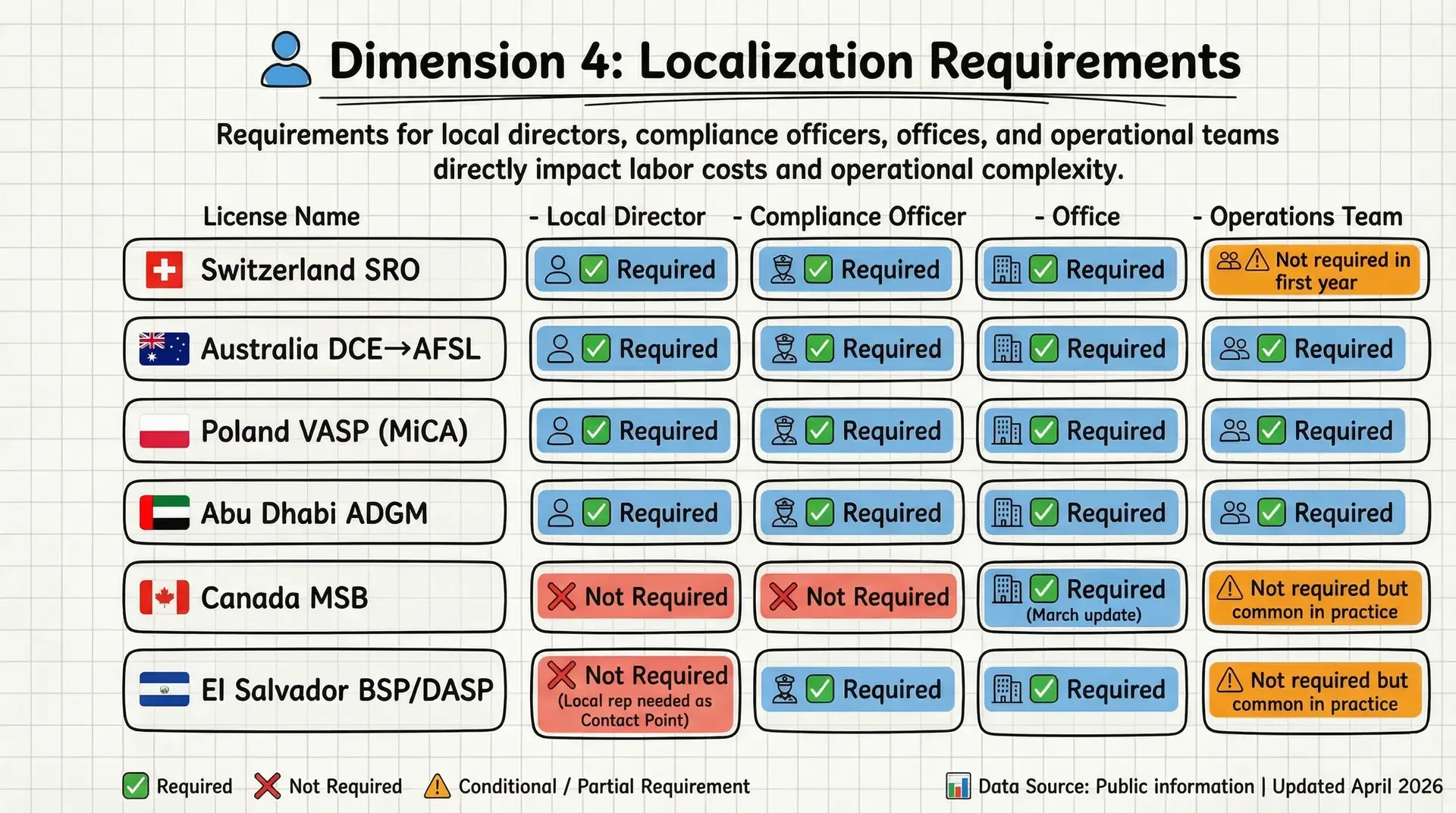
- Switzerland, Australia, Poland, ADGM: All require local directors, a dedicated Compliance Officer, and a physical office. You are essentially building a local headquarters.
- Canada: Historically the most relaxed (no mandatory local director), but as of 2026, regulators now require a physical office address rather than a virtual one.
- El Salvador: Unique setup. No local director required, but you must have a local Contact Point, a physical office, and a resident Compliance Officer.
5. Regulatory Approval Rigor
Even if you meet the requirements, what is the risk of rejection?
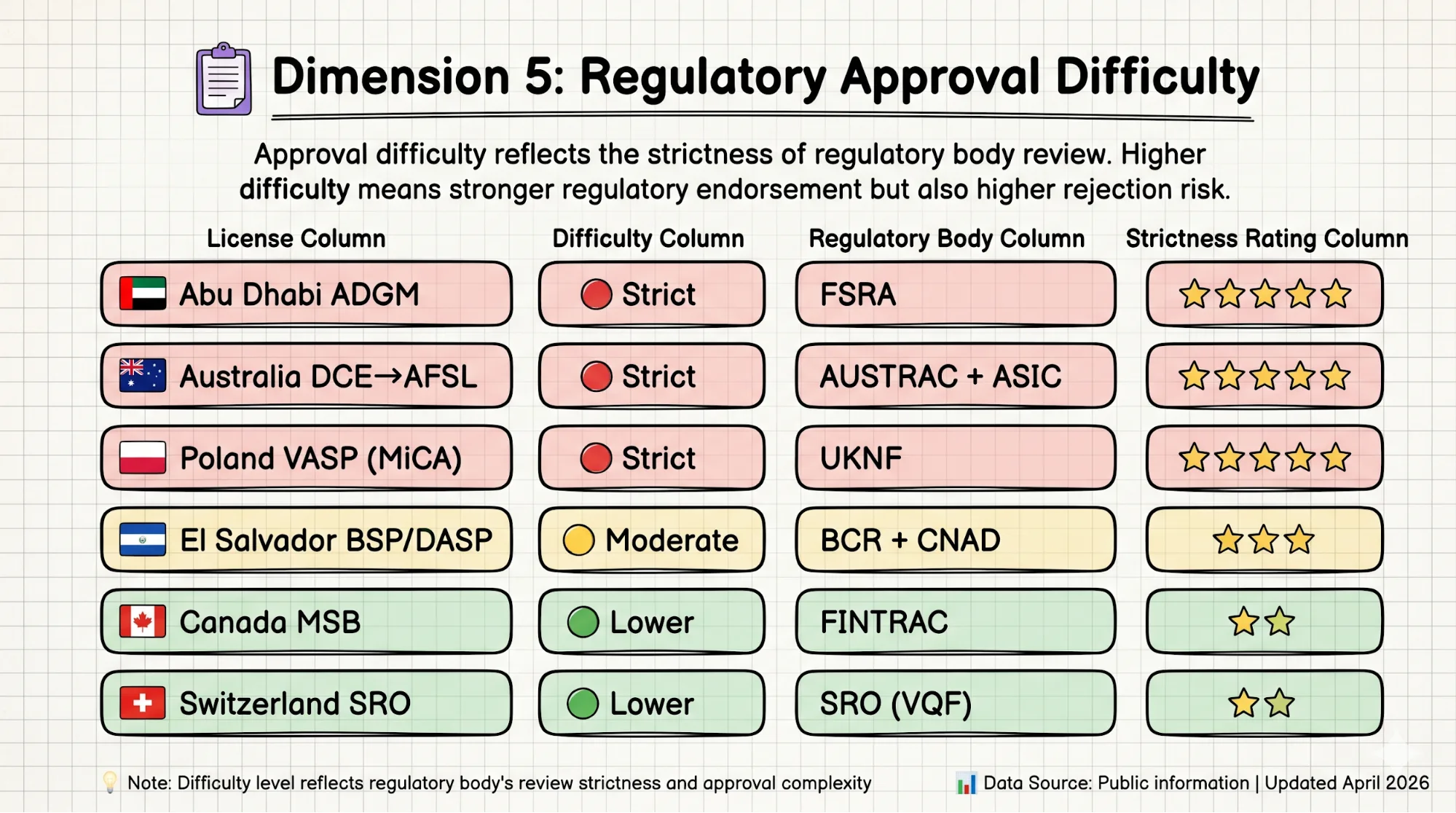
- ADGM: The most stringent. The FSRA interview is a major hurdle; inconsistent or unprofessional responses often lead to immediate rejection.
- Australia & Poland: Strict. Dual-agency oversight in Australia and UKNF scrutiny in Poland leave little room for error.
- Switzerland (VQF) & Canada (FINTRAC): Generally higher approval rates, provided documentation is professional and complete.
6. Branding & Credibility
What does the license say to your partners and institutional clients?
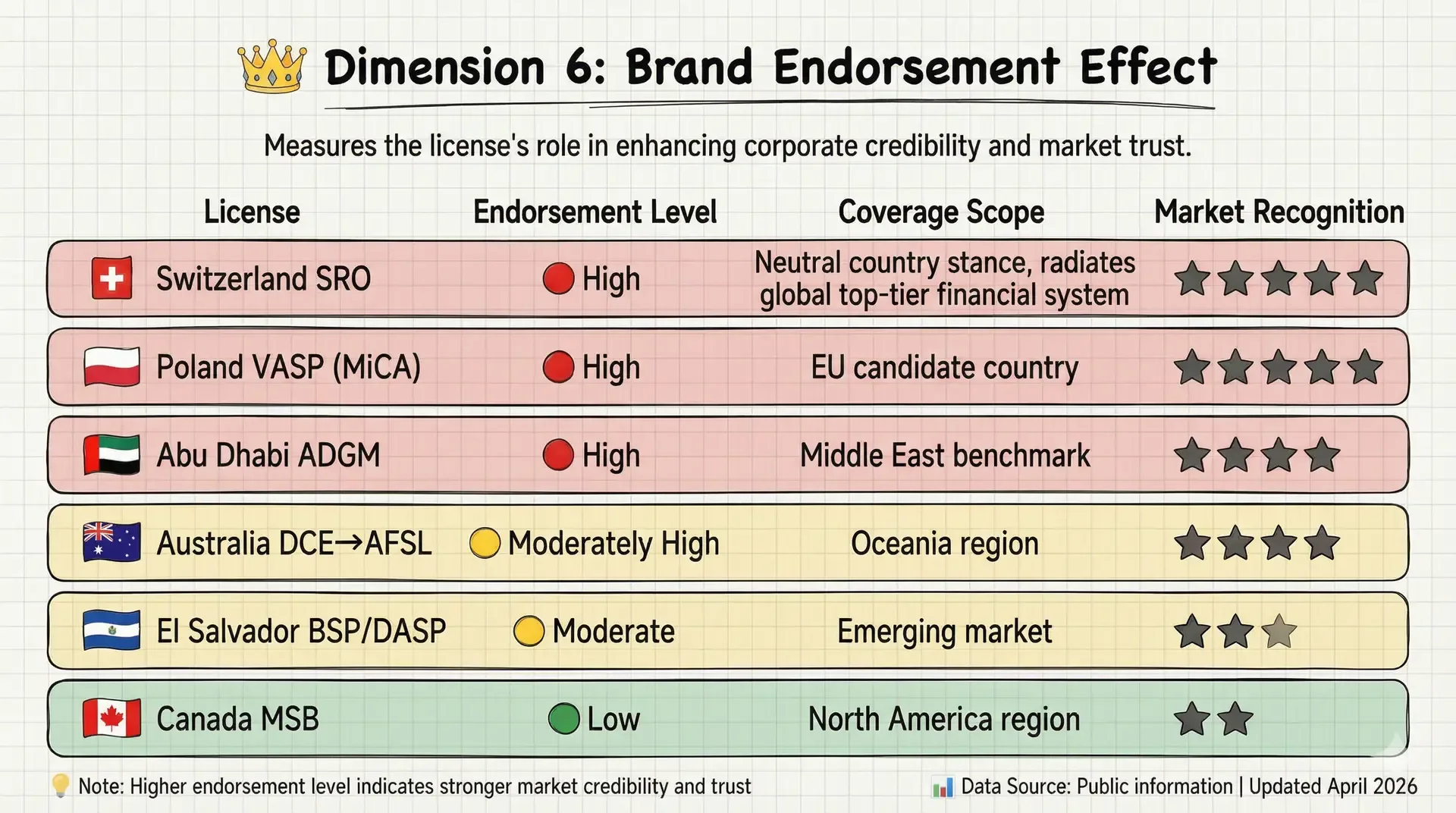
- Switzerland & Poland (High): Switzerland offers “Gold Standard” prestige for high-net-worth individuals. Poland offers (eventual) EU-wide passporting rights under MiCA.
- ADGM (High): The benchmark for the MENA (Middle East and North Africa) region. Essential for institutional credibility in the Gulf.
- Australia (Medium-High): Strong regional reputation in Oceania.
- El Salvador (Emerging): Gaining traction for stablecoin issuers and firms looking for a “crypto-native” friendly jurisdiction.
- Canada (Low-Medium): Often viewed as an entry-level license; less weight with major global institutions.
III. Practical Advice from the CryptoLicense Team
Building on the six-dimensional comparison above, we would add several observations drawn from real-world mandates:
- A higher price tag does not mean a better fit, and faster is not always the right answer. Canada’s MSB regime is cost-efficient and relatively quick to obtain, but its utility is limited if your target clients are European institutions. By contrast, Abu Dhabi’s ADGM framework involves higher costs and longer timelines, yet it can be a rational investment if your objective is to establish long-term credibility in the MENA market.
- For entering the EU market, a Swiss SRO structure is often more stable than a Polish VASP registration. Ongoing legislative developments in Poland have introduced a meaningful degree of uncertainty, requiring a reassessment of both time and opportunity costs.
- Localization requirements are a frequently underestimated hidden cost. Many projects account for application and legal fees upfront, but overlook expenses such as local directors’ compensation, compliance officer hiring, and the ongoing cost of maintaining a physical office. In practice, these can materially widen the funding gap.
- For jurisdictions in regulatory transition, build in a buffer for uncertainty. Both Poland and Australia are currently in periods of policy evolution. If your timeline is tight, positioning these jurisdictions as secondary options rather than primary choices is often a more prudent approach.
Final Thoughts
Choosing a jurisdiction is the foundation of your Web3 compliance strategy. While this framework provides a roadmap, the devil is in the details. Regulators today demand high-granularity documentation: from your system architecture and risk management protocols to your AML/CFT manuals.
There is no such thing as a “copy-paste” compliance manual. Using templates often leads to grueling rounds of RFI (Request for Information) from regulators or outright rejection.
If you are evaluating your next move or need help refining your application materials, contact CryptoLicense. We’ll help you clear the hurdles and secure your operational future.