

Decoding Binance's 20+ License Empire: What Can Web3 Founders Learn from Its 9-Year Journey?
Over the years, we have witnessed the global crypto industry being dragged from the regulatory gray zone into the harsh light of strict oversight.
If there’s one case study that perfectly illustrates this transition, it’s undoubtedly Binance.
It has navigated almost every pitfall of the industry’s wild early days and, in a remarkably short time, evolved into a top-tier exchange that relies heavily on a robust compliance framework.
From its founding in 2017 to the present, Binance’s compliance trajectory is essentially a microcosm of the crypto industry’s regulatory evolution, offering a wealth of actionable insights.
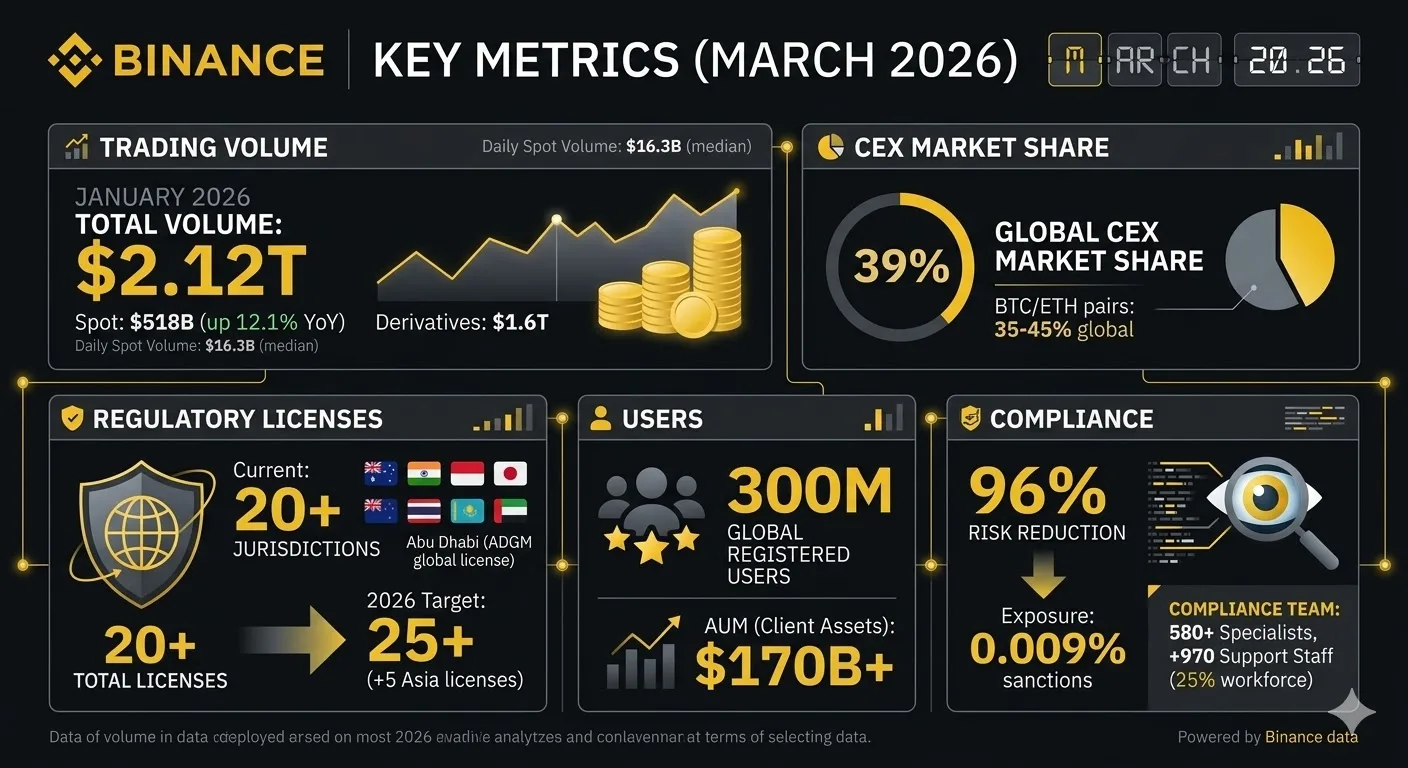
From wild growth to a compliance leader, Binance now holds over 20 regulatory licenses — including Abu Dhabi’s ADGM — and commands nearly a 40% market share among centralized exchanges (CEXs).
Looking back at this journey and based on public records, CryptoLicense has broken down Binance’s 9-year compliance evolution into four distinct phases:
- 2017–2020: The Regulatory Arbitrage Era – Explosive Growth
- 2021–2022: The Regulatory Awakening – From Patching Holes to Building Frameworks
- 2023: The US Crackdown and Settlement – Compliance as a Survival Imperative
- 2024–2026: The Proactive Rebuilding Phase – Reshaping Business Boundaries Through Compliance
Next, CryptoLicense will walk through this timeline from the perspective of a seasoned compliance practitioner: what happened back then, and what lessons we can draw from it today.
I. 2017–2020: The Regulatory Arbitrage Era – Explosive Growth
Rewind to 2017, when Changpeng Zhao (CZ) and his team founded Binance in Shenzhen.
Riding the explosive wave of the ICO boom, Binance seemed to scale overnight. At the time, the crypto industry was in a classic era of “undefined rules, fierce competition.”
Starting in this environment, Binance made a pivotal strategic choice (partly driven by the policy climate at the time): it refused to anchor itself to a single, defined regulatory jurisdiction. With no fixed headquarters, its operations and servers were distributed across multiple countries. This decentralized structure allowed it to sidestep direct oversight from any single regulator in its early days.
Simultaneously, its product suite expanded rapidly. Spot trading, futures, and margin trading were rolled out, driving user numbers past the 10-million mark in record time. Onboarding friction was minimized — an email address was all it took to open an account, and KYC (Know Your Customer) was optional. This design supercharged user acquisition and fueled the platform’s rapid global expansion.
By 2019–2020, regulatory scrutiny began to tighten. Authorities across multiple countries issued warnings, focusing heavily on Anti-Money Laundering (AML) and investor protection. Binance started testing the waters by applying for licenses in select jurisdictions, but its overall rhythm remained: growth first, compliance later.
During this phase, Binance achieved massive scale at lightning speed—while simultaneously accumulating a massive regulatory debt that would later demand a centralized reckoning.
Practitioner’s Insight: The Window of Opportunity is Just Delayed Settlement
In retrospect, this was a textbook “window of opportunity” strategy.
With regulations unformed and market dividends clear, prioritizing scale was an understandable choice. However, it’s crucial to recognize that this strategy doesn’t eliminate risk; it simply defers it.
Once a systematic regulatory framework emerges, all past decisions made in the “gray zone” will be scrutinized—often under much stricter standards.
For industry practitioners, there are three highly practical takeaways:
- A regulatory vacuum is not a safe harbor; it is a zone of delayed reckoning.
- Every action leaves a trail, and one day, you will be required to explain it.
- In the early stages, compliance might not dictate every business decision, but it must at least leave a clear paper trail of risk awareness.
Many issues didn’t arise because risks were ignored at the time, but because there was no documentation to prove that the platform was “aware of and managing” those risks.
II. 2021–2022: The Regulatory Awakening – From Patching Holes to Building Frameworks
Following four years of hyper-growth, 2021–2022 marked Binance’s first true baptism by regulatory fire.
The most defining shift in this phase was the concentrated release of regulatory pressure.
The United States emerged as the core variable. The CFTC and SEC successively investigated whether Binance offered unregistered derivatives to US users and whether its geo-blocking measures were being circumvented.
Meanwhile, authorities like the Ontario Securities Commission in Canada demanded that the platform either register or exit the local market. Through multiple rounds of dialogue, Binance experienced instances of “announcing an exit but delaying execution,” gradually breeding regulatory distrust regarding its compliance commitments.
Simultaneously, regulators across Europe and Asia issued risk warnings, explicitly calling out Binance for operating without authorization. The glaring shift was that regulators pivoted from merely “warning about risks” to “demanding action.”
Under this mounting pressure, Binance’s response underwent a substantive transformation.
First came the comprehensive rollout of mandatory KYC. Starting in 2021, new users were required to complete identity verification, a policy that was gradually extended to existing users. Accounts failing to verify faced restrictions on core functionalities.
Next was the systematic development of an AML/CFT (Anti-Money Laundering/Combating the Financing of Terrorism) framework. According to later disclosures, Binance began establishing an enterprise-wide risk assessment mechanism to identify and monitor high-risk users, regions, and trading behaviors.
Even more critical were organizational changes. The compliance team scaled rapidly, recruiting professionals with traditional finance backgrounds. Compliance transitioned from a peripheral role to a seat at the core decision-making table.
Ultimately, this phase saw Binance shift from a reactive “patching vulnerabilities” mode to actively architecting a comprehensive compliance framework.
Practitioner’s Insight: Compliance Transforms from Patchwork to Systems Engineering
The most significant change during this period wasn’t the volume of remediation, but the fundamental shift in the logic of compliance.
1. Compliance cannot be built on a foundation of "constant explaining."
A single issue might be viewed as an isolated case, but repeated cross-jurisdictional failures will be deemed a systemic flaw by regulators. Once trust is depleted, the cost of all future regulatory dialogue skyrockets.
2. KYC is never just a tool; it’s the starting point for business restructuring.
The real challenge isn’t implementing ID verification—it’s accepting the churn of high-risk users, adjusting account permissions based on risk profiles, and successfully integrating KYC with transaction monitoring and reporting mechanisms.
3. The ceiling of compliance is determined by its voice within the organization.
If compliance is relegated to “post-mortem patching,” issues will inevitably recur. Only when the compliance team has the authority to participate in—and potentially veto—key decisions can remediation evolve into a sustainable mechanism.
Starting from this phase, compliance was no longer just a cost center; it became the foundational capability dictating whether a platform could continue to operate.

III. 2023: The US Crackdown and Settlement – Compliance as a Survival Imperative
If one were to draw a dividing line in Binance’s history, 2023 is undeniably the clearest inflection point.
This year saw a concentrated explosion of US regulatory actions, which rapidly escalated into a systemic shock.
In March, the CFTC sued Binance and CZ, alleging the operation of an unregistered derivatives platform and intentional evasion of US oversight, even citing internal chat logs as evidence. In June, the SEC filed a broader lawsuit, escalating the allegations to highly sensitive areas like the mishandling of customer funds.
This regulatory pressure quickly bled into business operations. Binance’s banking relationships in the US deteriorated rapidly, fiat on/off ramps were crippled, market liquidity dropped significantly, certain trading pairs traded at a discount, and overall market depth was weakened.
In November, the saga culminated in a historic settlement. Binance reached an agreement with the US Department of Justice, paying a staggering $4.3 billion fine, while CZ pleaded guilty and stepped down as CEO. The public filings not only systematically detailed the platform’s early violations but also thoroughly documented its remediation efforts in AML and sanctions compliance over the prior two years.
Ultimately, this was not just a hefty fine; it was a centralized reckoning of historical debts.
Practitioner’s Insight: After the Settlement, True Development Begins
For compliance professionals, this settlement served as a masterclass.
1. What do regulators actually care about?
Regulators will piece together years of behavior—spanning product design, internal communications, and public statements—to construct a comprehensive narrative of “intentional regulatory evasion.” Once this narrative takes hold, isolated issues are no longer treated as standalone incidents.
2. A settlement is not an end; it’s the beginning of an intensified probation.
After admitting to historical flaws, every new move the platform makes will be scrutinized under much harsher standards. For the compliance team, this means risk assessment must be proactive, not reactive.
3. The role of compliance fundamentally shifts.
A $4.3 billion fine fundamentally alters a company’s internal risk perception. The true existential threat to a platform is no longer just business failure, but cross-jurisdictional compliance crises.
From this moment on, compliance ceased to be merely a cost; it became the foundational capability determining a company’s very survival.
Simultaneously, a noticeable shift occurred: compliance became “outward-facing.” The platform began proactively disclosing its remediation measures, risk control workflows, and related metrics, explaining the value of its compliance architecture in a highly accessible way.
For practitioners, this drives a very practical pivot: it’s not enough to just build good compliance; you must also make the business and the broader market understand why it matters.
IV. 2024–2026: The Proactive Rebuilding Phase – Reshaping Business Boundaries Through Compliance
Post-settlement, Binance didn’t just sit back in a state of passive remediation. Instead, it aggressively leveraged its compliance capabilities to restructure its core business.
The most visible changes surfaced first at the organizational level.
In 2024, Binance appointed Noah Perlman as Chief Compliance Officer. His background sent a strong signal: an executive with deep prosecutorial and traditional finance experience was entering the core decision-making circle.
In his subsequent public remarks, he repeatedly emphasized a crucial pivot: moving from “reactive compliance” to “preventative compliance.”
Simultaneously, Binance’s compliance team expanded rapidly, significantly increasing its share of the total headcount. Data shows that between 2023 and 2025, the platform slashed its direct exposure to suspicious and sanctions-related accounts by over 90%.
The logic behind this shift is clear: compliance is no longer about putting out fires; it’s about identifying and neutralizing risks before they ignite.
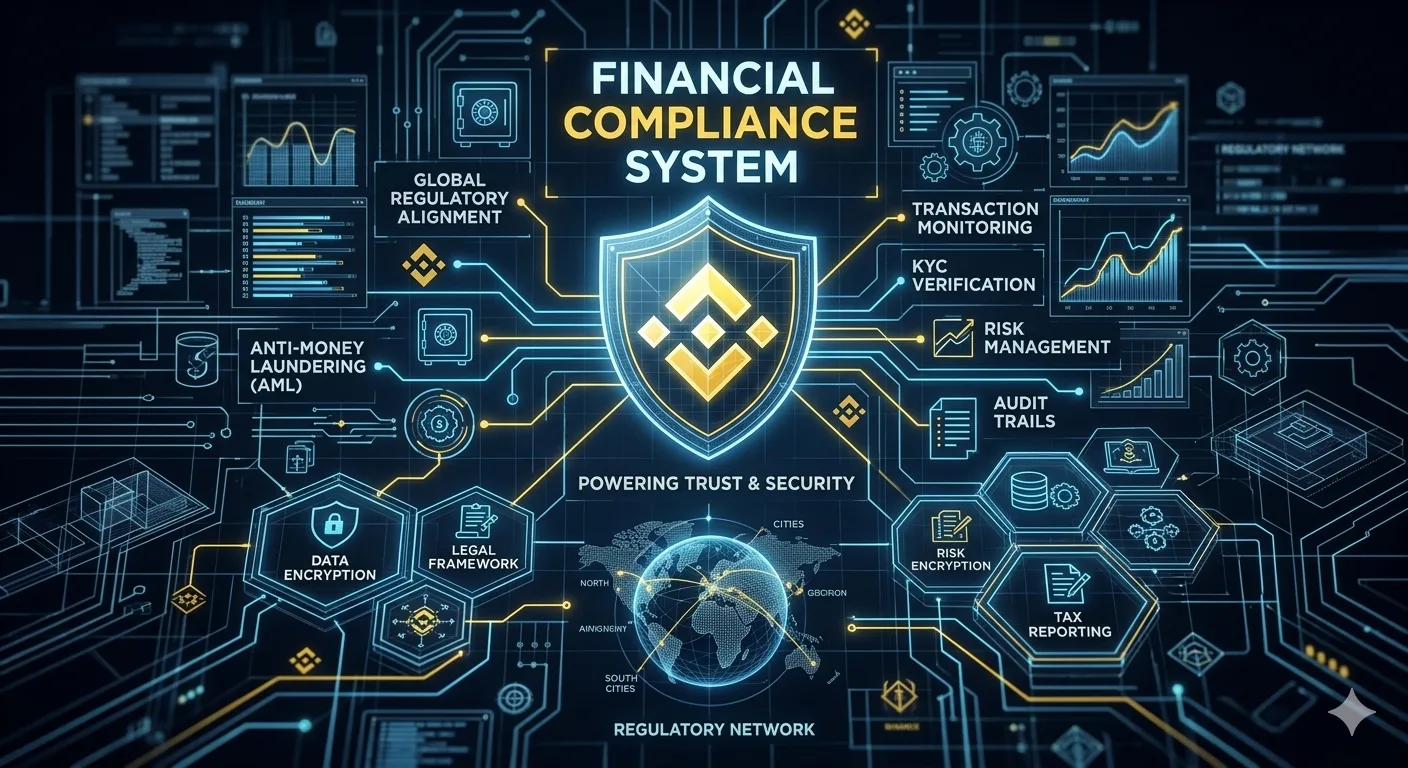
Another major storyline is the strategic pivot in its licensing approach.
If the early days were characterized by a “build wherever we can” mentality, this phase was about establishing anchors in key jurisdictions. By 2024–2025, Binance had secured various licenses or registrations in at least 15 jurisdictions. A landmark moment came in 2025 when it obtained a comprehensive regulatory permit from Abu Dhabi’s ADGM covering exchange, brokerage, and custody services—cementing it as a core compliance hub for Binance.
At the same time, it made strategic trade-offs: initiating a phased retreat from high-pressure markets like the US, while doubling down on expansion in the Middle East and Asia. By early 2026, public statements indicated plans to secure multiple new licenses across Asia, pushing its regulated footprint past 20 jurisdictions. This clearly signals a trajectory where “business expansion is inextricably tied to compliance capability.”
Finally, a critical shift occurred in how Binance communicated externally.
Instead of merely repeating “we are compliant,” Binance began wielding hard data. For instance, it highlighted how its sanctions-related risk exposure plummeted from 0.284% in early 2024 to 0.009% by mid-2025, and how its overall exposure to suspicious funds dropped by nearly 96% over two years. These metrics essentially transformed compliance into a quantifiable, systemic capability.
From an industry perspective, the shift during this phase is equally stark.
Historically, the competition was about listing speed, leverage limits, and trading fees. But entering 2024, a new consensus emerged: the ability to survive compliantly in major jurisdictions is now the baseline prerequisite for competing at all.
In this sense, Binance serves as a magnified case study. It has traversed the entire path from “regulatory arbitrage” to “licensed operations,” laying bare both the immense costs and the ultimate rewards.
Practitioner’s Insight: Compliance Enters the True Competitive Arena
The most vital takeaway from this phase is that compliance now directly dictates business boundaries.
1. Compliance capability dictates market access.
Lacking a license doesn’t just mean “you can’t operate here”; it means you forfeit the right to participate in mainstream markets altogether. Compliance has evolved from a hurdle into the ultimate entry ticket.
2. Compliance must be quantified and communicated.
Simply meeting regulatory minimums is no longer enough. You must use data to prove that risks are declining and frameworks are effective, ensuring both internal business units and external markets grasp the value of your compliance efforts.
3. The logic of industry competition has flipped.
In the past, the game was won on product speed and low fees. Today, the winners are those who can sustain operations within a strict regulatory framework and scale their business on top of it.
Looking at the longer macro-cycle, this phase marks the industry’s transition from early, chaotic sprawl to structured competition built on a bedrock of compliance.
For any team still navigating license applications or strategic mapping, this isn’t just a trend — it’s the inescapable reality.
V. Looking Back from 2026 – Honest Reflections from a Veteran Compliance Practitioner
At this point, CryptoLicense wants to draw on years of frontline compliance experience and numerous consulting cases across different growth stages to share some hard-earned, repeatedly validated insights.
Bridging the Time Gap: Balancing Compliance and Business Growth
Looking back at Binance’s global compliance journey, one glaring observation stands out: the pace of business growth and the pace of regulatory formation are rarely perfectly synced. There is almost always an unavoidable time gap—and compliance typically operates right in that gap.
Often, our job isn’t executing a crystal-clear rulebook; it’s anticipating the trajectory of rules before they fully crystalize.
However, in practice, there’s a harsh reality: while compliance is critical, it shouldn’t become a bottleneck that stalls business momentum. The true challenge lies in helping the business find a path forward in an uncertain regulatory environment—without crossing the red line.
When this translates into daily operations, two specific types of judgment become paramount:
- Proactively sensing regulatory boundaries and balancing growth with compliance so that the latter doesn’t impede the former during periods of hyper-growth.
- Having the courage to clearly articulate hidden costs that might surface two or three years down the line, ensuring that decisions during overly optimistic growth phases aren’t purely short-sighted.
From this perspective, the core of compliance work is largely about managing this chronological misalignment and finding a sustainable equilibrium between regulatory demands and business velocity.
Making Mistakes Isn't Fatal — Failing to Learn From Them Is
Looking back at Binance, many of its early missteps would be considered severe through the lens of traditional finance.
But from another angle, it undeniably accelerated the industry’s drive to clarify many previously ambiguous gray areas in record time.
Regulators made standards far more concrete through settlements and enforcement actions; platforms built more robust systems through remediation; and the role of compliance steadily migrated from the periphery to the very core.
Therefore, for practitioners, the more pressing question to ask after every crisis is: Did this leave us with something reusable?
It’s not enough to just write a post-mortem report and move on. You must dig deeper: Did this hard lesson translate into a new workflow, a set of metrics, or a hard boundary that won’t be easily crossed again?
If not, the same problem hasn’t been solved; it’s merely been postponed.

Compliance is Not a Department; It’s Critical Infrastructure
A distinct shift over the past two years is that compliance is organically “growing” into business systems, rather than remaining siloed within a specific department.
It’s no longer just the responsibility of the legal or compliance team; it’s increasingly embedded into product design, risk-control algorithms, and every touchpoint of user service.
Every step a user takes—from onboarding to account usage to fund transfers — is continuously governed and interpreted by a cohesive regulatory framework.
In this environment, the very nature of compliance has evolved. What was once seen as a mere “process checkpoint” has matured into a foundational, underlying support structure.
Placed in a more realistic context, practitioners might ask themselves these questions:
- Can our current compliance setup still be bypassed or deferred, or is it already inextricably linked to the core business?
- Over the next three years, where in the operational pipeline will the most impactful regulatory changes hit our company?
These questions rarely have standard answers, but the earlier you start asking them, the lower the ultimate cost will be.
VI. Navigating the Compliance Path with CryptoLicense
Looking at Binance over the past 9 years, it’s hard to view its journey simply as a corporate history. Instead, it serves as a highly compressed evolution of the entire crypto industry’s relationship with regulation.
From its initial hyper-growth, through continuous course correction, and finally into systemic rebuilding, a stark reality emerges: the larger the platform, the more intense the regulatory scrutiny. CZ himself expressed this bluntly in his early 2025 podcast.
Today, for the vast majority of Web3 enterprises, the question is no longer “Should we be compliant?” but rather, “How compliant do we need to be just to stay at the table?”
Binance’s path is amplified, and many of its milestones were extreme. But precisely because of this, it provides a crystal-clear reference point. You don’t have to agree with all of its choices, but it’s impossible to ignore the hard-won lessons and the massive costs they’ve validated.
If you are currently mapping out your own compliance strategy — whether it’s applying for licenses, designing your legal architecture, or fine-tuning existing frameworks — the key is finding an approach that perfectly matches your current business stage.
CryptoLicense has deep, frontline experience in crypto compliance, having partnered with projects across various stages and with diverse needs. If you have questions or want to further refine your compliance roadmap, feel free to reach out to us.