

How Compliance Is Reshaping the Crypto Market: 2025 Review & 2026 Outlook
Table of Contents
As 2025 draws to a close, a subtle but consequential shift is underway across the global digital asset industry. Markets continue to expand and innovation has not slowed, yet the forces shaping the industry’s long-term trajectory are increasingly moving beyond technology and narratives toward rules, institutions, and compliance capabilities themselves.
For market participants, identifying where opportunities lie has become inseparable from understanding regulatory direction. Against this backdrop, CryptoLicense presents the Global Compliance Review and Outlook 2025.
This report takes a macro view of the global regulatory landscape, reviewing key developments in 2025, examining why stablecoin regulation has emerged as a central policy focus, and surveying major regulatory developments across jurisdictions alongside their potential trajectories into 2026. Where relevant, we also highlight critical regulatory milestones and extract compliance signals that may serve as practical reference points for the year ahead.
In an environment where regulatory momentum continues to accelerate and information remains highly fragmented, this report aims not only to clarify what happened over the past year, but also to provide a more stable and comparable framework for decision-making and strategic planning in the next phase of market development.
From Policy Signals to Market Structure
Over the past year, regulation has begun to embed itself systematically into the structure of the crypto market. Across stablecoins, crypto-asset service providers, and cross-border payments and custody arrangements, regulatory measures are no longer emerging as isolated policy actions. Instead, they are taking shape as increasingly coherent, executable frameworks.
Regulatory focus has shifted visibly from whether to regulate toward how to regulate in a granular, sustainable manner. Compliance thresholds, technical requirements, and cross-border supervisory coordination have risen in tandem, with compliance evolving from a constraint into a foundational layer of market infrastructure.
From a global perspective, CryptoLicense observed several converging trends in 2025:
- Stablecoin regulation entered an implementation and operationalization phase across multiple jurisdictions
- Licensing frameworks for crypto-asset service providers became more granular and standardized, with higher entry thresholds
- AML, CFT, and data transparency requirements intensified materially
- Enforcement cadence stabilized, improving regulatory predictability
- Traditional financial institutions re-engaged with digital assets under clearer compliance conditions
Taken together, these developments signal that compliance is no longer a peripheral risk management consideration. Instead, it is becoming a decisive variable in determining whether institutions can enter markets, access financial infrastructure, and sustain long-term growth.
The sections that follow examine these trends in detail. We begin with a global overview of regulatory developments in 2025, explore why stablecoin oversight has emerged as a focal point, and then review major jurisdictional developments alongside their implications for 2026. Throughout, we anchor the analysis to key regulatory timelines and extract compliance signals with practical relevance for the year ahead.
2025 in Review: Compliance Takes Shape, Stablecoins Move to the Center
1. Macro Overview: From Market Recovery to Structural Rebuilding
2025 was less a year of recovery for the digital asset market than one of reconstruction. After prolonged volatility and erosion of trust, the industry did not return to unchecked growth, but instead began rebuilding around clearer rules and institutional discipline. Innovation continued, but it became evident that long-term viability now depends on regulatory frameworks and compliance capabilities, not narrative momentum alone.
Regulators, for their part, shifted focus from reacting to individual risk events to building sustainable, long-term oversight structures. Frameworks introduced in prior years moved decisively into implementation in 2025, as licensing regimes, stablecoin rules, and AML and data governance requirements transitioned from policy design to enforcement. Regulation did not become looser, but more targeted. Business models are increasingly differentiated by risk profile, reducing regulatory uncertainty and establishing compliance as a baseline condition for market participation.
2. Stablecoins as the Primary Regulatory and Market Focus
Among all regulatory themes, stablecoins emerged as the most consequential focal point in 2025. As market capitalization reached new highs, regulatory activity accelerated. Across more than 30 key jurisdictions, roughly 70% are now advancing or refining stablecoin-specific frameworks.
Regulatory attention reflects stablecoins’ dual role: they combine price stability suitable for payments with deep integration into both fiat and on-chain systems, amplifying systemic risk. In response, regulators have moved toward dedicated regimes governing issuance, reserves, redemption, and disclosure. From the EU’s MiCA framework to initiatives in the US, Asia, and the Middle East, a common direction is evident: credible asset backing, enforceable redemption rights, and ongoing issuer-level compliance.
For institutions, stablecoins have also become a practical entry point into digital assets. As regulatory clarity improved, participation from banks and financial institutions increased, particularly in jurisdictions with defined and innovation-aware frameworks. By 2025, around 80% of major regulated markets had seen formal institutional engagement with digital asset initiatives.
Taken together, 2025 marked not a tightening of regulation, but the formation of a coherent regulatory logic. Stablecoins sit at the center of this shift, offering a clear window into how compliance is reshaping the crypto market—and setting the stage for developments in 2026.

Global Crypto Regulatory Watch: Key Jurisdictions and Outlook
Europe, Middle East and Africa
Switzerland: Technology-Neutral Precision and an Evolving Legal Framework
In 2025, Switzerland continued to strengthen its regulatory positioning of supporting innovation while tightly controlling risk. Rather than expanding licensing volume, regulators focused on refining legal structures and supervisory expectations, ensuring that new digital asset activities develop within a stable and clearly defined framework.
2025 Review: Innovation in Practice and Regulatory Precision
- Risk-based and technology-neutral supervision reinforced
FINMA reaffirmed its risk-based, technology-neutral supervisory approach, first articulated in its 2024 Annual Report. In 2025, this principle was reflected in licensing decisions that emphasized economic substance and risk controls over technical design. - First DLT trading facility license issued
In March, FINMA granted Switzerland’s first distributed ledger technology (DLT) trading facility license to BX Digital under the 2021 DLT Act, providing a clear legal foundation for on-chain trading infrastructure. - Regulatory scrutiny focused on operational and technical risks
During the approval process, FINMA placed particular emphasis on operational resilience, business continuity, and risk management for public blockchains and smart contracts, signaling that technology neutrality does not equate to reduced compliance standards. - Continued institutional engagement in digital assets
In September, the Swiss Bankers Association, PostFinance, Sygnum, and UBS completed a proof of concept for tokenized Swiss franc deposits. In October, UBS supported a jointly backed stablecoin initiative based on G7 currencies, reflecting sustained institutional investment in compliant digital asset models. - Proposed restructuring of licensing regimes
In October, Switzerland proposed amendments to the Financial Institutions Act to replace the existing fintech license with two dedicated regimes: a payment instrument license for stablecoin issuers and a crypto institution license. The consultation period runs through February 2026.
- Tax transparency and international alignment advanced
In February, the Federal Council confirmed the implementation of the OECD’s Crypto-Asset Reporting Framework (CARF) from January 1, 2026, aligned with the EU’s DAC8. In October, the EU Council approved corresponding tax information exchange arrangements with Switzerland.
2026 Outlook: Regulatory Refinement and Global Integration
In 2026, Switzerland is expected to finalize its revised crypto licensing framework, offering more targeted regulatory pathways for stablecoins and crypto service providers. At the same time, CARF implementation will further integrate Switzerland into global compliance networks while maintaining its appeal as an international financial center.
United Kingdom: Rules First and a Domestic Crypto Regulatory Framework
In 2025, the UK accelerated the build-out of a comprehensive, domestically tailored crypto regulatory framework. Rather than prioritizing rapid licensing, regulators focused on extensive consultation and rule design to establish long-term foundations for market integrity, stablecoin governance, and financial crime prevention.
2025 Review: Intensive Policy Design
- FCA consultations define the market integrity regime
Throughout 2025, the Financial Conduct Authority (FCA) issued multiple discussion and consultation papers covering market abuse and disclosure (DP24/4), trading venues and intermediaries, lending, staking, and DeFi (DP25/1). The FCA proposed a dedicated Market Abuse Regime for Cryptoassets (MARC) and token admission disclosure rules. Parallel consultations on stablecoin issuance and custody (CP25/14) and prudential requirements (CP25/15) point to final rules in 2026. - Cryptoassets brought into core financial services legislation
HM Treasury published draft statutory instruments to bring qualifying cryptoassets and stablecoins under the Financial Services and Markets Act, requiring relevant activities to be conducted by FCA-authorized firms. This marks a clear step toward integrating crypto into the UK’s mainstream regulatory perimeter. - Systemic GBP stablecoins regulated separately
In November, the Bank of England (BoE) consulted on a distinct framework for systemic sterling stablecoins, proposing temporary holding caps to limit deposit outflows. While controversial, the BoE emphasized that these measures are transitional and subject to revision as risk assessments evolve. - AML and sanctions enforcement strengthened
The 2025 National Risk Assessment upgraded crypto-related money laundering risk to “high”, reflecting increased reliance on on-chain analytics by UK authorities. The Office of Financial Sanctions Implementation (OFSI) released its first crypto sanctions threat assessment, requiring firms to monitor multi-hop transactions and report exposure. Enforcement actions against Russia-linked crypto entities and ruble-pegged stablecoins intensified during the year. - Cross-border coordination advanced
In September, the UK and the US launched a Transatlantic Future Markets Working Group to coordinate capital markets access and crypto policy, underscoring the UK’s active role in global rule-setting.
2026 Outlook: From Consultation to Implementation
In 2026, attention will shift to whether the UK can convert extensive consultations into clear and enforceable rules. In stablecoins, market integrity, and financial crime controls, the UK is positioned to develop a structured and differentiated regulatory model, with competitiveness hinging on execution speed and international alignment.
European Union: MiCA in Full Effect, Enforcement Divergence Emerges
In 2025, EU crypto regulation moved decisively from framework design to full-scale implementation. With MiCA taking effect, stablecoin issuers and crypto-asset service providers (CASPs) were brought under a unified regime. At the same time, differences in national enforcement approaches began to surface, creating tangible implications for cross-border operations.
2025 Review: Implementation Amid Diverging Enforcement
- MiCA enters force, focus shifts to enforcement and ongoing compliance
MiCA’s core CASP rules became effective at the end of 2024, making 2025 the first full year of enforcement. ESMA began publicly disclosing authorized firms and non-compliant entities, tying regulatory compliance directly to market visibility and operational continuity. - Stablecoins subject to strict regulation with clear transition limits
The EU set firm adjustment deadlines for non-compliant ARTs and EMTs, requiring remediation or market exit by the end of Q1 2025. This signaled that stablecoin activities would not benefit from prolonged regulatory exemptions. - National enforcement differences challenge the single market
As MiCA rolled out, variations in licensing standards, risk controls, and market access became more evident across member states. Some regulators openly called for stronger EU-level coordination to reduce regulatory arbitrage. - DORA takes effect, expanding the compliance scope
The Digital Operational Resilience Act (DORA) became applicable to crypto firms in 2025, introducing unified requirements for cybersecurity, incident reporting, and third-party risk management, significantly raising compliance expectations.
2026 Outlook: Convergence, Cross-Border Coordination, and Deeper Compliance
In 2026, EU attention is expected to shift toward narrowing enforcement gaps among member states and expanding AMLA’s direct supervision over selected CASPs. In parallel, the rollout of DAC8 tax information exchange is likely to further strengthen cross-border transparency and regulatory alignment.
Poland: MiCA Legislation Faces Setbacks as the Regulatory Framework Remains in Flux
In 2025, Poland became one of the most representative MiCA case studies in Central and Eastern Europe. While its regulatory direction aligned with EU-level objectives, domestic political dynamics significantly slowed implementation, leaving Poland temporarily not fully aligned with MiCA execution.
2025 Review: Legislative Progress Amid Political Intervention
- MiCA-aligned national bill advanced but failed to pass
Throughout 2025, Poland released and reviewed multiple drafts of the Crypto-Assets Market Act, aiming to fully transpose MiCA into national law. The bill designated the Financial Supervision Authority (KNF) as the competent authority for CASPs and sought to establish a comprehensive licensing, supervision, and enforcement regime broadly consistent with EU standards. - Presidential veto becomes a decisive factor
At a late stage of the legislative process, the Polish President exercised a veto, citing concerns over proportionality, civil liberties, and administrative burden. This decision forced the legislative process to restart, delaying MiCA’s local implementation. - Transitional arrangements remain uncertain
Although earlier drafts proposed transitional periods allowing existing VASPs to continue operations, the veto removed legal certainty around these provisions. As a result, market participants largely adopted a cautious, wait-and-see approach to compliance planning and business expansion.
2026 Outlook: Legislative Restart Under Growing EU Alignment Pressure
In 2026, Poland is expected to relaunch its MiCA transposition process, potentially revising politically contested provisions. As EU-wide regulatory convergence continues, pressure to accelerate alignment will intensify. Once the framework is enacted, CASP licensing, ongoing compliance, and enforcement practices are likely to become immediate focal points. Poland’s ability to balance regulatory compliance with market competitiveness will shape its role within the Central and Eastern European crypto landscape.
Austria: High-Threshold MiCA Implementation to Curb Regulatory Arbitrage
In 2025, Austria advanced MiCA implementation with a notably conservative approach. The Financial Market Authority (FMA) maintained stringent entry standards: under the previous VASP AML registration regime, only a small fraction of 79 applicants were approved. During the MiCA transitional period, just 4 of 13 existing CASPs obtained authorization as of end-November 2025, with remaining entities required to cease regulated activities by 31 December 2025.
Austria also joined France and Italy in calling for more consistent and rigorous MiCA enforcement across the EU. Looking ahead to 2026, the FMA is expected to further clarify its approach to ongoing supervision of authorized CASPs and maintain a cautious stance under the MiCA passporting regime.
France: Strict MiCA Interpretation, Regulatory Certainty over Rapid Expansion
In 2025, France continued to position itself as a high-standard MiCA enforcer. Regulatory priorities focused less on rapid licensing and more on ensuring a smooth transition from existing regimes to the EU framework, maintaining depth of compliance and supervisory consistency.
2025 Review: Structured Transition and Stringent Enforcement
- Clear MiCA transition path for incumbent institutions
By early 2025, eight CASPs had obtained MiCA authorization in France. A February decree formally aligned the Monetary and Financial Code with MiCA, providing registered entities with a structured pathway to complete transition by 2026, reflecting the AMF’s cautious approach. - Stricter regulatory interpretation and emphasis on EU consistency
France, together with Austria and Italy, called for stronger EU-level coordination, explicitly opposing cross-border regulatory arbitrage and signaling willingness to challenge weaker licensing regimes where necessary. - Rising domestic compliance requirements and active enforcement
Throughout 2025, the AMF incorporated EBA internal control and AML guidelines, ESMA market abuse rules, and reinforced its blacklist regime, with unauthorized platforms and major exchanges remaining under close scrutiny. - Deeper integration of digital assets into mainstream finance
Amendments to the Monetary and Financial Code introduced a crypto-asset collateral framework, indicating France’s intent to embed digital assets within its traditional financial legal structure.
2026 Outlook: Regulatory Certainty and European Coordination
In 2026, France is expected to maintain high compliance thresholds under the MiCA passporting regime and take a cautious stance on cross-border activity. Alongside advancing the Franco-German economic agenda, France is also likely to play a more active role in the digital euro, tokenised settlement, and EU digital financial infrastructure initiatives.
Germany: Rapid MiCA Implementation Balancing Enforcement and Market Appeal
In 2025, Germany demonstrated high execution efficiency under MiCA, accelerating licensing while maintaining strict standards. Compared with more cautious member states, Germany moved quickly to reinforce regulatory authority and strengthen its role as an EU crypto hub.
2025 Review: Fast Licensing with Strong Supervision
- MiCA licensing scaled rapidly, leading the EU
Following the inclusion of CASPs under MiCA in December 2024, BaFin approved 20 CASPs in 2025, accounting for roughly 30% of all EU approvals and placing Germany well ahead of other member states. - Diverse licensees and deep participation by traditional finance
Germany attracted both crypto-native firms and domestic banks and fintechs, reflecting a regulatory stance that is institution-friendly without lowering entry thresholds. - First euro-denominated stablecoin approved
On 1 August, BaFin authorized the first euro stablecoin under MiCA, issued by AllUnity, a joint venture of DWS, Flow Traders, and Galaxy Digital. Built on Ethereum (ERC-20), it targets compliant cross-border payments and institutional settlement. - Clear policy alignment with MiCA and the digital euro
Germany, alongside France, publicly supported building a competitive European crypto market anchored in MiCA and aligned with the digital euro and broader financial sovereignty objectives. - Intensified enforcement and cross-border cooperation
In 2025, Germany took part in major enforcement actions, including coordinated measures against sanctioned exchange Garantex and the seizure of over €25 million in crypto assets linked to money laundering cases.
2026 Outlook: Deeper Frameworks and Tax Transparency
In 2026, Germany is expected to continue steady MiCA licensing while consolidating its central role in EU crypto regulation. The domestic implementation of DAC8 under the CARF framework will extend oversight from market entry to ongoing tax transparency and cross-border coordination.
Netherlands: Rapid MiCA Rollout with Efficient Execution Under a Short Transition
In 2025, the Netherlands gained a clear first-mover advantage in MiCA implementation. With one of the EU’s shortest transition periods and a highly centralized licensing process, it completed the shift from national rules to MiCA swiftly, positioning itself as a reliable jurisdiction for compliant digital asset activity.
2025 Review: Short Transition, Fast Licensing
- Exceptionally short transition period
The Netherlands adopted a six-month MiCA transition period, ending on 30 June 2025, one of the shortest in the EU, significantly compressing adjustment timelines for existing firms. - Early and active licensing under MiCA
On the first day MiCA CASP rules took effect (30 December 2024), the Netherlands issued four licenses, followed by 14 additional approvals in 2025 (as of end-November). Early approvals accounted for over 20% of total EU licenses, second only to Germany. - AML standards fully aligned with traditional finance
In May 2025, the AFM published updated Wwft guidance for CASPs, strengthening requirements on CDD, transaction monitoring, beneficial ownership checks, and suspicious activity reporting. Crypto was formally treated as a core part of the financial system, not an experimental sector. - Innovation encouraged, governance prioritized
The AFM and DNB continued to support sandboxes and pre-licensing engagement, while making clear that innovation must be matched by robust governance and compliance, reflecting an “open but not lenient” approach.
2026 Outlook: From First-Mover Advantage to Regulatory Influence
In 2026, the Netherlands is expected to further refine MiCA supervisory practices and technical guidance, leveraging its early implementation experience to shape EU-level execution standards. The focus is likely to shift from speed to regulatory precision and cross-border replicability, strengthening its institutional influence within the EU crypto framework.
South Africa: From Licensing Oversight to Deeper Stablecoin and Systemic Regulation
In 2025, South Africa built on its existing crypto licensing regime by deepening its understanding of market structure and risk, laying the groundwork for the next phase of stablecoin and systemic regulation. Rather than tightening immediately, regulators focused on research, rule completion, and international alignment to improve supervisory effectiveness.
2025 Review: Stronger Regulatory Insight and Compliance Foundations
- Stablecoin oversight enters diagnostic phase
In March, the IFWG’s Crypto Asset Regulatory Working Group (CAR WG) released a stablecoin diagnostic report, identifying six local-currency stablecoins, all issued by non-bank entities. The report highlighted gaps in issuance oversight, governance, reserves, and redemption, and initiated a second phase to design a comprehensive framework. - Travel Rule implemented, FATF compliance improves
In April, Directive 9 of the Financial Intelligence Centre took effect, making South Africa one of the first African jurisdictions to implement the Travel Rule for crypto assets. By June, FATF confirmed substantial progress on grey-list remediation, pending only an on-site assessment, significantly improving South Africa’s compliance standing. - Enhanced data collection under the existing licensing regime
In October, the FSCA issued extensive information requests to over 240 licensed CASPs, covering business models, transaction volumes, risk management, AML/CFT controls, blockchain analytics, consumer protection, and stablecoin activity, with particular focus on FX compliance. - Regulatory focus shifts to market integrity and consumer protection
The scope of supervisory inquiries reflected a move from basic compliance checks toward effective oversight, emphasizing transparency, market integrity, and risk containment.
2026 Outlook: Clearer Stablecoin Rules and More Targeted Supervision
In 2026, South Africa is expected to formalize stablecoin issuance and service requirements based on the diagnostic findings, while further refining ongoing CASP supervision. Regulation is likely to remain innovation-friendly but increasingly precise and enforceable.
United Arab Emirates: Stablecoins and Tokenization Integrated into a National Framework
In 2025, the UAE’s digital asset regulation entered a mature phase. Regulatory focus shifted from parallel pilot regimes to a unified national strategy centered on stablecoins, tokenization, and AML, positioning the UAE as the most institutionally complete crypto jurisdiction in the Middle East.
2025 Review: From Fragmented Experiments to Unified Governance
- Stablecoin policy anchored in monetary sovereignty
By mid-2025, the Central Bank of the UAE (CBUAE) fully implemented the Payment Token Services Regulation (PTSR), allowing only dirham-backed stablecoins issued by licensed entities for domestic payments, while prohibiting foreign-currency and algorithmic stablecoins. This reinforced monetary sovereignty and set clear boundaries for compliant innovation. AE Coin became the first regulated AED stablecoin, with FAB and ADQ advancing similar initiatives. - ADGM expands the stablecoin regulatory perimeter
ADGM’s FSRA issued Consultation Paper No. 9, proposing to extend fiat-referenced token (FRT) regulation beyond issuance to custody, intermediation, and regulated use cases. It also outlined principles for accepting domestic and foreign stablecoins, potentially forming a regional classification benchmark in 2026. - Tokenization embedded into capital markets law
The Securities and Commodities Authority (SCA) refined its frameworks for securities and commodities tokens, formally integrating tokenized instruments into existing securities law. Trading and settlement are restricted to licensed venues or approved wallets, subject to strict AML and finality requirements. - AML and sanctions enforcement intensifies
In 2025, multiple exchange houses and insurance brokers were penalized for AML/CTF deficiencies. At the same time, the EU removed the UAE from its AML high-risk list, reflecting improved international confidence in enforcement effectiveness. - VARA transitions into a mature regulator
In May, Dubai’s VARA released Version 2.0 of its rulebooks, significantly raising governance, reporting, and compliance standards with defined remediation timelines. Continued civil enforcement against unlicensed operators signaled VARA’s shift from sandbox supervision to full-scale regulation.
2026 Outlook: Regional Benchmark with Global Alignment
In 2026, the UAE is expected to further align federal and free-zone regimes, refine stablecoin classifications and tokenization rules, and maintain close alignment with global AML and sanctions standards. Its ambition has moved beyond attracting activity toward establishing the Middle East’s most internationally credible digital asset regulatory framework.
Americas
United States: From Enforcement-Led Oversight to Parallel Legislation and Rulemaking
In 2025, the United States accelerated its approach to digital asset regulation, moving away from a fragmented, enforcement-driven model toward a more coordinated framework combining executive action, regulatory guidance, and legislation.
2025 Review: Marked Improvement in Regulatory Clarity
- Executive alignment and a “rules-first” signal
Early in the Trump administration, an executive order on digital assets set a pro-innovation tone, rejected retail CBDCs, and established the President’s Working Group on Digital Asset Markets (PWG). A cross-agency report released in July addressed stablecoins, market structure, payments, AML, and banking access, directing regulators to provide clearer guidance ahead of full legislative implementation. - Regulatory agencies move in closer coordination
The SEC launched Project Crypto to clarify token classification, custody, and trading rules while recalibrating its enforcement posture. The CFTC advanced registration and reporting frameworks in parallel, marking unprecedented coordination with the SEC. The OCC reopened pathways for bank custody and stablecoin issuance, while the Federal Reserve focused on wholesale tokenization and institutional settlement. - Breakthrough in stablecoin legislation
Congress passed the GENIUS Act, establishing a federal framework for stablecoin issuance, reserves, and audits. Broader market structure legislation continued to advance, with passage expected in early 2026. - State-level regulation continues to complement federal efforts
New York and California tightened licensing, capital, and consumer protection standards, while Wyoming launched the first state-issued stablecoin, adding institutional diversity to the regulatory landscape.
2026 Outlook: From Framework Formation to Full Implementation
In 2026, U.S. regulatory focus is expected to shift toward implementing stablecoin rules and finalizing market structure legislation. As federal and state regimes become more aligned, the U.S. is moving from regulatory uncertainty toward a more predictable and durable rule-based environment.
Canada: Gradual Tightening with Parallel Progress on Stablecoins and Payments
In 2025, Canada’s crypto regulatory framework remained broadly stable, while oversight of stablecoins and payment infrastructure advanced significantly. With the stablecoin transition period ending in late 2024, the Canadian Securities Administrators (CSA) fully implemented its dedicated stablecoin rules in 2025, complemented by a new central bank–led payments regime that further improved regulatory clarity.
2025 Review: Stablecoin Rules Move into Full Effect
- Stablecoin requirements formally enforced
CSA Staff Notice 21-333 entered operational phase, permitting only fiat-backed stablecoins denominated in CAD or USD, fully reserved, redeemable at par, and held with qualified custodians. Circle’s USDC became the first compliant stablecoin, while QCAD announced plans to align with the framework as Canada’s first regulated domestic stablecoin. - Retail payments regime goes live
The Retail Payment Activities Act (RPAA) and related regulations took full effect on September 8, 2025, placing retail payment service providers (PSPs) under the supervisory authority of the Bank of Canada. PSPs are now required to register, implement risk management and end-user fund safeguarding measures, and meet ongoing reporting obligations, strengthening transparency and system resilience. - Enforcement and AML oversight remain active
FINTRAC and the Royal Canadian Mounted Police continued enforcement actions against unregistered platforms and crypto-related fraud, reinforcing compliance expectations for virtual asset dealers and exchanges. - Stablecoins integrated into payment modernization plans
In November, the government confirmed stablecoins as part of Canada’s payments modernization agenda, with the Bank of Canada overseeing implementation. Stablecoins were formally distinguished from other crypto assets, and a two-year budget of approximately CAD 10 million was approved to support regulatory development.
2026 Outlook: Regulatory Clarity as the Enabler of Innovation
In 2026, attention will focus on how stablecoin and retail payment rules function in practice. The effectiveness of RPAA supervision and its interaction with crypto compliance requirements will be critical in shaping Canada’s capacity for payment innovation and broader digital asset market growth.
El Salvador: From Bitcoin Pioneer to Institutional Balance
In 2025, as the first country to adopt Bitcoin as legal tender, El Salvador continued to recalibrate its policy focus between innovation and risk control, maintaining its digital asset strategy while strengthening institutional constraints.
2025 Review: Policy Recalibration and Regulatory Progress in Parallel
- De-mandatory Bitcoin Legal Tender Status
In January, lawmakers amended the law to remove the obligation for merchants to accept Bitcoin, shifting to voluntary acceptance. This change was directly linked to IMF loan conditions tied to a USD 1.4 billion agreement, which also limited public-sector involvement in Bitcoin activities. - Continued Expansion of the Digital Asset Licensing Regime
The National Digital Assets Commission (CNAD) issued 26 new Digital Asset Service Provider (DASP) licenses in 2025, bringing the total to 60 as of December 1, 2025. CNAD also publicly warned against unauthorized operations failing to meet business plan or AML standards, reinforcing regulatory boundaries. - Regional Regulatory Cooperation and Rule Export
Mid-year, CNAD signed a cooperation agreement with the Central Bank of Bolivia, collaborating on blockchain intelligence tools and risk analysis, signaling El Salvador’s ambition to shape regional regulatory standards. - Formal Approval of Institutional Crypto Services
In August, new legislation allowed regulated financial institutions to apply for crypto-related services, limited to investment banks with at least USD 50 million in capital and restricted to high-net-worth clients with investable assets above USD 250,000.
2026 Outlook: Execution as the Key Test
In 2026, attention will focus on whether El Salvador can enforce risk controls while continuing license issuance, balancing innovation appeal with strengthened institutional credibility.
Mexico: Cautious Progress Under the FATF Spotlight
In 2025, as chair of the Financial Action Task Force (FATF), Mexico recalibrated its digital asset regulatory stance, strengthening AML alignment with international standards while maintaining a focus on financial inclusion.
2025 Review: AML Framework Significantly Strengthened
- Comprehensive AML Law Revision, Virtual Assets Brought Into Scope
In July, Mexico passed major amendments to its AML law (LFPIORPI), introducing risk assessments, designated compliance officers, and periodic audits, while expanding the scope of “high-risk activities.” Virtual asset activities were explicitly included, covering VASP services by non-financial entities, with clearer reporting thresholds and requirements. - Strict Controls on Virtual Assets Within the Financial System
Under the 2018 Fintech Law, virtual asset activities remain restricted to licensed financial institutions and require prior approval from the central bank (Banxico). To date, approvals remain rare, reflecting a consistently cautious regulatory stance.
2026 Outlook: Clear Rules, Restrained Pace
Mexico is prioritizing gradual institution-building over rapid market opening. In 2026, its regulatory approach is expected to continue emphasizing risk control and international coordination under the FATF framework.
Argentina: Parallel Push on Higher Entry Standards and Institutional Frameworks
In 2025, Argentina accelerated crypto asset regulation, focusing on raising VASP compliance thresholds while exploring a formal path for tokenized assets. The overall approach is more cautious, without closing off innovation.
2025 Review: Upgraded Registration Regime and Framework Formation
- Significantly Higher VASP Registration Requirements
Building on the VASP registry launched in March 2024 (GR 994), the National Securities Commission (CNV) issued GR 1058 in May 2025, adding requirements on AML, client asset segregation, cybersecurity, audits, and governance. Registered entities must submit supplementary compliance materials by Q3 2025 or lose registration, marking a shift from simple registration to substantive review. - Tokenized Assets Enter the Regulatory Sandbox
In June, CNV established a legal framework for tokenized assets via GR 1069 and GR 1081, launching a one-year sandbox pilot that signals conditional support for financial innovation. - Market Events Heighten Regulatory Urgency
Early-year volatility and investigations linked to a presidential meme coin incident underscored investor protection and market integrity risks, accelerating regulatory tightening.
2026 Outlook: Enforcement and Regulatory Predictability Take Center Stage
In 2026, attention is expected to focus on how effectively new rules are enforced and whether CNV can translate formal requirements into stable, predictable ongoing supervision.
Brazil: Central Bank–Led Implementation Marks the Authorization Era
2025 marked a turning point for Brazil’s digital asset regulation. After years of preparation, the Central Bank of Brazil (BCB) released detailed VASP rules in November, formally bringing crypto service providers under central bank supervision and moving the market from a transition phase to a licensing regime.
2025 Review: Regulatory Framework Takes Shape
- VASP Authorization Regime Implemented
Designated as the lead VASP regulator in 2023, the BCB concluded public consultations in February 2025 and issued three resolutions in November. The rules take effect on February 2, 2026, covering AML, disclosure, transparency, and prudential requirements. - Significantly Higher Capital Thresholds
The regime introduces minimum capital requirements of roughly BRL 10.8–37.2 million, sharply raising entry barriers. Existing operators may rely on grandfathering provisions and must file or apply for authorization by October 30, 2026. - Stablecoins and Cross-Border Transactions Under FX Oversight
Stablecoins and cross-border crypto transactions are now subject to foreign exchange and payment regulations. Transactions above roughly USD 100,000 face enhanced reporting, while authorities assess potential taxation of crypto-based cross-border payments. - Drex Project Path Adjustment
In August, the BCB revised the Drex CBDC roadmap, pausing blockchain deployment in favor of a short-term collateral reconciliation solution, potentially delaying DLT adoption in payments.
2026 Outlook: Execution Will Shape Market Outcomes
In 2026, attention will center on how the VASP licensing regime is enforced and how higher capital and FX compliance requirements affect Brazil’s crypto and payment ecosystems.
East Asia
Japan: Transitioning Toward Securities-Based Oversight, with Tax Reform and Stablecoins Advancing
In 2025, Japan prepared for a structural shift in crypto regulation, with oversight likely moving from the Payment Services Act toward the Financial Instruments and Exchange Act (FIEA). Policymakers view FIEA as better suited for disclosure, market integrity, anti-fraud enforcement, and investor protection. Japan also confirmed that from 2026, the maximum tax rate on crypto gains will be reduced from 55% to 20%, aligning with capital gains tax and materially improving market attractiveness.
Stablecoin regulation continued to mature. In 2025, USDC and yen-backed JPYC received regulatory approval, while authorities supported bank-led stablecoin pilots, balancing payment efficiency with enhanced financial crime controls. Looking ahead to 2026, Japan may further ease restrictions on banks’ crypto holdings, supporting deeper institutional participation alongside regulatory upgrades.
South Korea: Unlocking Institutional Participation as Stablecoin Policy Takes Shape
In 2025, South Korea accelerated both crypto regulation and market development. The Financial Services Commission (FSC) released an institutional crypto trading roadmap and launched its first phase mid-year, allowing corporate crypto transactions for settlement purposes. A second pilot phase, expected by year-end, would expand access to approximately 3,500 firms, subject to independent custody, strengthened AML controls, and enhanced disclosures, with regulators assessing broader liberalization based on outcomes.
Politically, President Lee Jae-myung has promoted a more crypto-friendly agenda, including spot crypto ETFs and a won-denominated stablecoin. While stablecoin legislation remains under debate and regulators and the central bank remain cautious over financial stability risks, pilot programs within the banking sector are already underway. In 2026, expanding institutional access and greater policy clarity are expected to be key drivers of Korea’s crypto market growth.
Hong Kong: Accelerating the Build-Out of an International Crypto Hub Under High Entry Barriers
In 2025, Hong Kong significantly accelerated virtual asset regulation within its already stringent framework. While maintaining strong investor protection and financial stability safeguards, regulators focused on procedural optimization and rule refinement to address long-standing operational frictions, support compliant scaling, and reinforce Hong Kong’s positioning as a global crypto hub.
2025 Review: Faster Licensing and More Granular Regulation
- Optimized VATP licensing process
In January, the Securities and Futures Commission (SFC) introduced a “fast-track licensing mechanism,” allowing approved third-party assessors, under SFC oversight, to conduct internal control reviews in place of traditional on-site inspections. Four additional platforms were licensed during the year, bringing the total number of licensed VATPs to 11 (as of December 1, 2025), materially improving licensing efficiency and signaling support for compliant market entry. - ASPIRe roadmap signals a regulatory pivot
In February, the SFC released the ASPIRe roadmap, adopting a “technology-neutral, outcomes-based” approach to virtual asset regulation. Key initiatives include reassessing the 98% local cold-storage requirement in favor of holistic custody risk assessments, and establishing standalone regulatory regimes for crypto OTC trading and custody services to enhance clarity and operational feasibility. - Gradual expansion of trading, custody, and product scope
Throughout the year, the SFC advanced roadmap implementation by approving staking services for licensed VATPs subject to enhanced risk controls and disclosures, and consulting on new frameworks for virtual asset trading (including OTC) and custody. Based on the principle of “same activity, same risk, same regulation,” the regime now covers market-making, brokerage, and advisory models. In the second half, VATPs were allowed to share order books with qualified overseas affiliates and expand token and product access for professional investors, improving liquidity and price discovery. - Stablecoin regime takes effect with high entry thresholds
On August 1, the fiat-referenced stablecoin (FRS) issuer regime formally came into force, with the Hong Kong Monetary Authority (HKMA) overseeing all issuers operating in or actively marketing to Hong Kong. Existing issuers must apply for a license within the transition period or cease operations. Despite receiving over 70 expressions of interest, the HKMA reiterated a “high-threshold, limited licensing” approach, emphasizing viable business models and genuine use cases.
2026 Outlook: Hub Ambitions Face Market Validation
Entering 2026, Hong Kong’s regulatory framework is expected to further solidify as the VATP ecosystem expands, stablecoin licenses are issued, and OTC and custody rules take shape. Whether regulatory flexibility can translate into sustained market depth and international competitiveness will be a key test of Hong Kong’s crypto hub strategy.
Taiwan: Clearing the Legacy Market to Pave the Way for Comprehensive Legislation
In 2025, Taiwan’s crypto regulation shifted decisively toward a “clean-up first, legislate next” approach. Following revisions to its AML framework, the Financial Supervisory Commission (FSC) conducted a concentrated review of existing VASPs, recognizing only nine as compliant while requiring others to exit regulated activities, significantly raising industry entry thresholds.
In parallel, the FSC released a draft Virtual Asset Service Act, proposing a comprehensive licensing regime covering trading, custody, and token issuance, alongside a dedicated regulatory framework for stablecoins. With bank-led virtual asset custody pilots now underway, Taiwan is transitioning from an AML-centric model toward a more structured and predictable regulatory system.
Southeast Asia
Singapore: Expanding Regulatory Boundaries with AML at the Core
In 2025, Singapore maintained its “prudent innovation” stance while significantly widening the scope of crypto regulation. Through the Financial Services and Markets Act (FSMA), the Monetary Authority of Singapore (MAS) tightened regulatory boundaries to curb offshore risk and regulatory arbitrage, recalibrating the balance between compliance and innovation.
2025 Review: Expanded Reach and Regulatory Refinement
- FSMA in force, offshore crypto activities brought under supervision
FSMA took effect in 2025, introducing licensing and AML obligations for Digital Token Service Providers (DTSPs) operating from Singapore even if serving only overseas clients. Any entity with substantive presence now falls under MAS oversight, extending well beyond the Payment Services Act. MAS has signaled limited tolerance for “pure offshore” models, aiming to deter cross-border regulatory arbitrage. - Licensing continues as stablecoin regime takes shape
Despite tighter boundaries, MAS continued issuing DPT licenses under the PS Act, adding eight in 2025 for a total of 36. On stablecoins, MAS is expected to release a revised consultation by year-end, proposing a voluntary issuance framework under which compliant products may be designated as “MAS-regulated stablecoins,” while others remain regulated as DPTs. - Innovation alongside supervision, multi-track settlement assets explored
MAS advanced its “trusted settlement asset” strategy, spanning regulated stablecoins, tokenized bank liabilities, and CBDCs. Project BLOOM launched in 2025 to test settlement using stablecoins and tokenized deposits, while wholesale CBDC efforts expanded into pilot issuance of tokenized government securities.
2026 Outlook: Structural Differentiation under High-Compliance Standards
By 2026, as stablecoin rules and market conduct guidance crystallize, Singapore’s crypto framework is expected to become more defined. Elevated compliance costs and strict AML standards may accelerate market segmentation, while reinforcing Singapore’s position as a high-trust digital finance hub.
Malaysia: Policy Support Accelerates as Exchange Autonomy Expands
In 2025, Malaysia signaled stronger support for digital asset innovation. In June, Prime Minister Anwar announced the launch of a “Digital Asset Innovation Hub,” encouraging regulated experimentation in programmable payments, ringgit-backed stablecoins, and supply-chain finance, reinforcing coordination between regulators and industry.
On the regulatory front, the Securities Commission (SC) proposed easing token listing rules by shifting from case-by-case approval to greater exchange-led discretion, aiming to enhance domestic platform competitiveness. To offset risks, the reforms are paired with tighter custody, governance, and financial requirements. Looking ahead to 2026, the effectiveness of these measures will be central to Malaysia’s digital asset market expansion and innovation trajectory.
Indonesia: Regulatory Transfer Completed as Licensing Framework Takes Shape
In 2025, Indonesia completed a major regulatory transition, formally transferring crypto asset oversight from the commodities regulator Bappebti to the Financial Services Authority (OJK). This shift brings digital assets fully under the financial and securities regulatory framework.
OJK introduced a new licensing regime for crypto service providers, covering exchanges and custodians, with requirements spanning AML, consumer protection, data security, and corporate governance. Under transitional arrangements, existing Bappebti licenses were recognized, while pending applicants continued under the OJK framework. By October 2025, OJK had issued 29 licenses, including 15 exchanges. Additional rules on management fitness, cybersecurity, and investor identification are being phased in, alongside exploration of Islamic finance use cases. In 2026, regulatory focus is expected to remain on enforcement and rule refinement.
Philippines: Dual-Track Regulation Takes Shape as Securities Classification Gains Focus
In 2025, the Philippines introduced a Securities and Exchange Commission (SEC)–led CASP framework alongside the existing central bank VASP regime, formally bringing crypto assets into a securities-based regulatory perspective. Under the new system, entities engaged in trading, custody, or token issuance must obtain SEC licenses and meet capital, AML, client asset segregation, and cybersecurity requirements. A dedicated CASP regulatory sandbox was also launched to support compliant innovation.
In contrast, the central bank continues its indefinite suspension of new VASP licenses, citing consumer protection and financial stability risks. Despite tighter entry conditions, stablecoin use continues to expand among existing licensed entities. Looking ahead to 2026, effective CASP implementation and coordination between the SEC and the central bank will be key to regulatory clarity and market development.
Thailand: Supply Expansion and Incentives Align to Boost Market Competitiveness
In 2025, Thailand’s crypto regulation shifted toward a more growth-oriented stance. Within the existing digital asset licensing framework, the Thai SEC expanded the range of tradable assets, approving USDC and USDT for local exchanges and allowing new instruments such as carbon credit tokens. It also advanced the G-Token project—tokenized government bonds with a minimum investment of THB 100—to broaden retail and institutional participation and enhance financial inclusion.
Policy incentives reinforced this approach. From September, capital gains from crypto trading on licensed exchanges receive a five-year tax exemption, while the Tourist DigiPay program enables crypto payments for visitors with automatic fiat conversion, supporting tourism and local payments. Regulators also eased custody and suitability requirements, reduced capital charges for cold wallets, and simplified retail ICO assessments. In 2026, as crypto ETF guidelines progress, Thailand is positioned to further strengthen its appeal as a regional crypto hub while maintaining regulatory control.
Vietnam: Legal Recognition First, Cautious Progress Through Regulatory Pilots
In 2025, Vietnam took a decisive step in crypto regulation. The Law on Digital Technology Industry, passed in June, granted crypto assets and tokenized assets formal legal status for the first time, classifying them by use case and technical features. Effective 1 January 2026, the law ends a prolonged regulatory grey zone and provides a legal foundation for subsequent rulemaking.
Alongside legal recognition, the government approved a crypto services pilot program in September. During the pilot, trading is limited to platforms licensed by the Ministry of Finance; issuance is generally restricted to foreign investors and must be asset-backed, while stablecoins and security tokens remain prohibited. Platforms must establish local entities, meet a high minimum capital requirement of VND 10 trillion, maintain majority local ownership, and operate under a cap of five pilot licenses. As initial licenses are issued, Vietnam plans to curb unlicensed offshore platforms from 2026, a move likely to reshape the domestic crypto market landscape.
South Asia
India: Enforcement-Led Clarity, Policy Direction Still Divided
In 2025, India continued to anchor crypto oversight in AML enforcement. FIU-India issued compliance warnings to 25 unregistered offshore platforms serving local users, while the number of FIU-registered virtual digital asset service providers rose to 50, underscoring tighter execution.
Policy clarity, however, remained limited. A long-anticipated discussion paper was still pending. While officials signaled a reassessment in light of global trends, the RBI maintained a cautious stance, opposing regulatory recognition of crypto assets. Government messaging focused on advancing the e-rupee and reiterating that crypto trading is at users’ own risk. Entering 2026, whether India can reconcile internal differences into a coherent policy path remains uncertain.
Pakistan: From Hesitation to Centralized Institution-Building
In 2025, Pakistan accelerated its shift toward a formal crypto framework. The government established the Pakistan Crypto Council (PCC) and appointed its first Minister of State for Crypto and Blockchain, elevating digital assets within the national innovation and finance agenda. Authorities also announced plans for a strategic Bitcoin reserve and expanded international cooperation.
On regulation, the newly formed PVARA began designing a licensing regime, opening applications to VASPs already compliant in major jurisdictions and emphasizing AML/CFT and KYC standards. In parallel, the central bank advanced CBDC pilots and related legislation. In 2026, the rollout of a formal licensing system will be pivotal in translating policy intent into enforceable regulation.
Oceania
Australia: From Risk Containment to Systemic Framework Building
In 2025, Australia entered a phase of deep regulatory reform. While maintaining a strong focus on consumer protection and AML, the government moved toward a more coherent, system-wide framework to balance compliance with innovation and provide clearer regulatory direction.
2025 Review: Framework Construction and Higher Compliance Barriers
- Digital asset and stablecoin legislation advances
Treasury released draft bills covering digital asset platforms and stablecoin arrangements, proposing to bring trading and custody into the Corporations Act. Platforms would be required to hold an AFSL and meet ASIC standards on custody, settlement, and risk management, aligning crypto activities with mainstream financial regulation. - AML/CTF overhaul: DCEs transition to VASPs
Amendments to the AML/CTF Act reclassified digital currency exchanges (DCEs) as broader VASPs, introducing stricter registration, CDD, and Travel Rule obligations from March 2026. Enhanced reporting will apply to counterparty identification and certain self-hosted wallet transfers. - Transitional relief and regulatory guidance
ASIC’s INFO 225 clarified that many digital asset activities may already fall under AFSL requirements and granted a compliance buffer until June 2026, allowing firms time to assess obligations and seek licenses. - Enforcement and market clean-up
AUSTRAC intensified oversight of crypto ATMs and inactive entities, imposing transaction caps and “use-it-or-lose-it” registration rules to remove non-compliant operators and raise sector credibility.
2026 Outlook: Rule Implementation Meets Risk Discipline
In 2026, as new VASP rules, the Travel Rule, and payment reforms take effect, Australia’s regulatory landscape is expected to become more predictable. How effectively these measures translate into enforceable practice will be critical in shaping market vitality and innovation capacity.
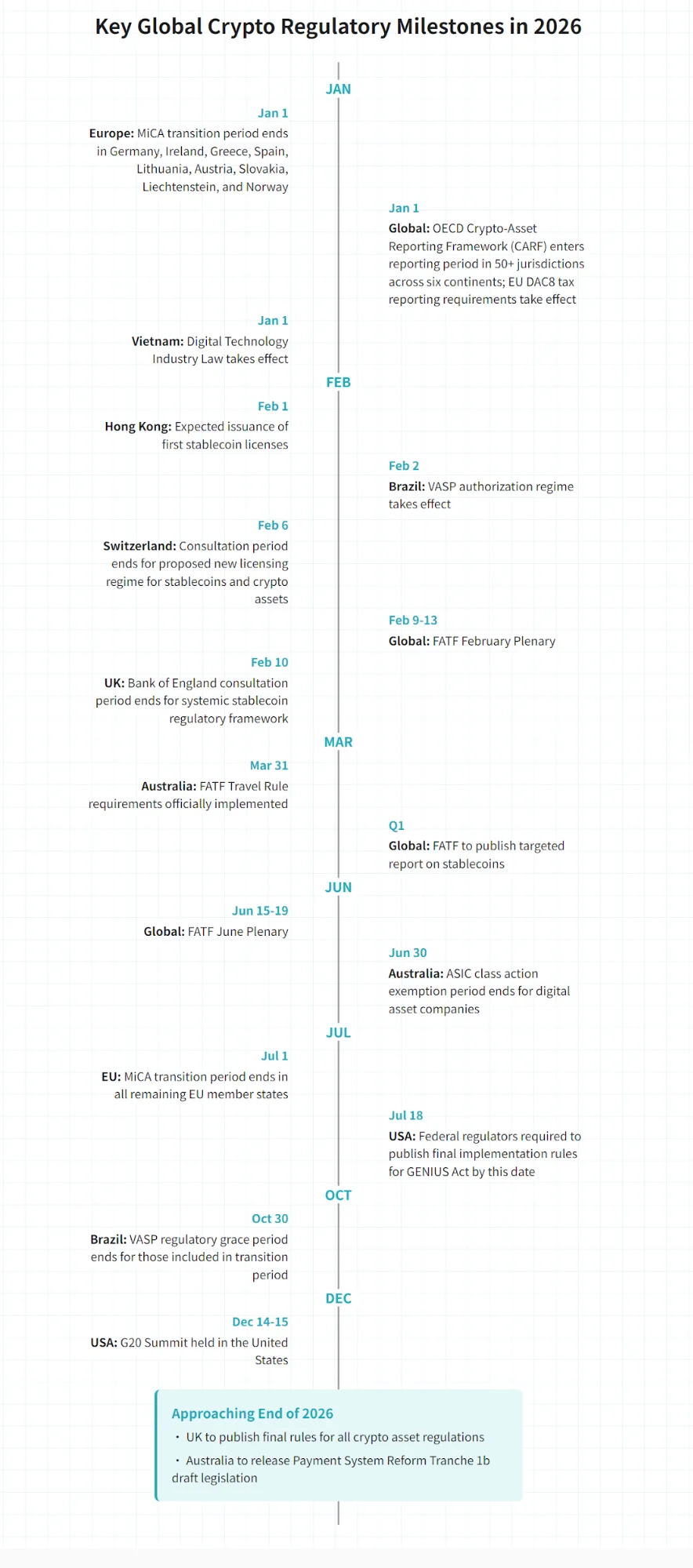
2026 Crypto Regulatory Timeline: Key Dates at a Glance
CryptoLicense has compiled the key regulatory milestones identified to date for 2026 for reference. It is worth noting that as global policies advance and implementing rules are clarified, timelines may continue to evolve, and additional milestones could emerge.
CryptoLicense View: Compliance and Licensing Are Changing the Game
Looking back at the past year of global regulatory developments, a clear consensus is emerging:
Compliance is shifting from an “optional feature” to core industry infrastructure.
This is not an isolated move by a single jurisdiction, but a collective outcome driven by regulators, financial systems, and market participants under converging pressures.
Trend 1: No Compliance Threshold, No Long-Term Players
In the early stages of most industries, rapid and unregulated growth is almost inevitable—and crypto has been no exception. Technological advantages combined with regulatory gaps fueled innovation, but also amplified risk. Repeated incidents involving fraud, misappropriation, and platform failures ultimately undermined user trust, market order, and the industry’s long-term growth potential.
From this perspective, compliance is not merely an added cost. By raising entry barriers, it helps distinguish institutions with genuine governance capacity, risk awareness, and long-term commitment, while accelerating the exit of participants reliant on regulatory gray areas.
This may pose challenges for individual firms, but it represents a necessary corrective process for the industry as a whole.
Trend 2: Regulation Is Not Anti-Innovation, but a Recalibration of Boundaries
From a regulatory standpoint, current efforts are not aimed at specific technologies, but are responses to three structural pressures:
- Accountability to the public and markets
Investor protection, anti-money laundering, and financial stability concerns require institutional responses to real and recurring risk events. - Alignment with existing financial and tax systems
Crypto assets’ cross-border mobility, anonymity, and settlement efficiency challenge traditional financial supervision, tax enforcement, and capital controls, making integration into formal rule-based systems inevitable. - Preservation of long-term order
The objective is not to suppress innovation, but to embed it within a sustainable and orderly framework.
Trend 3: Licenses Are Becoming Strategic Assets, Not Window Dressing
Against this backdrop, market behavior is also evolving.
Following repeated market failures, users have raised their standards when selecting platforms. Whether an institution holds high-quality, credible licenses is increasingly a core trust indicator. At the same time, stricter regulatory regimes mean licensing processes are more selective, increasing both scarcity and value.
More importantly, licenses are no longer just external compliance endorsements. They function as access passes to financial infrastructure. Banks, clearing institutions, and traditional financial partners are tightening their own risk controls, and only institutions with robust licensing frameworks can secure high-quality banking access, settlement capabilities, and liquidity support.
Without reliable financial infrastructure backing, both business scale and product innovation face material constraints.
As a result, licenses are shifting from a “competitive advantage” to a “basic requirement.”
CryptoLicense’s Industry View
Based on current trends, we offer four key observations and recommendations for market participants:
- Proactive compliance
Treat compliance as a core business strategy, not a reactive or remedial function. - Technology-driven compliance
Invest in compliance technology and data capabilities to build long-term advantages in efficiency, accuracy, and scalability. - Global vision, local execution
While regulation is becoming more coordinated globally, implementation remains highly localized. Operating strategies must adapt accordingly. - Ongoing engagement and professional support
In a rapidly evolving regulatory environment, sustained dialogue with professional institutions such as CryptoLicense, regulatory advisors, and industry bodies will become a critical competitive capability.
Final Thoughts
Every emerging industry undergoes a phase of rule redefinition as it transitions from exploration to maturity. The crypto asset sector is no exception.
We believe that tighter compliance is not the end point, but the starting line for the next phase of high-quality growth. Institutions with long-term vision and strong execution capabilities are already beginning to stand out.
To explore jurisdiction-specific compliance pathways, licensing strategies, or how regulatory trends may shape your market strategy, feel free to contact us.