

Poland’s New Crypto Rules: Stricter Oversight Signals, and Why Acting Early Matters
On 26 September 2025, the lower house of the Polish Parliament passed the long-awaited Crypto-Assets Market Act by a vote of 230 to 196. The bill aims to formally incorporate the EU’s Markets in Crypto-Assets Regulation (MiCA) into Poland’s domestic framework. However, it still requires approval from the Senate and the President’s signature before becoming law.
For the crypto industry, this development is a significant signal. Poland’s move marks a shift among EU member states—from discussing regulation to putting it into practice. The details of the bill also reveal a clear trend: crypto oversight in Europe is tightening fast.
For companies seeking to operate in Poland, this is an important moment. Once the new regime takes effect, the window for adjusting compliance strategies or applying for a license will be limited. Those who act early and secure a compliant status are more likely to gain a strategic advantage as the new regulatory landscape takes shape.
In this post, CryptoLicense summarizes the key points of the bill, discusses its potential impact, and offers practical guidance for institutions planning their next steps in the European market.
Key Highlights of Poland’s Crypto Bill
Poland’s new legislation focuses on bringing the EU’s MiCA framework into its national system. The bill’s most notable features can be grouped under four key themes: fees, blocking, transition, and review.
1️⃣ Higher Regulatory Fees
Crypto-Asset Service Providers (CASP) will be required to pay an annual supervisory fee of 0.4% of their revenue. For smaller exchanges, brokers, or wallet providers, this represents a considerable financial burden. In a low-margin market, compliance costs could easily erode profitability.
2️⃣ Domain Blocking Mechanism
The Polish Financial Supervision Authority (KNF) will have the power to maintain a “blacklist” of unauthorized domains, effectively blocking public access to unlicensed crypto websites. While this measure aims to protect investors, it also gives the regulator stronger technical tools to combat unregistered operations.
3️⃣ New Transition Period
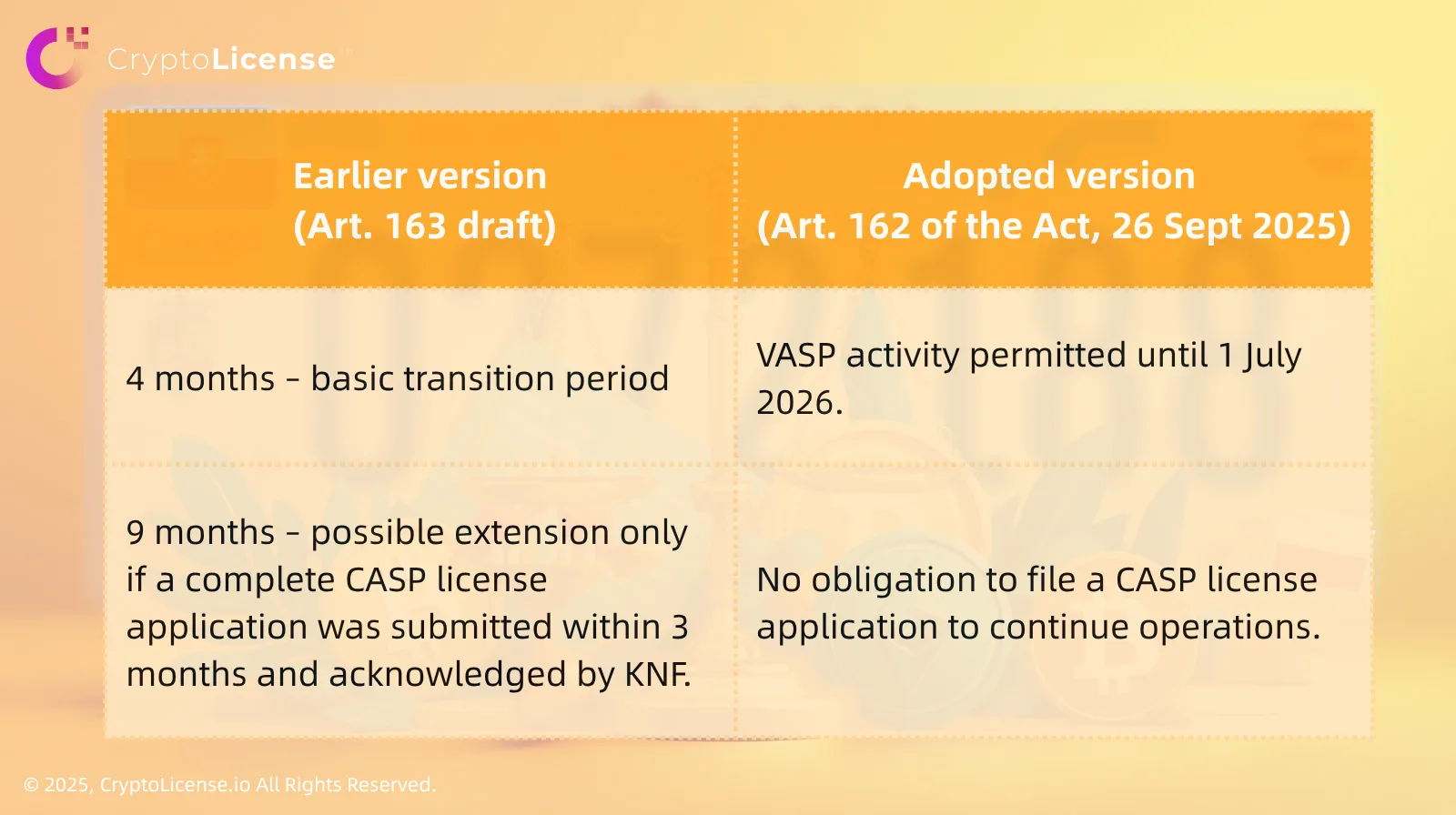
Existing Virtual Asset Service Providers (VASP) will be allowed to continue operating under the current framework until July 1, 2026. This provides a temporary buffer but also indicates that the window for regulatory adjustment is narrow. Companies should start preparing their license applications as soon as possible. The table below shows a comparison between the old and new versions of the bill:
(Still unsure about the difference between VASP and CASP? Read our quick guide: “VASP or CASP? How to Pick the Right License for Your Crypto Startup”)
4️⃣ Still Under Review
The bill must still pass the Senate’s review and receive the President’s approval before it officially becomes law. While adjustments or delays are still possible, the overall direction is clear — crypto regulation in Poland is tightening.
Regulatory Insights: Signs of Tightening and a Policy Turning Point
Although the Crypto-Assets Market Act is still under review, Poland’s regulatory direction is already clear: the country is shifting from a relatively lenient registration system toward a license-based framework with ongoing supervision at its core.
From the text of the bill, several key trends point to tighter control. These include higher supervisory fees, stricter disclosure obligations, and expanded enforcement powers for the Polish Financial Supervision Authority (KNF)—such as blocking unauthorized platforms and reviewing the compliance of market participants. Once the new regime takes effect, crypto service providers operating without a license will find it increasingly difficult to conduct business legally in Poland.
At the same time, KNF will take on a more centralized role, overseeing licensing, supervision, and enforcement. This means companies will need to strengthen governance, maintain adequate capital, and enhance their risk management frameworks.
Overall, the bill marks a major shift toward a more structured and compliance-driven environment in Poland’s crypto market. For institutions still evaluating or planning to enter the Polish market, this is both a policy milestone and a clear signal that the window for compliance preparation is closing fast.
Getting Ahead: Compliance as a Competitive Advantage
When regulation is on the horizon, time becomes the most valuable resource. For companies planning to enter or remain in Poland, starting the license application process early means securing regulatory recognition sooner and maintaining operational stability during the transition period.
Given the bill’s relatively high compliance standards, the licensing process—from documentation to internal control setup and communication with regulators—can be complex. Without local experience, working with a professional advisory firm is highly recommended.
The CryptoLicense team has extensive experience in crypto compliance and license applications under MiCA and related national regimes. We provide end-to-end support, from initial assessment and document preparation to direct engagement with regulators, helping companies complete their license applications efficiently and navigate the upcoming transition smoothly.
For firms seeking a faster route to compliance or evaluating a multi-jurisdiction setup, alternative licenses may also be worth considering. Options such as the Canadian MSB license or El Salvador’s Digital Asset Service Provider (DASP) license offer simpler application procedures, shorter approval times, and can serve as a first step toward building a compliant international presence.
Act Early, Stay Ahead with CryptoLicense
The progress of Poland’s Crypto-Assets Market Act marks a shift from policy direction to practical enforcement. Although the bill still awaits Senate approval and the President’s signature, the broader trend is already clear—compliance is becoming the new threshold for operating in the European market.
For crypto businesses, this is not a setback but an essential phase of industry evolution. Those who act early will be better positioned once the new framework takes effect. Whether your goal is to obtain a Polish license or explore alternative jurisdictions, early planning and proactive compliance remain the best long-term strategies.
CryptoLicense will continue to monitor regulatory developments across Europe and provide timely updates and tailored compliance support.
If your company is evaluating its expansion or licensing plans in Poland or other regions, feel free to Contact us — our experts are ready to help you achieve a smooth and secure path to compliance.