
How to Choose a Crypto LicenseKey Takeaways from CryptoLicense’s Hong Kong Event
If your business is preparing to expand internationally, which license should you apply for first?
Should you start with the application costs or your target market?
And how does choosing a license to access banking services overseas differ from choosing one to offer crypto services?
Late last month, CryptoLicense gave a presentation on international licensing and compliance at the Hong Kong Monetary Authority (HKMA) building.
We explored cross-border payments, crypto services and the factors that businesses should consider when deciding where to apply for licenses.

CryptoLicense CEO Sheldon covered these topics in detail. Here, we have brought together a few of the key takeaways for teams planning an international expansion and considering their licensing options.
01Before you apply, be clear about why you need a license
This was the first question in our presentation.
Are you looking to expand your business, work with banks overseas, build customer trust or support a future funding round?
Your reasons for applying will shape the options you consider.
We heard these needs again in our subsequent conversations with teams at TOKEN2049. In last week’s article, we looked at how licenses can help businesses work with financial institutions and other service providers, build brand trust, and prepare for fundraising and corporate transactions.
For your own business, the question to answer before applying is: What is the most pressing problem you want a license to solve?
With a clear objective, it becomes easier to assess the different regulatory options for cross-border payments and crypto services and decide which ones fit your business.
Related reading: Why Get a Crypto License? Three Practical Benefits for Your Business
02Start with the business model: cross-border payments and crypto services
The presentation focused on two areas: cross-border payments and crypto services.
For cross-border payments, we covered markets including the European Union, Singapore, Canada, the United States and New Zealand. For crypto services, we explored jurisdictions and frameworks including the EU’s Markets in Crypto-Assets Regulation (MiCA), El Salvador, Switzerland, Australia and Abu Dhabi Global Market (ADGM).
Put these names together, and it is easy to end up with a list of popular licensing options. In practice, businesses need to understand how each option relates to what they actually do.
For cross-border payments, start by mapping out a transaction: who pays, who receives the money, which entities the funds pass through, and where your company provides a service.
For crypto services, define exactly what you will offer, such as exchange services, trade matching or custody. Then establish whether the business will also handle fiat payments and receipts.
Even businesses described as providing “payment services” or “crypto services” can operate in very different ways. A clear picture of your business processes gives you a meaningful basis for comparing licensing options.

03Look beyond application fees and timelines
Once you know why you are applying, the next step is to compare your options.
In the presentation, we compared the EU’s MiCA framework, Digital Asset Service Provider (DASP) registration in El Salvador, membership of a self-regulatory organization (SRO) in Switzerland, the relevant Australian frameworks, and ADGM in Abu Dhabi. We looked at the activities covered, application timelines and complexity, local regulatory requirements, capital requirements, credibility, and the ease of opening bank accounts.
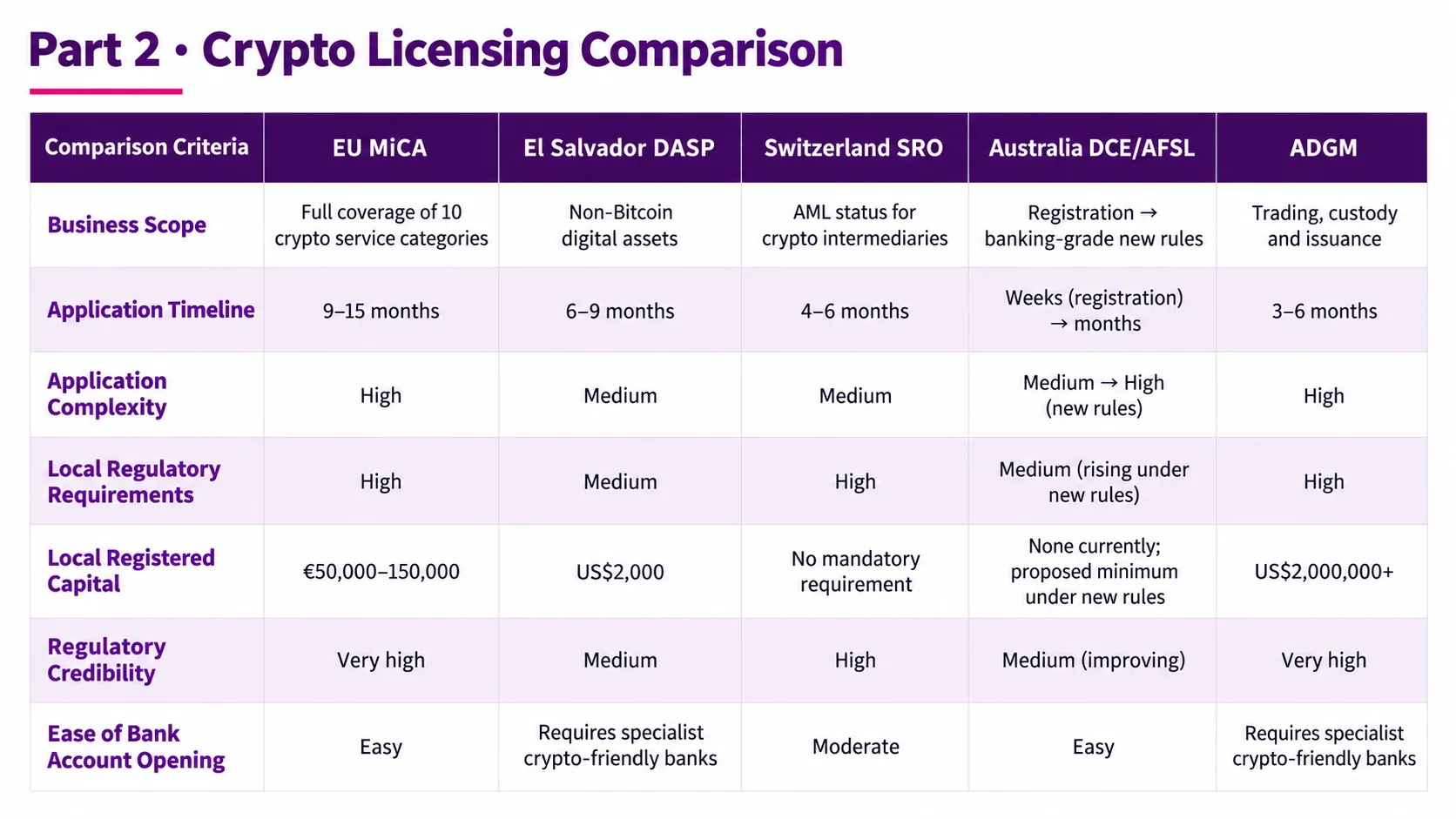
Before comparing these options, outline your own requirements and resources:
- Which markets will your customers be in?
- What services will you provide?
- When do you want to launch?
- How much can you invest, and what team can you put in place locally?
Your answers will determine how much weight to give each factor.
If you are working toward a tight launch date, pay close attention to application timelines and the preparation involved. If your budget is limited, include the ongoing costs of staffing, office space and compliance. If you want to work with a particular bank or service provider, find out about its onboarding requirements early.
Our earlier article, A Comparison of Six Popular Crypto Licensing Options: Timelines, Costs and More, takes a more detailed look at application timelines, complexity, costs, local presence requirements, regulatory approvals and the implications for a company’s brand.
It offers further context for teams working through these comparisons.
04Not everything called a “license” gives you the same regulatory status
In industry discussions, “license” is often used as shorthand for different types of regulatory status across jurisdictions. But their legal nature and the activities they permit can differ substantially.
For example, in New Zealand, registration as a financial service provider does not mean the business is licensed, nor does it constitute official endorsement. When assessing an option, you still need to check whether the services you intend to provide require a separate license.
In Canada, registration as a money services business (MSB) and registration as a payment service provider under the Retail Payment Activities Act (RPAA) also need to be assessed separately. They are distinct registrations and should not be treated as interchangeable.
So when you come across a familiar acronym, look further: who registers or authorizes the business, which activities are covered, and what obligations must the company meet?
This was one of the main points we wanted to convey in the presentation:
Choosing a license for international expansion means looking at the specific business activities and requirements. The name alone is not enough.

Final thoughts
Our presentation at the HKMA began with a simple question: why does your business need a license for international expansion? From there, we explored the different regulatory options for cross-border payments and crypto services, and the factors to consider when choosing between them.
If you are considering licenses in other markets, start by defining your target markets, business model and the problems you want to solve. Then assess the options against your budget and staffing plans. If there are details you are unsure about as you move forward, we would be happy to discuss them.
Whether you are reviewing your compliance approach or have questions about license applications and corporate structuring, please get in touch.