
Why Get a Crypto License? Three Practical Benefits for Your Business
Back in the office after TOKEN2049 Singapore, we finally have time to reflect on the many conversations we had over the past few days.
This was CryptoLicense’s first time exhibiting at TOKEN2049. We would have been happy to have meaningful conversations with a few dozen teams.
The response exceeded our expectations. Our booth was rarely quiet. We handled more than 130 inquiries and held over 50 in-depth discussions. Those conversations have continued since the event ended.
Here is a look at the event and what those conversations revealed about the compliance challenges businesses are trying to address.
1. Interest in compliance exceeded our expectations
The teams visiting our booth came from across the industry: exchanges, payment companies, card issuers, Web3 projects and startups preparing to expand internationally. Many came specifically to discuss the compliance options they were considering.

Three topics came up most often:
- Real-world assets (RWAs)
- Compliance pathways for forex businesses expanding into crypto and tokenized stocks
- Opening bank accounts that support crypto-related business activities
These questions were closely tied to the teams’ business plans. As we discussed which markets they wanted to enter, what licenses and permissions they needed and how they would work with financial institutions, the conversation often turned to how we could help.
For us, one of the most valuable parts of exhibiting was getting to understand these needs face to face. Once a team had explained its business, it was much easier to focus on the questions that mattered most.
On the evening of October 7, we also co-hosted a networking event, “Powering Modern Payments,” with UPay. Conversations about the payments business continued there, and compliance was a recurring topic.
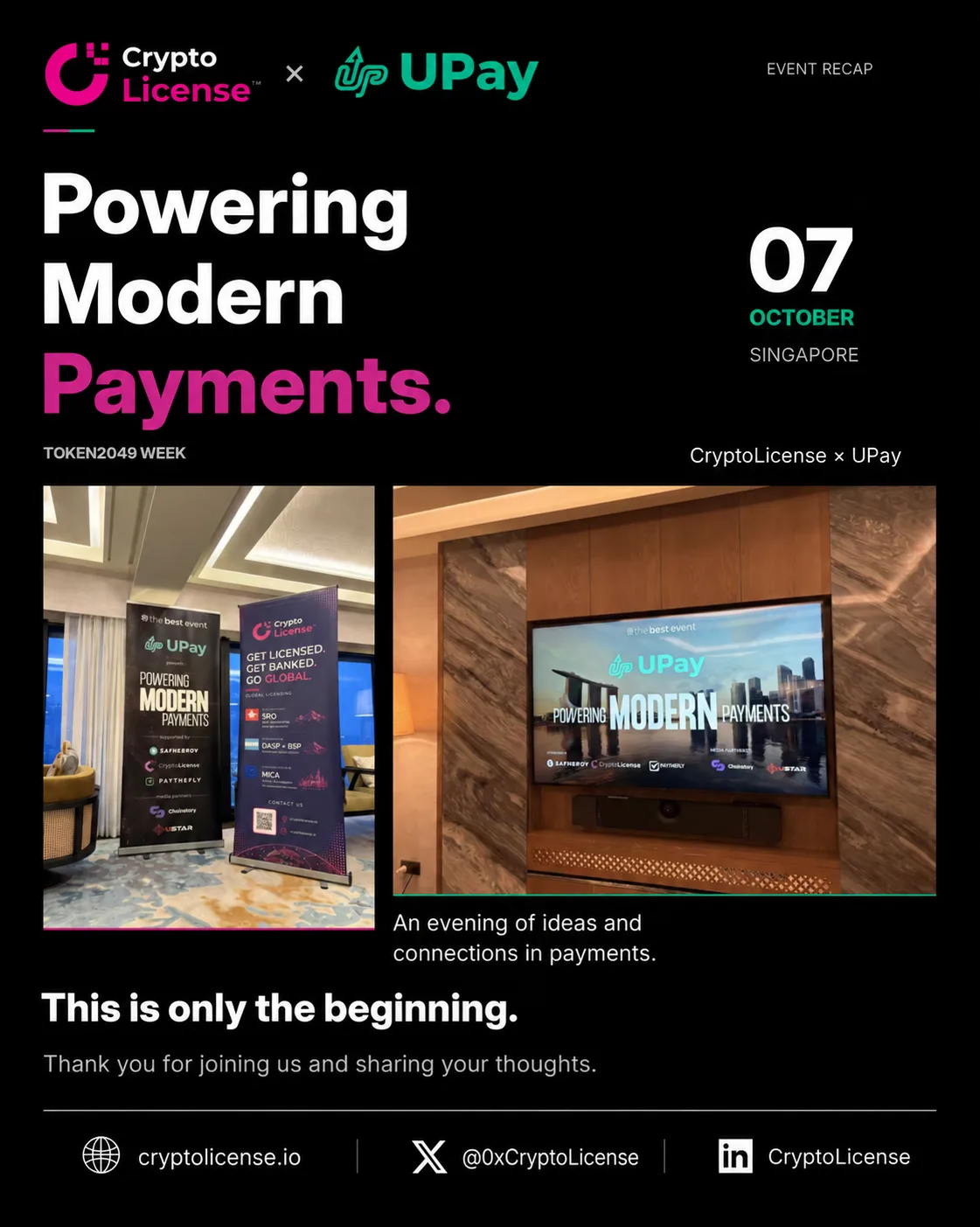
Looking back at the conversations at our booth and the evening event, we heard three main reasons for taking compliance seriously.
2. Why are so many businesses focusing on compliance?
Working with banks and other financial service providers
This was the most immediate business need teams raised with us.
Whether a business wants to open a bank account, connect to payment providers, offer fiat on- and off-ramps, or work with card issuers, liquidity providers or exchanges, it needs relationships with the relevant financial institutions and service providers.
Before agreeing to work together, prospective partners want to know where the company operates, what licenses or other regulatory permissions it holds, and which activities it plans to carry out.
A company’s ability to clearly establish its regulatory status can determine whether a partnership moves forward.
That helps explain why bank accounts and card issuance came up so often. Teams already knew where they wanted to take their businesses. They now needed the financial services and partnerships to support those plans, making licensing an immediate consideration.
Of course, a license does not guarantee that a bank or service provider will agree to work with you. Each has its own review process. But having the right licenses and permissions for your business lays the groundwork for those relationships.
Customer confidence and brand trust
Some teams told us that as more projects have collapsed, more customers have started asking about companies’ licensing status.
After the industry’s ups and downs over the past few years, individual users, institutional clients and business partners have become more cautious when choosing a platform or service provider. Alongside products and pricing, they want to know who regulates the company and whether it is committed to meeting the relevant requirements.
A license is no guarantee of how a company will perform. It does, however, give customers another basis for assessing the business.
A willingness to invest in compliance and accept regulatory oversight is part of building trust in a brand.
That investment may not immediately bring in large numbers of new customers. But it can influence how customers view the company and whether they are willing to commit to a long-term relationship.
For some teams, getting licensed is about meeting business requirements and shaping how customers and the wider market see the company. Businesses planning for the long term have good reason to think this through early.
Fundraising, valuation and access to capital markets
Other teams wanted to discuss licensing in preparation for their next funding round, a future acquisition or a stock market listing.
At this stage of a company’s development, investors tend to look more closely at the details.
Beyond revenue and growth, they want to know whether the business can continue operating, whether its existing regulatory permissions cover its actual activities, and whether there are compliance gaps to address.
These questions form part of due diligence. They also shape investors’ assessment of risk, which can affect deal terms and valuation discussions.
A clear compliance framework helps investors understand the business and can reduce uncertainty around future fundraising and corporate transactions.
A license does not add a set amount to a company’s valuation. Its value depends on the company’s business, markets and development plans. But once a business has grown, finding out during a funding round or transaction that its licensing arrangements and corporate structure need to be reworked can make the process much harder.
That is why some teams build compliance into their long-term plans from an early stage.
3. What we took away from the conversations
One thing stood out at the booth: people may all be asking about licensing, but they are often trying to answer very different questions.
Some were just beginning to explore licensing and wanted to understand the full application process. Others had already applied but had run into difficulties along the way and wanted help understanding specific application requirements.
Some teams were preparing to enter a new market and wanted to understand the regulatory requirements before taking that step. Others already had a broad licensing plan and wanted to compare options: was there a more cost-effective approach, or a license that would offer greater value for their business?
Those conversations reinforced the importance of listening before offering compliance advice. What is the company trying to do? Where is it in the process? What concerns does it have about its current plan? It is worth taking the time to work through these questions.
That is what makes meeting in person valuable: the better we understand a company’s circumstances, the more specific our advice can be.
In future articles, we will explore RWAs, compliance pathways for forex businesses expanding into crypto and tokenized stocks, and bank accounts that support crypto-related activities in more detail. We will also cover the application process, common obstacles and how to compare licensing options. We hope these articles will help teams facing similar questions.
Thank you to everyone who stopped by our booth, and to UPay for co-hosting the evening event. We look forward to continuing the conversations we started there.
If you are planning a license application, entering a new market, or looking to work with banks and financial institutions, talk to CryptoLicense about your business needs and compliance plans.